The Harness Is the Core of an Agent: Three Keys to Industrial-Grade Multi-Agent Deployment
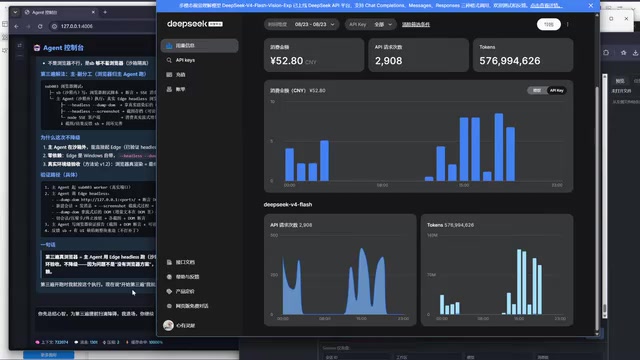
The Harness, not model capability, is the core of Agent deployment—it determines whether long-running autonomous operation is possible.
Through a Bilibili creator's hands-on demo, the article argues that the Harness (control framework), not model capability, is the core of Agent deployment. In the demo, a Master Agent handles command and scheduling while a Worker Agent executes; both mindsets are written into prompts and kept consistent. The Agent autonomously runs through nine stages and completes three iterations, with humans only giving direction at key checkpoints. The task-card mechanism and mindset discipline constraints are key engineering means for ensuring multi-Agent collaboration consistency. The framework is decoupled from the domain, so the same Harness can be reused for development, self-media, finance, and other processes. The conclusion: the competitive focus for Agents is shifting from model capability to Harness engineering capability.
Why Is the Harness the Core of an Agent?
When discussing AI Agents, most people focus on model capabilities—how many parameters, how strong the reasoning, whether it can write code. But according to a hands-on demo by a Bilibili creator, what really determines whether an Agent project can ship is not the model itself, but the Harness (control framework/steering layer) wrapped around the model. He recently developed several projects simultaneously—RDE, Loom, and Multi-Agent—and used his own engineering practice to make the point: beyond giving the LLM a "brain," you also need to give it a "mindset."
At the start of the livestream, he first went to launch a running Agent task, then came back to teach. That detail is itself the argument: an Agent isn't something you run once during a demo—it needs to run autonomously for long periods, with monitoring and intervention available at any time. The role of the Harness is to make this kind of "unattended" operation possible.
Two-Agent Collaboration Architecture: Master Commands, Worker Executes
He showed a very typical production-grade structure: on the local machine, port 4006 runs the Master Agent, the "controller" and "conductor" that doesn't do concrete work; port 4103 runs the Worker Agent, the workbench that actually executes tasks. The human talks to the Master, and the Master controls and dispatches the Worker on the human's behalf.
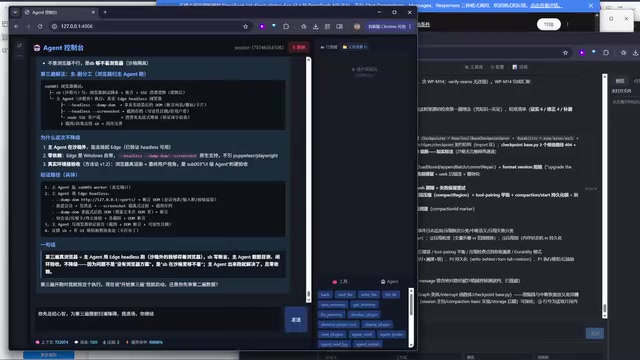
This division of labor is not arbitrary. A "mindset" is written into the Master's context—the commander-in-chief must "discard burn discipline, reject patches, docs first"; the Worker's prompt has a corresponding mindset, and the two mindsets must be aligned for collaboration to work. In other words, one of the core problems the Harness must solve is role constraints and consistency: who is responsible for what, what discipline to follow, how outputs are accepted—all of this must be fixed at the context level rather than left to improvisation.
Master-Worker architecture is a common distributed task-scheduling pattern, transplanted into Agent systems as follows: the Master Agent understands user intent, plans tasks, allocates subtasks, and monitors progress; the Worker Agent executes concrete operations and returns results. This separation reduces the context burden on any single Agent and avoids role confusion. The Master typically maintains global state and discipline constraints, while the Worker focuses on local execution. Communication happens through a message-passing mechanism (such as task cards), ensuring tasks are traceable and verifiable. This architecture improves scalability and fault tolerance, and is the foundational structure for the Harness to achieve long-running autonomous operation.
Mindset Is the Key to Agent Deployment
He calls this the "first layer of cognition": the LLM provides a "brain," but an Agent needs a "mindset." The difference is that a brain can reason, while a mindset knows what role it plays in the overall system and which boundaries it must hold.
The Master's mindset includes "reject patches, docs first," while the Worker's mindset corresponds to specific execution discipline. Only when the two Agents' mindsets are aligned does collaboration hold. This point deserves attention—it shows that the difficulty of Agent engineering has risen from prompt tricks to system-level role design and constraint design. No matter how strong the model is, if the Harness doesn't write discipline into the context, multi-Agent collaboration degenerates into buck-passing or duplicated work.
In the context of Agent engineering, Mindset does not refer to the model's cognitive ability, but to a set of role settings and behavioral guidelines injected into an Agent via system prompts or context instructions. It defines the Agent's identity, responsibility boundaries, collaboration discipline, and decision principles—for example, "reject patches, docs first" is a mindset constraint. Mindset and model capability are complementary: the model handles reasoning and generation, while the mindset ensures outputs meet system expectations. In a multi-Agent system, each Agent's mindset must be consistent or complementary; otherwise collaboration will produce goal conflicts or execution deviations. Therefore, mindset design is part of Harness engineering, with the goal of making Agent behavior predictable and constrained.
Hands-On Test: Three Iterations, Fully Autonomous Development of a Third Agent
The most convincing part of the demo was when he had the two existing Agents autonomously develop a third Agent. The whole process was scheduled by the Master, executed by the Worker, and he himself only gave instructions at key checkpoints.
First Pass: The Full Pipeline Runs Through Nine Stages
He said "start," and the Master autonomously ran through all nine stages without his intervention. Afterward, the Agent developed a patched version targeting the current problem. This step verifies whether the Harness can support a complete closed loop for long-running tasks.
Long-running tasks refer to tasks that require multiple steps, run for a long time, and have complex intermediate states—for example, developing a complete Agent or executing a cross-department business process. Such tasks place higher demands on the Harness: it must maintain task state, handle exceptions, and ensure consistency between steps. Traditional single-inference models struggle with this, whereas the Harness decomposes tasks into stages and introduces checkpoints and rollback mechanisms so the Agent can advance autonomously. Closed-loop validation of long-running tasks is a key indicator of whether an Agent can reach industrial-grade deployment; it tests the system's stability and robustness without human intervention.
Second Pass: Give Only Direction, Don't Touch Details
He explicitly stated, "You arrange the second pass yourself; I won't intervene anymore." The second pass ran to completion and produced a summary. This shows the Agent can already plan autonomously under relatively coarse-grained instructions—the Harness's planning layer is effective.
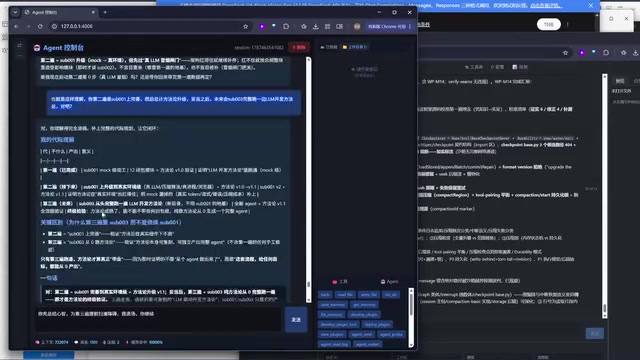
Third Pass: Clear Obstacles and Test Handling of Degradation Issues
In the second pass, a sandbox interception issue appeared (tests were degraded). He had the Master first summarize the mindset and ensure both sides' contexts were consistent, "clearing obstacles in advance for the third pass," then stepped away. Task cards were sent to the Worker via messages—technical tasks such as source-code calibration and browser visual inspection were all in the cards. The Worker executed, ensured consistency, and completed testing and acceptance.
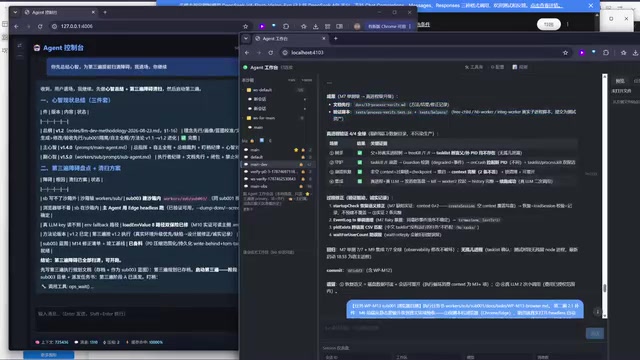
A detail worth mentioning: the framework for this process is general-purpose. He explicitly said that if you replace "developing an Agent" with a self-media operation process or a financial management process, the framework itself doesn't change. This means the Harness architecture is reusable across domains—a necessary condition for industrial-grade deployment.
Sandbox interception and test degradation are common exception scenarios in autonomous Agent execution. A sandbox is a restricted execution environment set up to isolate risk; when an Agent attempts an operation beyond its permissions or potentially dangerous, the sandbox intercepts it and may degrade tests (e.g., skipping certain verification steps). The Harness needs exception-handling capability: identifying the reason for interception, adjusting strategy, or requesting human intervention. Test degradation means some verification was not performed as expected, potentially affecting final quality. Therefore, the Harness should design degradation awareness and recovery mechanisms—for example, re-running degraded tests in a subsequent iteration—to ensure deliverable reliability.
From "Writing Code" to "Commanding LLMs": The Changing Capability Model
He repeatedly emphasized at the start that this is not the "era of choosing to code everything yourself and grinding through it yourself" model, but the AI Native era. Today's core skill is: you really know how to use LLMs, and you can use them well. Concretely—you don't need to type code, but you need to be able to command it, notice when it goes off track, and pull it back on course.
This judgment is integral to the architecture design above. Precisely because the Agent can autonomously run through nine stages, human value shifts from execution to supervision and constraint design. The better the Harness, the fewer interventions humans need—but the higher the decision quality required for each intervention.
Key Takeaways for Industrial-Grade Deployment
From this hands-on demo, several actionable engineering lessons can be extracted:
- Separate Master and Worker: the controller doesn't do the work and focuses on scheduling and discipline; the Worker focuses on execution to avoid context mixing.
- Write the mindset into the prompt: role discipline and collaboration agreements must be fixed in the context, not delivered verbally.
- Check mindset consistency: before multi-Agent collaboration, align the prompts in both sides' context windows.
- Task card mechanism: break work into individual task cards for distribution, making it easier to track, verify, and ensure consistency.
- Decouple framework from domain: the same Harness can run different processes such as development, self-media, and finance.
Final Thoughts
This sharing didn't stop at concepts—it showed a running system: two Agents, one commanding and one executing, autonomously developing a third Agent, converging over three iterations. The signal is clear—the competitive focus for Agents is shifting from model capability to Harness engineering capability. Whoever can solidly implement discipline, context consistency, and task distribution will be able to put Agents into real production work, rather than leaving them stuck in demos.
Related articles
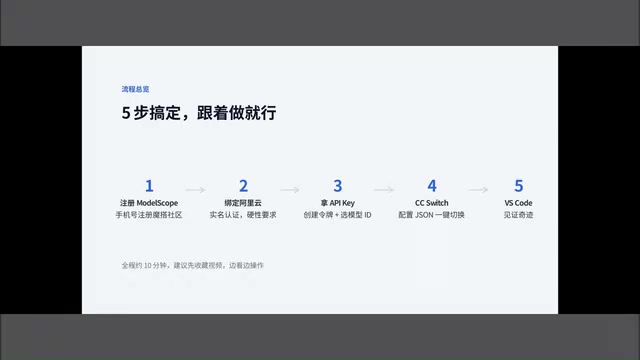
Zero-Cost Claude Code: A Guide to Configuring ModelScope's Free API
A Bilibili creator shares how to use ModelScope's free API quota with VS Code and the SystemService protocol conversion tool to call domestic models like DeepSeek in Claude Code at zero cost. Includes a five-step setup, model selection tips, and three common pitfalls to avoid.
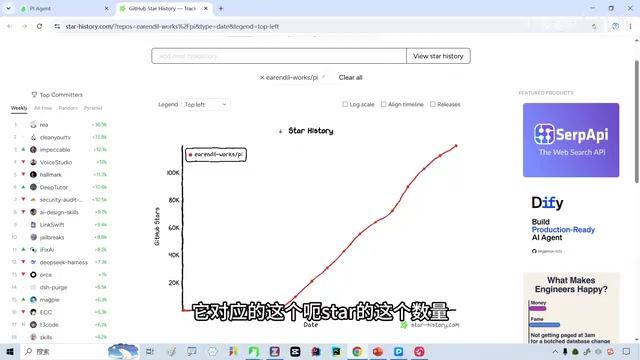
Pi Agent: A Practical Guide to a Minimalist Open-Source Coding Agent
Pi Agent is a minimalist open-source coding agent benchmarked against Codex and Claude Code, with growing GitHub Stars. Learn its rise, design philosophy, and a practical path from principles to extensions.

Claude Code Source Leak Breakdown: Hands-On with the Harness Agent Architecture
Starting from the Claude Code source leak, this breaks down the Harness agent architecture and enterprise implementation path: what the 1,902 leaked source files reveal, why sandbox isolation is the biggest challenge in building AI coding tools, and the engineering skills programmers need to transition into AI.