Pi Agent: A Practical Guide to a Minimalist Open-Source Coding Agent
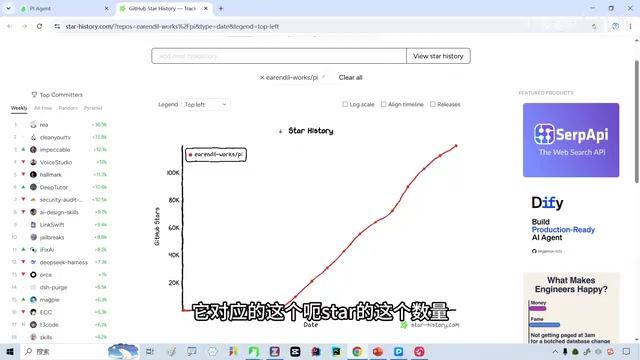
Pi Agent rose with a minimalist approach, Stars growing from thousands to nearly 70,000, a learning sample for coding agents.
The article outlines the rise and design philosophy of the open-source coding agent Pi Agent, whose GitHub Stars show phased, sustained growth from several thousand to nearly 70,000, reflecting real developer community choices rather than short-term marketing. Unlike Codex and Claude Code, Pi Agent's value lies in minimalism rather than feature count: while mainstream tools keep stacking capabilities, it chooses to subtract, offering higher readability and modifiability for those wanting to understand agent mechanisms or do secondary development. It also provides a complete learning path from principles and configuration practice to extension development.
Title
Pi Agent: A Practical Guide to a Minimalist Open-Source Coding Agent
Meta Description
Pi Agent is a minimalist open-source coding agent benchmarked against Codex and Claude Code, with GitHub Stars steadily growing. This article outlines its rise, minimalist design philosophy, and a practical learning path from principles and configuration to extension development, helping developers get started quickly.
Article Content
The AI programming tools space never lacks new faces, but few projects can consistently attract developer attention. Recently, Pi Agent—frequently mentioned on communities like Bilibili—is an open-source coding agent worth noting. It is often compared with Codex and Claude Code, yet it takes a completely different path. Based on publicly shared content, this article outlines Pi Agent's rise, design philosophy, and key points for getting started.
A Continuously Heating Open-Source Project
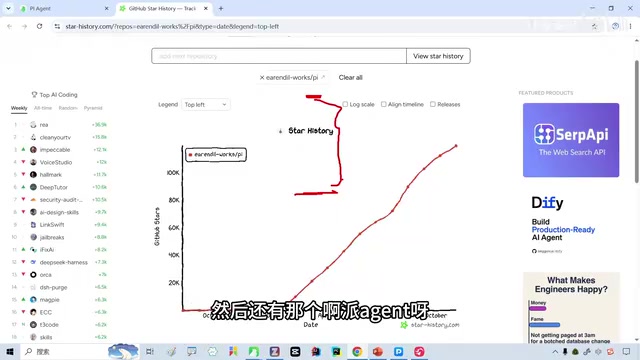
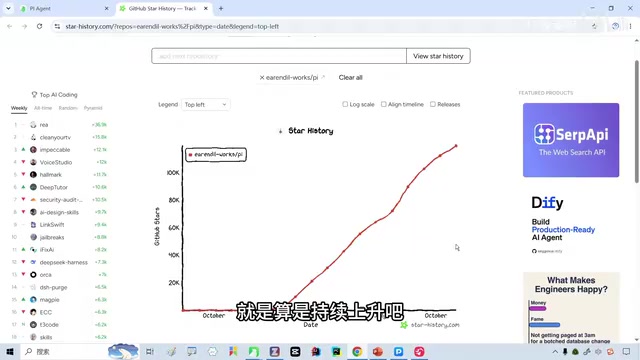
According to a Bilibili creator's sharing, the GitHub Star history trend website shows how Pi Agent's attention has changed. The project did not become famous overnight; instead, it shows phased, sustained growth: slow growth in the early accumulation stage, then a clear upward phase, with Stars rising from several thousand to around 20,000, then continuing to climb to nearly 70,000, and it is still accelerating further.
The significance of this growth curve is that it reflects the developer community voting with its feet, rather than short-term heat brought by a single marketing event. The sharer said bluntly that if you still haven't heard of Pi Agent by now, it may indicate that you are lagging in following new AI technology.
Why Pi Agent Is Needed Even With Codex and Claude Code
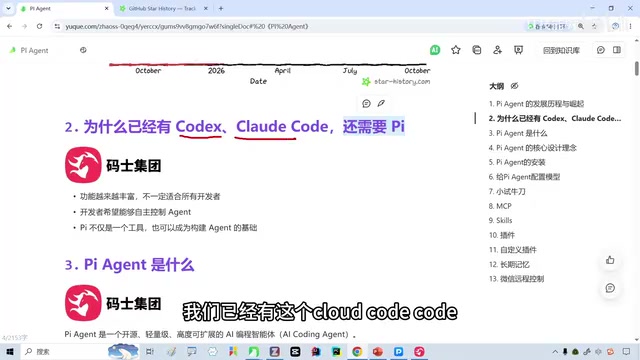
This is the key question for understanding the project's value. The sharer's core judgment is: Pi Agent attracts attention not because it surpasses Codex or Claude Code in the number of features—on the contrary, its characteristic is minimalism.
In other words, while mainstream AI programming tools continuously stack capabilities and expand integrations, Pi Agent chooses to subtract. For developers who want to understand the underlying operating mechanism of coding agents, or who want to build secondary development on a lightweight base, this positioning is actually more attractive. Fewer features does not mean lower value; readability and modifiability are themselves scarce resources.
Coding Agent refers to an AI system that can autonomously plan, call tools (read/write files, execute commands, retrieve code, etc.), and complete programming tasks. Unlike code completion tools, the core of a coding agent is a "perceive—decide—act" loop: the model chooses the next operation based on the current state, observes the result after execution, and then decides the next action until the task is complete. Codex and Claude Code both fall into this category.
Understanding this mechanism helps clarify Pi Agent's positioning: the number of features is not the key difference; the difference lies in the complexity and opacity of the agent loop. When an agent encapsulates a large number of built-in tools and automation processes, it is difficult for developers to observe its decision path; a streamlined implementation exposes the loop, making it easy to read, debug, and replace components. This is the practical engineering meaning of "minimalism."
A Learning Path from Principles to Extensions
The shared content covers a complete learning chain: first understand the basic principles of agents, then complete configuration and practice, and finally enter extension development. The value of this path for developers is that it does not teach you to call some ready-made tool, but helps you build an overall understanding of how coding agents work.
In the existing AI programming tool ecosystem, Cursor, Codex, and Claude Code each have their own focus, while Pi Agent provides a form closer to a teaching sample. Once you understand its structure, the migration cost when using other tools will be significantly lower.
Tool Calling / Function Calling is the fundamental mechanism by which coding agents operate. The model itself can only generate text and cannot directly read files or run commands; tool calling lets the model output structured call requests (tool name plus parameters), which the runtime executes and then returns the results to the model, and so on.
Therefore, the capability ceiling of a coding agent depends largely on which tools it exposes to the model and how clearly the tool descriptions are written. Task decomposition also relies on this mechanism: complex requirements are broken into a sequence of executable tool calls. When learning Pi Agent, first look clearly at the tool set and calling protocol it defines, then read the main loop code—the cost of understanding will be much lower. This also explains why lightweight implementations are better as learning samples: both the tools and the loop are out in the open.
What Developers Should Focus On
For developers preparing to get started, several directions are worth prioritizing: first, figure out the agent's task decomposition and tool calling logic, which is the common foundation of all coding agents; second, complete a full process from configuration to running by hand, avoiding staying at the conceptual level; third, if you plan to build extensions, evaluate in advance whether the project's code structure and interface design meet your needs.
Pi Agent's popularity also reminds us that the long-term value of open-source projects is often reflected in sustained community investment. The Star curve is only a surface phenomenon; what really determines how far a project can go is whether it solves real problems developers face. For the coding agent direction, the trade-off between minimalism and feature completeness will remain a major focus of discussion for some time to come.
One-line Summary
Pi Agent rose to fame with a minimalist approach, with Stars growing from several thousand to nearly 70,000, becoming a learning sample for understanding coding agents.
Paragraph Summary
The article outlines the rise and design philosophy of the open-source coding agent Pi Agent. Its GitHub Stars show phased, sustained growth, climbing from several thousand to nearly 70,000, reflecting real choices by the developer community rather than short-term marketing. Unlike Codex and Claude Code, Pi Agent's value lies not in the number of features but in minimalism: while mainstream tools continuously stack capabilities, it chooses to subtract, thereby offering higher readability and modifiability, suitable for developers who want to understand the underlying mechanism of agents or do secondary development. The article also provides a complete learning path from principles and configuration practice to extension development, and suggests that developers prioritize mastering task decomposition and tool calling logic, run through the complete process by hand, and evaluate code structure and interface design in advance.
Related articles
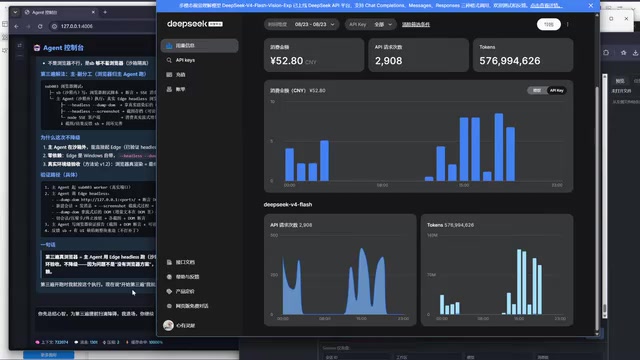
The Harness Is the Core of an Agent: Three Keys to Industrial-Grade Multi-Agent Deployment
From a Bilibili hands-on demo, we analyze why the Harness is the core of an Agent: Master-Worker dual-Agent architecture, mindset consistency constraints, three autonomous iterations, and reusable framework essentials for industrial multi-Agent deployment.
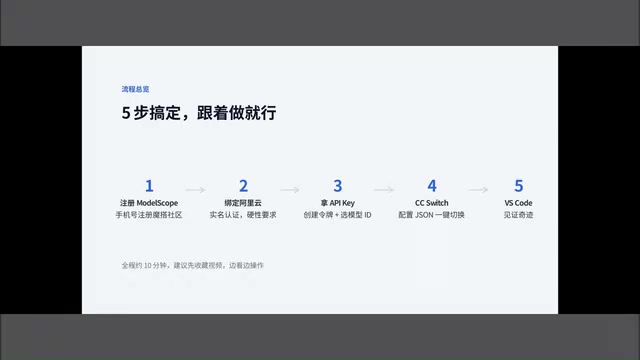
Zero-Cost Claude Code: A Guide to Configuring ModelScope's Free API
A Bilibili creator shares how to use ModelScope's free API quota with VS Code and the SystemService protocol conversion tool to call domestic models like DeepSeek in Claude Code at zero cost. Includes a five-step setup, model selection tips, and three common pitfalls to avoid.

Claude Code Source Leak Breakdown: Hands-On with the Harness Agent Architecture
Starting from the Claude Code source leak, this breaks down the Harness agent architecture and enterprise implementation path: what the 1,902 leaked source files reveal, why sandbox isolation is the biggest challenge in building AI coding tools, and the engineering skills programmers need to transition into AI.