Claude Code v2.1.270 Released: Fixes Regression Where Read-Only Git Commands Unexpectedly Prompted for Permission

Claude Code v2.1.270 fixes a regression where read-only Git commands incorrectly triggered permission prompts.
Claude Code v2.1.270 is a maintenance patch that fixes a regression introduced in v2.1.269, where read-only Git commands like `git status` and `git log` unexpectedly prompted for permission confirmation in long-running Bash sessions. These commands should execute silently by design, and the regression was especially disruptive for extended development sessions. Anthropic's quick turnaround reflects their focus on developer experience. The project has ~145K GitHub stars; users on v2.1.269 should upgrade immediately.
Claude Code v2.1.270 Update Overview
Anthropic's AI coding tool Claude Code has released version v2.1.270. This is a focused patch release that addresses a permission-related regression introduced in the previous version (v2.1.269).
While the update is small in scope, the bug it fixes directly impacts the user experience during extended coding sessions — making it worth attention for anyone who relies on Claude Code in their daily development workflow.
The Core Fix in This Release
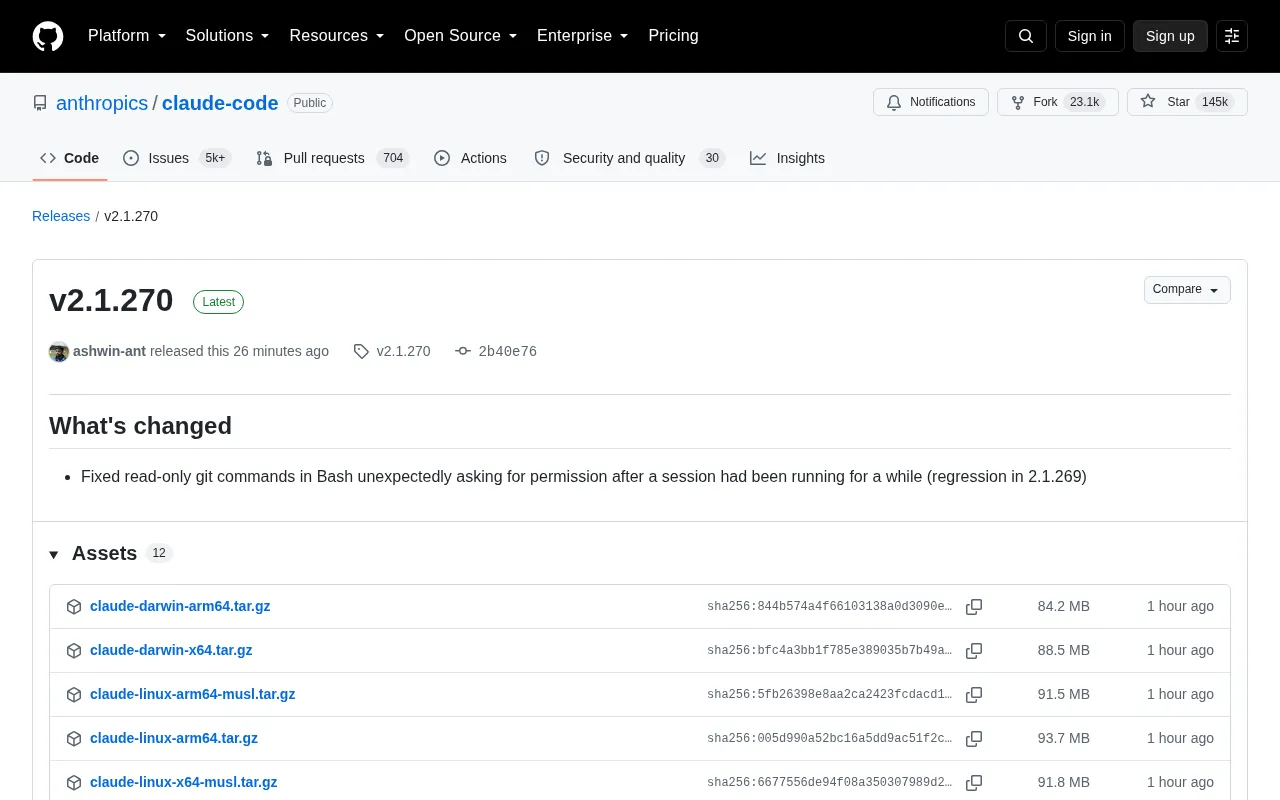
According to the official release notes, v2.1.270 resolves a permission anomaly involving read-only Git commands in Bash:
Fixed read-only git commands in Bash unexpectedly asking for permission after a session had been running for a while (regression in 2.1.269)
In practice, this means that read-only Git commands — such as git status, git log, and similar queries — were incorrectly triggering permission prompts after a session had been running for some time.
This was a regression introduced in v2.1.269. Read-only Git commands are those that only inspect repository state without modifying any code or history. By design, Claude Code should not interrupt users with permission requests for these side-effect-free operations.
Why This Bug Matters
In a typical AI-assisted coding workflow, Claude Code frequently invokes Git commands to check the current state of the codebase, review change history, and more. If read-only commands start triggering permission confirmations after a while, it significantly disrupts the flow of work and undermines the tool's automation capabilities.
For long-running development sessions — such as multi-hour refactoring or debugging tasks — the cumulative impact of repeated interruptions is especially noticeable. This fix delivers a tangible improvement in experience for heavy users.
Permission Management: A Critical Dimension of AI Coding Tools
As an AI coding assistant capable of executing terminal commands and modifying files directly, Claude Code must strike a careful balance in its permission model: ensuring security by requiring confirmation for potentially risky operations, while avoiding unnecessary interruptions for harmless ones.
This regression exposed exactly how delicate that balance is. Read-only commands were incorrectly categorized as requiring confirmation, breaking the intended permission logic. The swift fix reflects the team's ongoing attention to the finer details of developer experience.
Project Momentum and Release Cadence
According to GitHub metrics, the claude-code repository has accumulated approximately 145,000 stars and 23,100 forks, making it one of the most-watched open-source projects in the AI coding space. The rapid turnaround from v2.1.269 to v2.1.270 also demonstrates that the Anthropic team maintains a high-frequency release cadence and responds quickly to user-reported issues.
Users currently on v2.1.269 are encouraged to upgrade to v2.1.270 as soon as possible to eliminate the disruptive permission prompts on read-only Git commands.
Summary
v2.1.270 is a classic maintenance patch. Its core value lies in restoring the expected silent execution of read-only Git commands by fixing the permission regression introduced in the previous release. While the change is narrow in scope, upgrading promptly still makes practical sense for developers who prioritize a smooth, uninterrupted coding workflow.
Related articles
AWS AgentCore Gateway: Connecting AI A…
AWS AgentCore Gateway: Connecting AI Agents to Enterprise Backends with MCP
How AWS AgentCore Gateway acts as a primary MCP server to aggregate REST APIs, Lambda, and existing MCP services? Analyzing its AST real-time mapping, zero cold start, semantic search for tool overload, session isolation, and key injection security design, plus the architectural approach to decoupling enterprise AI agents from backends.

One Link Gives Figma AI a New Skill: Hands-On with MCP Connectors
Paste one MCP server link and the AI Agent in Figma gains new tool capabilities. We break down the setup flow, 20+ one-click apps, read/write permissions and execution policies, and the public HTTPS requirement.

Cognition SWE-2 in Practice: One Prompt to Handle the Whole Product Launch Process
Analyzing a YouTube creator's prompt for using Cognition SWE-2 to launch a product: a landing page, seven-email sequence, and non-buyer follow-up tool, plus how the 'test and report' constraint changes AI delivery quality.