Claude Connects to Bank Accounts: The Era of AI Financial Management Arrives

Claude connects to bank accounts via Plaid, moving from conversational assistant to personal financial steward.
Anthropic launches the Personal Finance feature, letting Claude directly read users' bank account and credit card transactions via the Plaid banking bridge platform. Users can ask questions in natural language, such as "Where did all my money go this month?" and Claude generates a structured financial overview. Plaid acts as an intermediary to isolate bank credentials, so users need not provide passwords to the AI but must trust both Anthropic and Plaid and authorize data sharing. This lowers the barrier to personal finance management and signals AI assistants evolving from information processing tools to account-level integration platforms. However, there is still a gap between generating overviews and providing reliable financial advice; model accuracy, responsibility boundaries, and user trust are the main challenges.
Anthropic has given Claude a new capability: directly connecting to your bank accounts and credit cards to manage your personal finances. This new feature, called "Personal Finance," is implemented through the Plaid banking bridge platform, allowing users to ask the chatbot questions directly, such as "Where did all my money go this month?" and Claude will generate a clear financial overview.
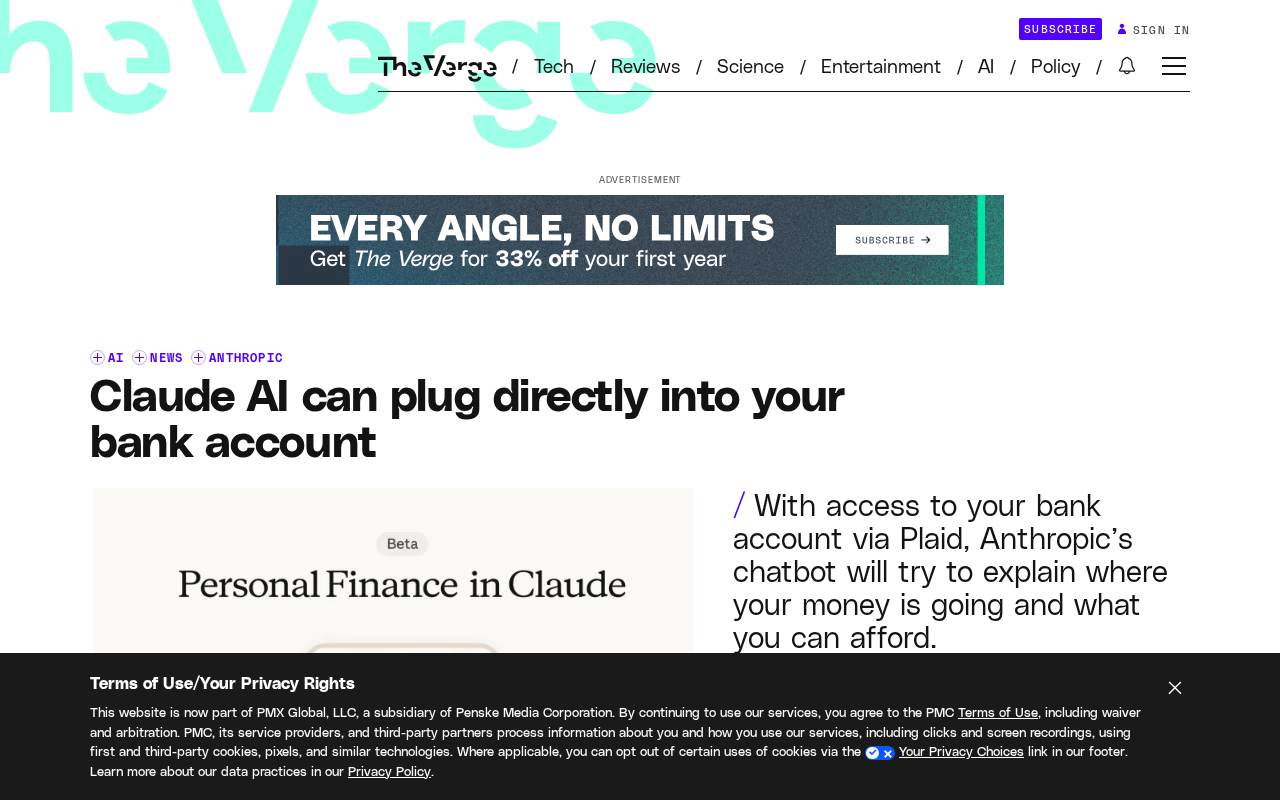
From Conversational Assistant to Financial Steward: Expanding Claude's Boundaries
In the past, Claude's positioning was as a safe conversational AI, skilled at writing, programming, and complex reasoning. The launch of the Personal Finance feature marks Anthropic's move to push Claude into a highly sensitive personal data domain—bank accounts. This is not just an extension of product functionality, but a redefinition of the AI assistant's role: from "answering questions" to "acting on your behalf."
Through Plaid, a banking connection infrastructure adopted by many fintech applications, Claude can read users' transaction records and account balances. Users no longer need to manually export statements or check expenses line by line; they can simply ask questions in natural language to obtain structured financial insights. For example, when a user asks "Where did all my money go this month?" Claude will summarize spending categories, list major expenses, and generate an overview.
The cleverness of this design lies in lowering the barrier to financial management. Traditional personal finance tools often require users to learn classification rules and set up budget templates, whereas Claude replaces forms with conversation and manual operations with intent understanding. For users who are not adept with digital tools, this interaction method is significantly more friendly.
Plaid Bridge: Balancing Convenience and Privacy
Allowing AI to read bank accounts naturally raises privacy concerns. Anthropic chose Plaid as an intermediary layer rather than requiring users to directly provide bank login credentials, which is an architectural risk isolation. As a professional financial data aggregation platform, Plaid is responsible for establishing secure connections with banks, while Claude obtains data through authorization tokens without accessing users' bank passwords.
This model has precedents in the fintech field, but it is still novel among general-purpose AI assistants. It means users need to trust both Anthropic and Plaid and explicitly authorize the scope of data sharing. For privacy-conscious users, this remains a decision that requires weighing: behind the improved convenience is the fact that personal spending data enters the AI model processing pipeline.
From an industry perspective, AI assistants integrating financial data may become the focus of the next stage of competition. As model capabilities gradually converge, whoever can more deeply integrate into users' actual life scenarios will build stronger user stickiness. Anthropic's move can be seen as a response to the trend of "making AI assistants practical," but it also brings the challenge of data governance to the forefront.
OAuth Authorization and Token Mechanism: Plaid's operation is built on OAuth-style token exchange. Users complete bank identity verification in Plaid's interface, and the bank then issues an access token to Plaid, which in turn issues a public token associated with that token to the application (here, Anthropic). Claude uses this token to pull transaction data on demand, while the original bank credentials always remain between the bank and Plaid. Tokens can be revoked, and users can disconnect an application's access at any time through the Plaid dashboard, providing a revocable technical path for data sharing.
The Promise and Challenges of Financial AI
The direct value of the Personal Finance feature lies in expense tracking and financial overviews, but its potential goes beyond that. If Claude can continuously access transaction data, it could theoretically support scenarios such as budget recommendations, unusual spending alerts, and even savings goal planning. Users can ask follow-up questions like "Which category of spending is growing fastest?" or "How much can I save next month?" and the AI will provide analysis based on real data.
However, there is still a considerable gap between "generating an overview" and "providing reliable financial advice." AI models may produce incorrect generalizations or have insufficient understanding of complex financial products. Anthropic needs to provide clear solutions regarding accuracy, explainability, and responsibility boundaries; otherwise, users will find it difficult to entrust real financial decisions to a chatbot.
Another challenge is cultivating user habits. It takes time for users to accept "AI viewing my bank statements," especially against the backdrop of frequent data breach incidents. If Anthropic wants to promote this feature, transparency and user control will be key—such as clear authorization management, the ability to disconnect at any time, and clear explanations of the scope of data use.
The Risk of AI Hallucinations in Financial Scenarios: Large language models generate probabilistic text, not audited calculation results. In tasks such as expense classification and amount aggregation, the model may mistakenly count a refund as an expense or attribute a cross-month transaction to the wrong period, causing the overview figures to deviate from the actual statement. Financial scenarios have extremely low tolerance for errors, so such features typically require a deterministic calculation layer (rule engine or structured query) to generate numbers, with the model only responsible for explanation and presentation. If Anthropic wants Claude to take on a heavier financial role, defining the boundary between "model presentation" and "system calculation" will be a core technical issue.
Industry Signal: AI Assistants Enter the "Account-Level" Integration Stage
Claude's connection to bank accounts sends a clear industry signal: AI assistants are evolving from "information processing tools" to "account-level integration platforms." Past integrations mostly stayed in productivity scenarios such as calendars, email, and documents, but the integration of financial accounts means AI is beginning to touch users' most sensitive data assets.
This trend may trigger a chain reaction. Other AI vendors may follow with similar financial data integrations, while banks and fintech companies need to rethink their relationship with AI platforms: should they become integrated data sources or build their own AI capabilities? For users, while choices increase, they also need to more clearly assess the data flows behind each authorization.
Anthropic's Personal Finance feature is still in its early stages, and whether it can become a killer app for Claude remains to be seen. But one thing is certain: as AI assistants begin to manage your wallet, the discussion about convenience, privacy, and trust has only just begun.
One-line Summary
Claude connects to bank accounts through Plaid, moving from conversational assistant to personal financial steward.
Paragraph Summary
Anthropic launches the Personal Finance feature, allowing Claude to directly read users' bank account and credit card transaction records through the Plaid banking bridge platform. Users can ask questions in natural language, such as "Where did all my money go this month?" and Claude will generate a structured financial overview. Plaid acts as an intermediary to isolate bank credentials, so users do not need to provide passwords to the AI, but they must trust both Anthropic and Plaid and authorize data sharing. This feature lowers the barrier to personal financial management and marks the evolution of AI assistants from information processing tools to account-level integration platforms. However, there is still a gap between generating overviews and providing reliable financial advice; model accuracy, responsibility boundaries, and user trust are the main challenges to implementation.
Related articles

Anthropic Fable 5.2 Hands-On: 3A Games and Excel Clones from One Prompt
Anthropic Fable 5.2 hands-on: three-line prompts generate a playable Gears of War clone, a full Excel clone, and a DaVinci Resolve clone. Benchmarks, Ultra Code mode, token costs, and pricing analyzed — is it worth replacing Opus 5.5?

RL Racing Agent Stuck Against the Wall? Try These Recovery Strategies
RL racing agent stuck against walls? We analyze recovery data, observation limits, and action space, comparing DAgger, behavior cloning, and SAC with diagnostic experiments.

Giving AI Agents Long-Term Memory: A New Approach to Supply Chain Disruption Decisions
A developer uses Hindsight to build persistent memory for a supply chain AI agent, enabling retrieval of past disruptions and decision outcomes. The article analyzes its architecture, memory retention and recall design, and engineering challenges such as what to remember and how to evaluate memory effectiveness.