Claude Multi-Model Error Incident: Official Fix and Ongoing Monitoring

Five Claude models errored simultaneously, with the official fix deployed within 21 minutes.
Anthropic's official status page disclosed that Claude Mythos 5.1, Fable 5.1, Opus 5.5, Sonnet 5.5, and Haiku 5.5 all showed elevated request error rates simultaneously. The notices went through Investigating, Identified, and Monitoring stages between 06:14 and 06:35 UTC, with root cause identification and fix deployment completed in about 21 minutes. The article notes that simultaneous cross-variant impact typically points to shared infrastructure problems rather than a single model defect — routing layers, API gateways, or cross-model configuration changes could all amplify failures. For developers relying on the Claude API, this incident highlights the need to enable status page subscriptions, prepare cross-provider fallback schemes, and use self-built monitoring metrics to decide whether to activate contingency plans, because multiple models do not equal multiple safeguards.
Anthropic's Claude series models experienced a notable incident. According to the official status page, Claude Mythos 5.1, Claude Fable 5.1, Claude Opus 5.5, Claude Sonnet 5.5, and Claude Haiku 5.5 all showed elevated request error rates simultaneously, and the entire process from discovery to fix lasted less than half an hour.
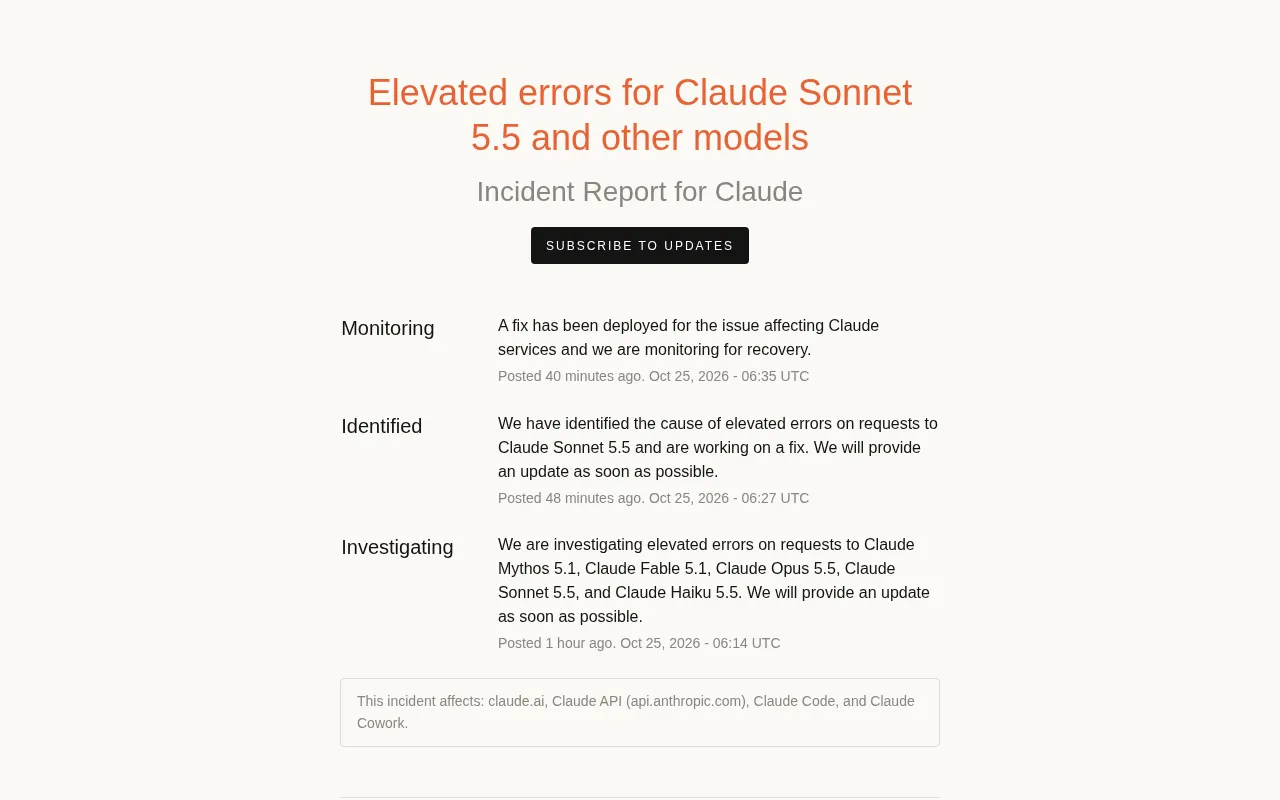
Incident Timeline: Three Updates from Investigation to Fix
The official status page updates came in quick succession, with three updates concentrated between 06:14 and 06:35 UTC.
At 06:14 UTC, the status page first published an "Investigating" notice, confirming it was investigating elevated request error rates across multiple Claude models, involving the five models listed above.
At 06:27 UTC, the status was updated to "Identified," indicating that the root cause of the Claude Sonnet 5.5 request errors had been located and that a fix was underway, with a promise to provide updates as soon as possible.
At 06:35 UTC, the status changed to "Monitoring," announcing that the fix had been deployed and that recovery was being monitored.
From the first notice to the announcement of the deployed fix, only about 21 minutes elapsed. For an online incident affecting multiple flagship models, this response speed is noteworthy. However, the status page did not specify the exact scope of impact, error rate figures, or the proportion of affected users.
The terms Investigating, Identified, and Monitoring used in the status page updates originate from the industry-standard incident severity workflow. Investigating means an anomaly has been confirmed but the cause is unclear; Identified means the root cause has been located and remediation has begun; Monitoring means the fix has been deployed and is now in an observation period. The full lifecycle typically also includes Resolved (recovery confirmed) and Postmortem (after-action review) stages. This terminology is not unique to Anthropic — the status pages of major cloud services such as AWS, Google Cloud, and Cloudflare generally adopt a similar terminology system, making it easy for users to quickly judge which stage an incident is in and decide whether to activate contingency plans. Understanding the semantic differences between these status terms helps developers avoid misreading "identified" as "recovered."
Behind the Simultaneous Multi-Model Failures: The Shadow of Shared Infrastructure
The most striking aspect of this incident was the breadth of the impact. Judging from the wording of the notices, Sonnet 5.5 was singled out as the model whose cause had been "identified," while the other models were listed together in the initial notice.
This pattern of multiple models being affected simultaneously typically points to a shared underlying infrastructure problem rather than a defect in any single model. The model routing layer, API gateway, common components of inference clusters, or certain cross-model configuration changes could all act as amplifiers of the failure.
You may not have noticed that the smaller Haiku 5.5 and the flagship Opus 5.5 were included in the same incident notice, indicating that the scope of impact spanned model services at different tiers. For developers building products on the Claude API, this is a real reminder: even if you choose different model variants for load distribution or fallback schemes, you may not be able to completely avoid platform-level failure risks.
The model routing layer mentioned in the article refers to the scheduling component situated between user requests and specific model instances. It is responsible for dispatching traffic to the appropriate inference cluster or model version based on factors such as request content, load conditions, and available capacity. The API gateway handles authentication, rate limiting, billing, and request forwarding — it is the common entry point through which all model calls pass. Inference clusters typically consist of a large number of GPU nodes; once common components such as node scheduling, memory management, or batch processing queues malfunction, multiple models are affected simultaneously. This is precisely why cross-variant multi-model failures are often not defects in the individual models themselves, but rather the result of these shared components or cross-model configuration changes — this is also the technical basis for the article's emphasis that "multiple models do not equal multiple safeguards."
Lessons Developers Should Take Away
For teams integrating Claude into production environments, this incident offers several actionable ideas.
First, it is worth enabling the status page subscription mechanism. The interval between investigation and fix notices in this incident was very short, and subscribing to status updates can help teams learn about failures at the earliest opportunity rather than responding passively only after user feedback.
Second, cross-provider fallback schemes remain necessary. When multiple models on the same platform fail simultaneously, switching between models alone cannot solve the problem; backup inference providers or local models should be prepared in advance as a fallback.
Third, the granularity of incident notices is limited. Official notices did not provide specific error rate figures or the scope of impact; teams should combine their own monitoring metrics (such as request failure rate and timeout rate) to determine whether to activate contingency plans, rather than relying solely on the platform's description.
Cross-provider fallback schemes typically involve integrating two or more model providers into the architecture simultaneously and encapsulating the calling interfaces through a unified abstraction layer, so that when the primary provider fails or latency rises, traffic can be switched to a backup provider automatically or manually. Common accompanying practices include: setting alert thresholds for request failure rates and timeout rates, adopting circuit breaker mechanisms to quickly stop sending requests to the failing source after consecutive failures, and using queues and retry strategies to smooth out transient fluctuations. It is important to note that models from different providers differ in output style, context length, and billing methods, so fallback schemes require compatibility testing in advance rather than being enabled on an ad hoc basis when a failure occurs.
Conclusion
This Claude multi-model error incident went from "Investigating" to "Monitoring" in just over twenty minutes, demonstrating the platform's relatively fast response pace. But for developers, the real value lies not in marveling at the speed of the fix, but in recognizing the unpredictability of platform-level failures and improving their own fault-tolerant architectures accordingly. Multiple models do not equal multiple safeguards; cross-platform redundancy and real-time monitoring are the more reliable lines of defense.
One-line Summary
Five Claude models errored simultaneously, and the official fix was deployed within 21 minutes.
Paragraph Summary
Anthropic's official status page disclosed that Claude Mythos 5.1, Fable 5.1, Opus 5.5, Sonnet 5.5, and Haiku 5.5 all showed elevated request error rates simultaneously. The notices went through three stages — Investigating, Identified, and Monitoring — between 06:14 and 06:35 UTC, with root cause identification and fix deployment completed in about 21 minutes. The article notes that simultaneous cross-variant impact typically points to shared infrastructure problems rather than a single model defect, and that the routing layer, API gateway, or cross-model configuration changes could all be amplifiers of the failure. For developers relying on the Claude API, this incident suggests enabling status page subscriptions, preparing cross-provider fallback schemes, and combining them with self-built monitoring metrics to determine whether to activate contingency plans — because multiple models do not equal multiple safeguards.
Related articles

Will GitHub Die? Open Source Maintainer Burnout and the Collaboration Crisis in the AI Era
Lex Fridman podcast discussion on open source maintainer burnout and GitHub's predicament: massive pull requests overwhelm core maintainers, and AI worsens code bloat. Using math journal peer review and Poincaré conjecture verification as analogies, the article analyzes why verification in knowledge production must be deliberately slow, and how open source communities can avoid the failure mode of maintainers exiting.

Stop Building Cookie-Cutter AI Websites: 3 Tools That Transform Your Coding Agent
Three tools that boost AI coding agents: FFmpeg skill for local video editing in Claude Code and Cursor, Hallmark's 50 design themes to fix cookie-cutter AI sites, and Jailbreaks' 25+ model prompts.

How America's Gerontocracy Squeezes the Younger Generation
Americans over 55 hold nearly three-quarters of national wealth, alongside an 80-year-old president and elderly congressional leaders. The Atlantic's Idrees Kahloon explains how gerontocracy drives up housing costs, squeezes opportunities for the young, and explores zoning reform and child poverty reduction as practical fixes.