CollabSciReM: A New Framework for Scientific Dialogue Alignment That Decomposes Rewards to Solve LLM Research Collaboration Challenges

CollabSciReM decomposes research dialogue rewards into quality, rigor, and efficiency, achieving a 65.3% win rate under length matching.
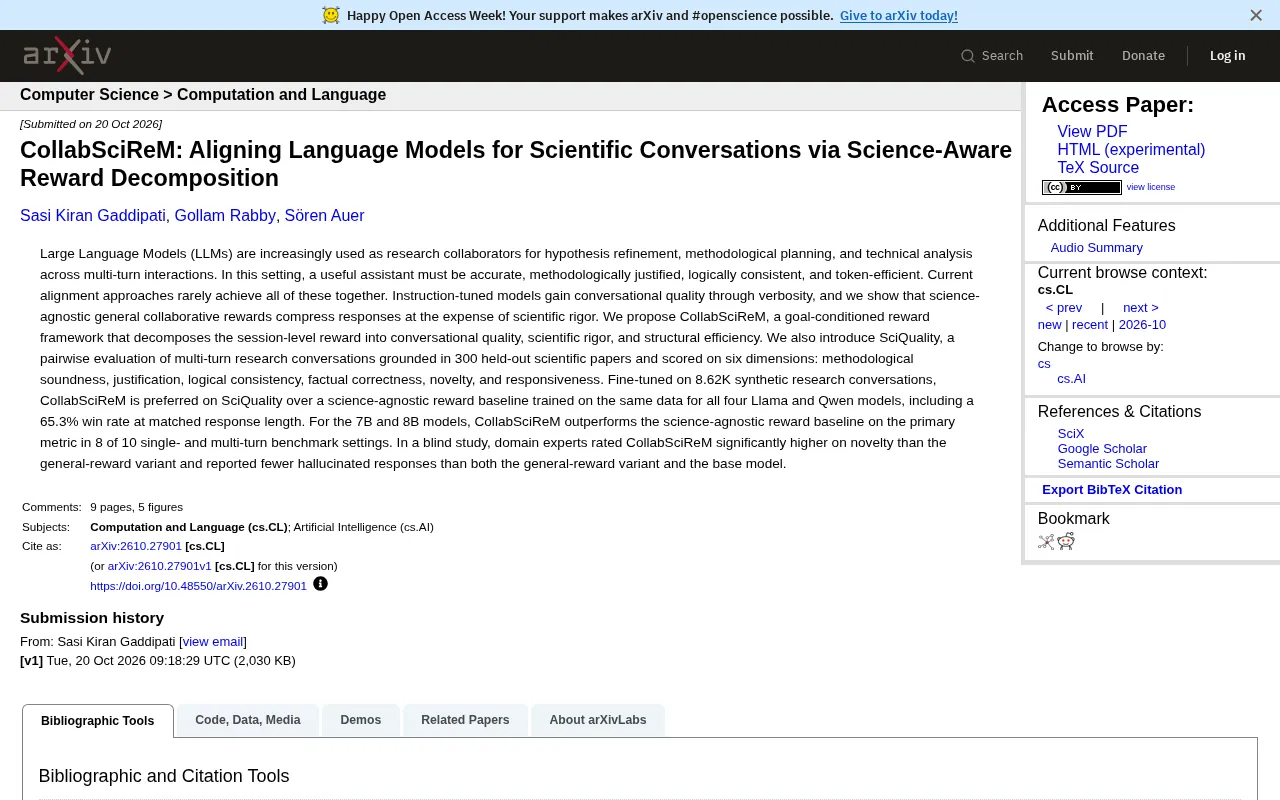
Large language models in scientific collaboration need to balance accuracy, rigor, logical coherence, and conciseness, but existing alignment methods often fail on one front while succeeding on another. The CollabSciReM framework decomposes vague session-level rewards into three independently optimizable components: dialogue quality, scientific rigor, and structural efficiency, avoiding forced compromises of a single reward signal across different objectives. The research team built a six-dimensional pairwise evaluation set, SciQuality, based on 300 held-out papers, and fine-tuned models on 8.62K synthetic scientific dialogues. Experiments show that under response length-matched conditions, CollabSciReM achieves a 65.3% win rate against science-agnostic reward baselines; 7B/8B models surpass the baseline on the primary metric in 8 out of 10 benchmark settings; expert blind tests also show superior novelty and fewer hallucinations.
Large language models are evolving from general-purpose chat tools into scientific research collaborators, but getting them to be accurate, methodologically rigorous, logically coherent, and concise all at once in multi-turn scientific conversations is something existing alignment methods often fail to achieve. A new study proposes the CollabSciReM framework, which decomposes rewards into three dimensions—dialogue quality, scientific rigor, and structural efficiency—and significantly outperforms science-agnostic general reward baselines across multiple evaluations.
When LLMs Become Research Collaborators, Alignment Faces Three Contradictions
The research team points out that LLMs are playing an increasingly important role in scenarios such as hypothesis refinement, method planning, and technical analysis. A qualified research assistant needs to satisfy four conditions simultaneously: factual accuracy, methodological grounding, logical consistency, and efficient token usage.
However, existing alignment approaches have structural flaws. Instruction-tuned models tend to trade verbosity for conversational fluency, while science-agnostic general collaboration rewards can compress response length but at the cost of scientific rigor. This "fix one problem only to create another" dilemma is precisely the core contradiction that CollabSciReM attempts to resolve.
Reward Decomposition: Breaking Session-Level Signals into Three Independently Optimizable Objectives
The core design of CollabSciReM is a goal-conditioned reward framework that decomposes the originally vague session-level reward into three distinct components:
- Dialogue Quality: Tracks coherence and responsiveness across multi-turn interactions
- Scientific Rigor: Examines methodological soundness, argumentative sufficiency, and factual correctness
- Structural Efficiency: Controls redundant expression and encourages efficient token utilization
The value of this decomposition lies in avoiding the forced compromise of a single reward signal across different objectives. The research team also constructed the SciQuality evaluation set—building multi-turn research dialogues based on 300 held-out scientific papers, and conducting pairwise evaluations across six dimensions: methodological reliability, argumentative sufficiency, logical consistency, factual correctness, novelty, and responsiveness.
Goal-Conditioned Reward is a common design in reinforcement learning and alignment: rather than directly producing a single scalar, the reward function conditions on task objectives, computing scores for different dimensions separately and then combining them according to preset weights or constraints. Its advantage is allowing the model to optimize for different objectives separately, preventing a vague "good response" signal from obscuring requirements on specific dimensions. In CollabSciReM, goal conditioning manifests as three independently evaluable components—dialogue quality, scientific rigor, and structural efficiency—which are integrated into a final reward through weighting or constraints during training, thereby enabling the model to achieve a more controllable balance across multiple objectives.
Pairwise Evaluation is one of the mainstream paradigms in current LLM evaluation: given two model responses to the same input, a judge (an automatic model or human expert) determines which is better, rather than directly assigning absolute scores. Pairwise comparison reduces dependence on scoring rubrics and makes it easier to control evaluator bias. SciQuality adopts pairwise evaluation, comparing CollabSciReM and baseline responses across six dimensions. The "65.3% win rate" cited in the paper comes from the proportion of pairwise comparisons in which CollabSciReM was judged superior; a win rate significantly above 50% indicates the advantage is not random fluctuation.
Experimental Evidence: 65.3% Win Rate Under Length-Matched Conditions
The research team fine-tuned models on 8.62K synthetic scientific dialogues. Results show that across all four Llama and Qwen models, CollabSciReM outperforms science-agnostic reward baselines trained on equivalent data in the SciQuality evaluation.
The key figure is: under response length-matched conditions, CollabSciReM achieves a 65.3% win rate. This number rules out the possibility of "scoring higher by giving longer answers," indicating that the improvement comes from content quality itself. For 7B and 8B models, across 10 single-turn and multi-turn benchmark settings, CollabSciReM exceeds the baseline on the primary metric in 8 settings.
Blind testing provides another layer of corroboration: domain experts found CollabSciReM significantly superior to general reward variants in novelty, while also reporting fewer hallucinated responses than both the general reward version and the base model.
Length-Matched Comparison is a control method targeting "reward hacking." Since both human and automatic evaluators tend to give higher scores to longer responses, without control, models might boost win rates by padding with redundant content rather than genuinely improving quality. Length matching requires selecting only response pairs of similar length during comparison, or statistically correcting for length differences, thereby剥离ing the "length effect" from quality differences. CollabSciReM still achieves a 65.3% win rate under length-matched conditions, demonstrating that its advantage stems from scientific content itself rather than longer responses.
Consensus and Divergence Under Multi-Source Cross-Validation
The study's conclusions are corroborated across multiple independent evaluation paths. Three evidence chains—SciQuality automatic pairwise evaluation, 10 standard benchmark tests, and expert blind testing—point in the same direction: science-aware reward decomposition indeed delivers measurable quality improvements. According to the paper's description and SciQuality evaluation data, all four models in the 7B to 8B parameter range show consistent trends, and this cross-model-family consistency enhances the credibility of the conclusions.
It should be honestly noted that currently available public information mainly comes from the research team's own evaluation design, and SciQuality, as a newly proposed evaluation set, still lacks independent third-party replication. The distribution gap between synthetic dialogue data (8.62K entries) and real-world scientific collaboration scenarios is also a dimension that requires further validation.
Held-out Papers refer to scientific papers excluded from model training data when constructing evaluation sets. Using held-out papers to construct dialogues prevents models from exhibiting artificially inflated fluency or factual recall due to having "seen the original text," making evaluation closer to novel problems in real scientific scenarios. SciQuality generates multi-turn research dialogues based on 300 held-out papers precisely to ensure that evaluation samples are unseen by the models being tested, thereby more credibly measuring their scientific dialogue capabilities.
Implications for Research AI Tool Development
CollabSciReM's approach suggests a more general direction: alignment for professional domains should not沿用 the reward design of general conversation. When users expect models to provide methodologically defensible judgments, using "does it sound like human chat" as an optimization objective will systematically deviate from requirements. Decomposing rigor into independently measurable components and explicitly constraining efficiency is an engineering path worth adopting. For product teams building research assistance tools, SciQuality's six-dimensional evaluation framework itself can serve as a reference template for internal quality assessment.
Paper title: CollabSciReM: Aligning Language Models for Scientific Conversations via Science-Aware Reward Decomposition
Related articles

Will GitHub Die? Open Source Maintainer Burnout and the Collaboration Crisis in the AI Era
Lex Fridman podcast discussion on open source maintainer burnout and GitHub's predicament: massive pull requests overwhelm core maintainers, and AI worsens code bloat. Using math journal peer review and Poincaré conjecture verification as analogies, the article analyzes why verification in knowledge production must be deliberately slow, and how open source communities can avoid the failure mode of maintainers exiting.

Stop Building Cookie-Cutter AI Websites: 3 Tools That Transform Your Coding Agent
Three tools that boost AI coding agents: FFmpeg skill for local video editing in Claude Code and Cursor, Hallmark's 50 design themes to fix cookie-cutter AI sites, and Jailbreaks' 25+ model prompts.

How America's Gerontocracy Squeezes the Younger Generation
Americans over 55 hold nearly three-quarters of national wealth, alongside an 80-year-old president and elderly congressional leaders. The Atlantic's Idrees Kahloon explains how gerontocracy drives up housing costs, squeezes opportunities for the young, and explores zoning reform and child poverty reduction as practical fixes.