Contrastive Learning Strategies for Multimodal Embeddings: What Actually Works?

Unified benchmark evaluation shows most contrastive learning strategies yield marginal gains, requiring coordinated combination and a diagnostic framework.
This study systematically evaluated representative multimodal contrastive learning strategies on the unified benchmark MMEB, finding that most strategies yield only marginal improvements over the standard alignment baseline, and some even drag down performance. By introducing the MLLM-as-a-Judge diagnostic framework, the study decomposed top-1 retrieval errors into false negatives and hard/easy negative errors, revealing three failure modes: gradient distortion, distribution illusion, and co-training. Weighting high-similarity negatives harms generalization, wider positive-negative distribution margins do not equal better retrieval, and only when hard negative mining, false negative mitigation, and hard batch construction are coordinated does performance reach its optimum, with Qwen2-VL-2B improving by about 6.0% on average.
Contrastive learning has long been the dominant paradigm for multimodal representation learning, with its core idea of pulling semantically matching samples closer in a shared embedding space while pushing mismatched samples apart. Academia has proposed a large number of training strategies around negative sample selection, batch construction, and gradient modulation. But a fundamental question has remained unresolved: under controlled, reproducible conditions, do these elaborate designs really deliver stable downstream gains?
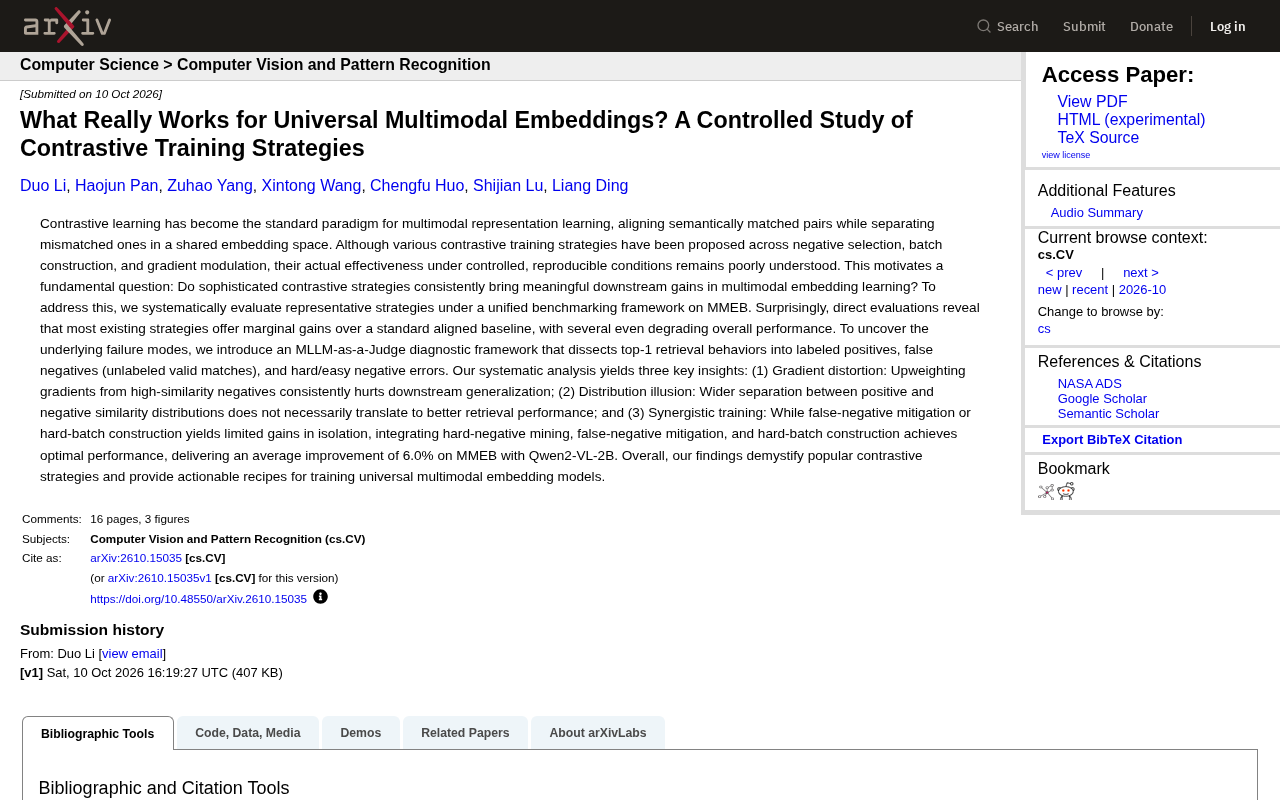
A recent study conducted a systematic evaluation of representative strategies on the unified benchmark MMEB, and the conclusion is quite counterintuitive—most strategies yield only marginal improvements over the standard alignment baseline, and some even drag down overall performance. The researchers further introduced the MLLM-as-a-Judge diagnostic framework, decomposing top-1 retrieval behavior into annotated positives, false negatives (valid matches that were not annotated), and hard/easy negative errors, thereby revealing three typical failure modes.
Three Failure Modes: Gradient Distortion, Distribution Illusion, and Co-training
Gradient Distortion: Weighting High-Similarity Negatives Is Actually Harmful
The first insight from the study is "gradient distortion." Intuitively, focusing attention on hard negatives that are very similar to positives seems to force the model to learn finer-grained discriminative ability. But experiments show that gradient weighting on high-similarity negatives consistently harms downstream generalization. In other words, the model is pushed too far away from certain samples, which instead disrupts the overall structure of the embedding space, causing retrieval performance to decline rather than improve.
Distribution Illusion: Well-Separated Distributions ≠ Good Retrieval
The second insight is named "distribution illusion." Many works use the margin between positive and negative similarity distributions as an optimization objective, assuming that a wider margin indicates higher representation quality. However, the study finds that a wider positive-negative distribution margin does not necessarily translate into better retrieval performance. There is a clear gap between what looks good at the distribution level and what works well at the task level, and judging strategy quality solely by distribution metrics can be misleading.
Co-training: Only When Three Strategies Are Combined Do Results Truly Improve
The third insight is the most constructive. False negative mitigation and hard batch construction yield limited gains when used alone, but when hard negative mining, false negative mitigation, and hard batch construction are integrated together, performance reaches its optimum. Taking Qwen2-VL-2B as an example, this combination achieves an average improvement of about 6.0% on MMEB. This shows that the value of contrastive learning strategies lies not in single-point breakthroughs, but in the synergistic effects formed through mutual coordination.
False negatives are a special type of noise in contrastive learning: samples in the dataset that are semantically highly matched to an anchor sample but are not recorded as positives due to incomplete annotation. When they are treated as negatives during training, the model is forced to push semantically similar samples apart, thereby distorting the embedding space. Multimodal data is particularly prone to false negatives because the matching relationship between images and text is often highly ambiguous, and a single description can often correspond to multiple images. Common approaches to mitigating false negatives include using soft labels from a momentum queue, dynamically masking potential positives based on similarity thresholds, or introducing an additional matching judgment module. This study lists false negatives as a separately diagnosable error type precisely because their interference with training signals is both pervasive and covert.
Implications for Multimodal Embedding Training
The value of this controlled study lies in throwing a bucket of cold water on the bustling strategy innovation while pointing out a pragmatic direction.
First, evaluation must return to unified benchmarks and reproducible conditions. Improvements reported by different papers under their own settings are often difficult to compare horizontally, and only controlled experiments under a unified framework can expose the true contribution of a strategy.
Second, diagnostic tools are more important than leaderboards. MLLM-as-a-Judge subdivides retrieval errors into false negatives and hard/easy negative errors, allowing researchers to locate the root cause of problems rather than blindly stacking techniques. The false negative problem deserves particular attention—valid matches in the dataset that are not annotated will be mistakenly treated as negatives and become training noise.
Third, combination beats single points. Since individual strategies yield limited gains, the design of training schemes should start from the whole, tuning negative mining, false negative handling, and batch construction as a coordinated mechanism, rather than isolatedly pursuing the extreme in one component.
For teams building general-purpose multimodal embedding models, these conclusions provide a directly actionable recipe: first establish a reliable baseline, then use the diagnostic framework to identify error types, and finally combine strategies in a coordinated way rather than believing in the "magical effect" of a single technique.
MMEB (Massive Multimodal Embedding Benchmark) is a unified benchmark for evaluating general-purpose multimodal embedding models, covering classification, retrieval, visual question answering, grounding, and many other tasks and numerous datasets, emphasizing horizontal comparison of different strategies under the same data and training conditions. MLLM-as-a-Judge refers to using a multimodal large model as the judge to perform semantic-level judgment on retrieval results rather than relying solely on annotated labels, thereby distinguishing "true errors" from "reasonable matches missed by annotation." The MLLM-as-a-Judge diagnostic framework is precisely built on this basis, decomposing top-1 retrieval behavior into annotated positives, false negatives, and hard/easy negative errors, making the root causes of strategy failure localizable and attributable.
One-line Summary
Unified benchmark evaluation shows most contrastive learning strategies yield marginal gains, requiring coordinated combination and a diagnostic framework.
Paragraph Summary
This study systematically evaluated representative strategies for multimodal contrastive learning on the unified benchmark MMEB, finding that most strategies yield only marginal improvements over the standard alignment baseline, and some even drag down performance. By introducing the MLLM-as-a-Judge diagnostic framework, the study decomposed top-1 retrieval errors into false negatives and hard/easy negative errors, revealing three failure modes: gradient distortion, distribution illusion, and co-training. Weighting high-similarity negatives harms generalization, wider positive-negative distribution margins do not equal better retrieval, and only when hard negative mining, false negative mitigation, and hard batch construction are coordinated does performance reach its optimum, with Qwen2-VL-2B improving by about 6.0% on average.
Related articles

beacon.sh: Giving AI Coding Assistants a Self-Evolving Memory
beacon.sh is an open-source, self-evolving memory layer for AI coding agents, supporting Claude Code, Cursor, Codex and 20+ harnesses—turning agent sessions into a compounding knowledge layer.

Xmind 2027 Launches: Mind Mapping Evolves into an AI Thinking Partner
Xmind 2027 launches on Product Hunt as an "AI thinking partner." It adds Xmind Agent for research with local documents and mind maps, and connects mind map context to ChatGPT, Claude, and other AI workflows via MCP. This article analyzes its product logic, differentiation, and open questions.

Display 1.0: Build Docs and Apps with Any Agent
Display 1.0 launches on Product Hunt, letting any Agent create docs, prototypes, and apps in one workspace, organized via Spaces and Folders into a team knowledge base with flat pricing.