Control Resonant Review: Reading the Documents Is the Whole Point

Control Resonant hides its best storytelling in optional documents — the more you read, the richer the world.
Control Resonant continues the series' signature "bureaucratic supernatural" aesthetic, filling its world with optional memos, research reports, and internal communications that carry the richest narrative details. The game wraps an apocalyptic crisis in cold government-document language, generating a distinctive dark humor. Its environmental storytelling design means depth scales with player investment — you can finish the game without reading a word, but reading everything is what truly brings this strange, sprawling world to life.
Control Resonant Review: Reading the Documents Is the Whole Point
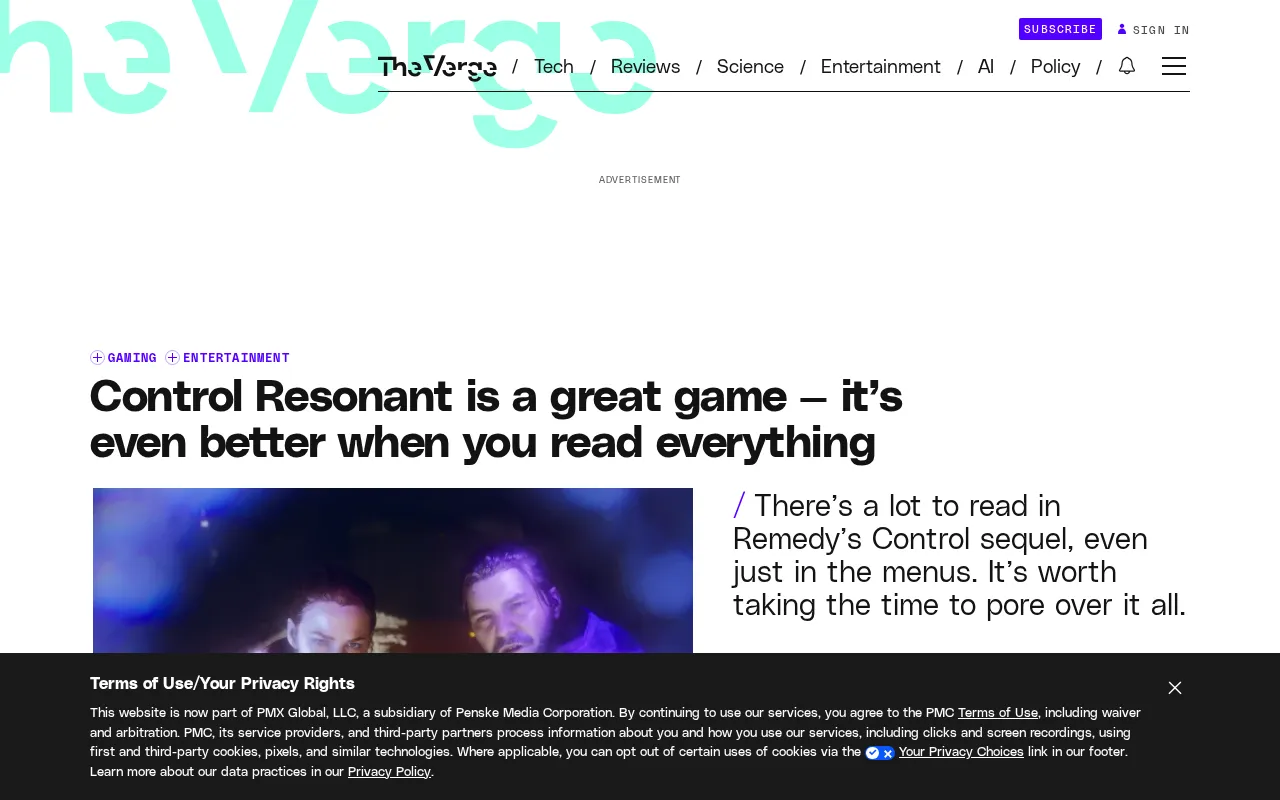
In Control Resonant, the fate of the world hangs in the balance. Yet somehow, the dedicated employees of the Federal Bureau of Control never stop filing their mountains of paperwork — and that hasn't stopped players from reading every single document they can find.
Reading Is Optional — But That's Where the Best Stuff Hides
Control Resonant carries on the series tradition of filling its world with memos, reports, internal communications, and research logs. In most cases, none of this text is required reading — players can skip all of it and follow the main storyline without missing a beat. Yet as the original author emphasizes, these seemingly tedious "bureaucratic documents" are precisely where some of the game's most compelling narrative details live.
This approach isn't new, but it reflects a mature storytelling philosophy: scatter world-building and character development throughout the environment, reward players who dig deeper, and avoid burdening those who just want to push through the story. This kind of environmental storytelling has become increasingly common in high-quality single-player games in recent years.
Environmental storytelling is a narrative technique that embeds story information within game spaces and objects rather than delivering it directly through dialogue or cutscenes. Its theoretical roots trace back to the "Show, Don't Tell" principle of writing. In game design, the Dark Souls series builds mythology through item descriptions, while BioShock reconstructs history through graffiti and audio diaries — both are landmark examples of this approach. What makes the Control series distinctive is its choice to frame this narrative medium as highly bureaucratic government documents rather than the more emotionally warm personal diaries or spoken recordings found elsewhere. That choice is itself a storytelling act: the friction between cold administrative language and terrifying supernatural content makes the way information is delivered part of its meaning.
The Narrative Tension Within Bureaucratic Aesthetics
One of the Control series' signature charms is placing supernatural phenomena alongside the cold, sterile culture of government paperwork. A scene on the verge of collapse, facing a world-ending crisis, still finds itself wrapped in endless forms, approval processes, and internal memos. This absurd juxtaposition generates a distinctive sense of dark humor.
The author notes that Federal Bureau of Control employees continue "filing stacks of paperwork" even as the world teeters on the edge — a parody of real-world bureaucracy and a key component of the game's atmosphere. As players read through these documents, they gradually piece together how a vast and bizarre organization attempts to manage, through institutional means, forces that defy all rational understanding.
The Control series is developed by Finnish studio Remedy Entertainment, with the original game releasing in 2019. The core premise centers on "Objects of Power" — everyday items that acquire supernatural properties after contact with a mysterious force, with the Federal Bureau of Control (FBC) tasked with tracking, containing, and studying these entities. The setting shares a strong spiritual kinship with the SCP Foundation, the well-known creative writing community: both use simulated institutional bureaucratic language to describe the indescribable, producing a powerful cognitive dissonance. Remedy takes this atmosphere to its fullest expression, making "administrative weirdness" one of the franchise's defining signatures.
The Rewards of Active Exploration
For players willing to invest the time, reading every piece of in-game text delivers a fuller, more immersive experience. This design philosophy means the game's depth scales with player engagement — the more you read, the more you understand, and the richer the game world becomes.
This raises an interesting design question: how do you encourage players to seek out content without forcing them to? Control Resonant's answer is to hide the best material in optional content, drawing players in through quality rather than obligation. This approach respects player agency while rewarding the genuinely curious.
Overall Assessment
From the overall tone of the source material, Control Resonant is an excellent game — and its optional text content elevates that experience even further. For players who enjoy deep storytelling and are willing to dive into the lore, this game offers far more than what's visible on the surface.
If you just want to race through to the credits, it's still a great game. But if you're willing to sit down like a dutiful Bureau employee and read every last document, it becomes something far more memorable.
Related articles

Anthropic Files S-1: $16.3B Revenue, $80.7B Net Loss in Half a Year — Who Controls the Company?
Anthropic files S-1 for a Nasdaq IPO: H1 2026 revenue of $16.3B, an $80.7B net loss from valuation remeasurement rather than cash burn, founders' Class F shares holding 50.1% voting power, and no price or date yet.

Anthropic Files S-1: The Truth Behind $16.3B Revenue and $80.7B Loss
Anthropic's S-1 reveals $16.3B revenue and $80.7B net loss in H1 2026, with $72.4B from accounting effects. The filing also discloses $265.6B compute commitments, cloud deal details, and a 50.1% founder voting control structure, while IPO pricing remains blank.

Anthropic Financials Leaked: Revenue Far Exceeds Compute Costs, Claude Inference Gross Margin Hits 68%
Leaked Anthropic financials show revenue roughly twice total compute costs, Claude inference gross margin at 68%, while frontier training burns $2.8B per quarter. This article breaks down the two accounts and analyzes shifts in AI company valuation logic.