DeepSeek Releases Super Agent Architecture: Router + Worker Two-Tier Design

DeepSeek proposes a Router + Worker two-tier Super Agent architecture, turning AI from a chat tool into an always-on virtual team.
Eleven days after open-sourcing its core inference framework, the DeepSeek Harness team published an exploration article on the Super Agent architecture. It notes that the core pain point of current Agents is growing AI capability versus limited human management capacity, making multi-session parallel management a bottleneck. Super Agent uses a two-tier structure: the Router handles message interfacing, task scheduling, and context synchronization, while multiple Workers execute in isolated parallel fashion. The architecture features continuous, efficient, proactive, and persistent operation, supporting cross-platform task advancement, environmental event monitoring, and failure self-healing. Measured P50 and P95 completion times are 12.4 and 15.7 minutes, about half that of a single session with SubAgent tools, at the cost of increased Token usage. Its deeper significance is the Agent's shift from a passive tool to an always-on collaborative team, with humans retreating to the role of requester and acceptor.
The DeepSeek Harness team has published an article on the design exploration of Super Agent, proposing an architectural approach for the next generation of Agent systems. Just 11 days after open-sourcing its core inference framework, this pace has drawn widespread attention from the developer community.
The Core Pain Point of Agents: Human Attention Becomes the Bottleneck
According to an interpretation by Bilibili creator "Yinshi Fenjie," the biggest pain point of current Agents is this: AI can handle more and more work, but human energy is limited. Existing Agents still use a single session as the basic unit, and different sessions are independent of each other. For an ordinary person, managing three to five active sessions simultaneously is already quite taxing.
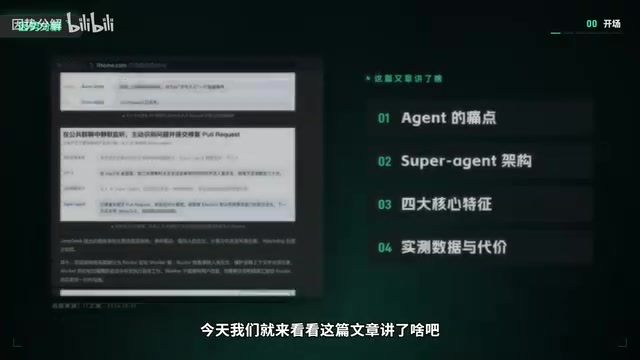
This observation hits the mark. Improvements in Agent capability have not simultaneously reduced the management burden on humans—instead, users have to switch back and forth between multiple chat windows, repeatedly explain context, and manually follow up on progress. DeepSeekAd's Super Agent architecture is proposed precisely to address this structural contradiction.
Two-Tier Architecture: Router Schedules, Worker Executes
The core idea of Super Agent is not complicated: transform AI from a question-and-answer chat tool into a virtual team that resides in the background. The system is divided into two layers—the dispatcher Router and the working Worker.
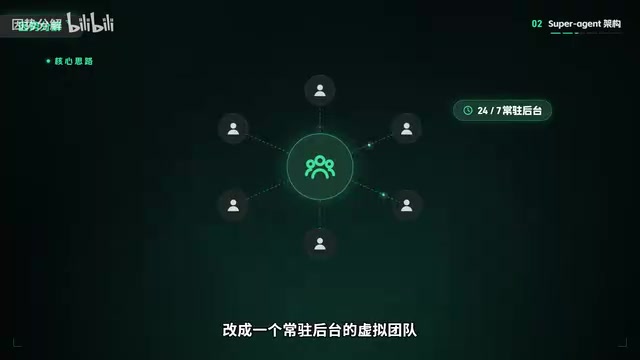
The Router interfaces with all messages and can also solve any problem; multiple Workers work in isolated parallel execution without interfering with each other. Users do not need to watch every execution detail—they are only responsible for setting goals and accepting results, while scheduling follow-up and context synchronization are handled automatically by the system. This division of labor effectively transfers the role of "project manager" from the human to the Router, with humans retreating to the position of "requester."
SubAgent mechanism: A SubAgent refers to a subordinate Agent instance derived from a main Agent and responsible for executing specific subtasks. After decomposing a large task, the main Agent dispatches it to multiple SubAgents for parallel processing. Each has its own independent context and tool permissions, and upon completion, results are aggregated back to the main Agent. This pattern can improve parallelism, but it also introduces additional overhead: each SubAgent must carry its own system prompt and task description, and the aggregation of results between master and subordinates itself consumes Tokens and an extra round of inference. The "single session with SubAgent tools" mentioned in the article refers to this relatively heavy baseline approach, and Super Agent's speedup is measured against it.
Four Core Characteristics
This architecture proposes four key features:
- Continuous: The same task can be advanced across multiple platforms such as group chats and GitHub, without repeatedly explaining context.
- Efficient: Multiple tasks run in parallel, and one long task does not block other work.
- Proactive: Continuously monitors environmental events; even without anyone reminding it, things like discovering a bug will trigger handling on its own.
- Persistent: Runs online for the long term; if the program freezes or errors, it can automatically recover, ensuring tasks are not interrupted midway.
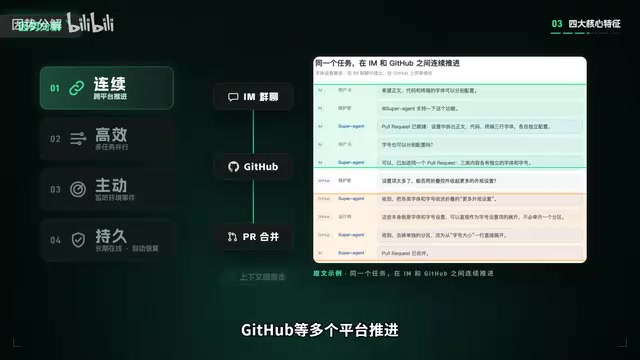
The "continuous" and "persistent" features are especially noteworthy. Cross-platform context retention means the Agent begins to possess cross-session memory and state management capabilities, while automatic recovery directly elevates the reliability of long tasks from "manual supervision" to "system self-healing."
Performance Data and Token Cost
The team's published measured data shows that the P50 and P95 completion times are 12.4 minutes and 15.7 minutes respectively, roughly half the time of a single session with SubAgent tools.
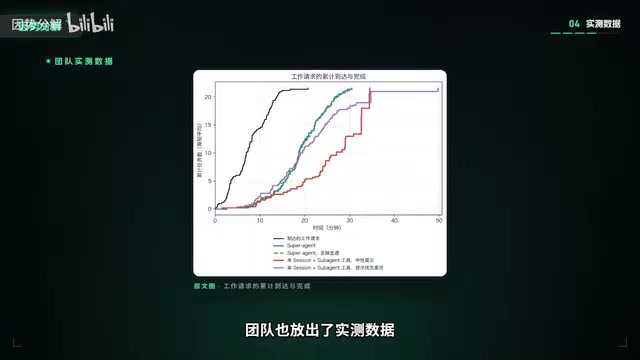
The speed improvement comes at the cost of increased Token usage. The Bilibili creator used a blunt analogy: to make a big fat fish cook quickly, you must provide enough white rice. For actual deployment, this means a change in the cost structure—what is saved is human time, and what is paid is inference overhead. Whether it is worth it depends on the task density of the specific scenario.
What P50 and P95 mean: These two metrics come from percentiles in latency statistics. P50 is the median, meaning half of the tasks have completion times shorter than this value; P95 means 95% of tasks have completion times shorter than this value, and the remaining 5% of "long-tail" tasks exceed it. Reporting P50 and P95 together reflects the real experience better than looking at the average alone—the average is easily skewed by individual extremely fast or extremely slow tasks, while P95 exposes just how slow the slowest batch of tasks really is. In the article, 12.4 minutes and 15.7 minutes are not far apart, indicating that the distribution of task completion times is relatively concentrated and the long tail is not severe, which is an important signal for always-on Agents that require stable delivery.
From Tool to Team
The deeper significance of the Super Agent architecture lies in the transformation of the Agent form: from a passively responding tool to a team that resides in the background and collaborates autonomously. The Router handles scheduling and context synchronization, Workers handle isolated parallel execution, and humans only define goals and accept results. If this model can be implemented, it will change the basic unit of collaboration between developers and AI—no longer a single conversation, but a continuously running task system.
At present, the article is still at the architectural exploration stage, and the specific implementation details and degree of openness remain to be seen.
One-line Summary
DeepSeek proposes a Router + Worker two-tier Super Agent architecture, turning AI from a chat tool into an always-on virtual team.
Paragraph Summary
Eleven days after open-sourcing its core inference framework, the DeepSeek Harness team published an exploration article on the Super Agent architecture. The article points out that the core pain point of current Agents is that AI capability is growing while human management capacity is limited, making multi-session parallel management a bottleneck. Super Agent adopts a two-tier structure: the Router handles message interfacing, task scheduling, and context synchronization, while multiple Workers execute in isolated parallel fashion. The architecture has four major characteristics—continuous, efficient, proactive, and persistent—supporting cross-platform task advancement, environmental event monitoring, and failure self-healing. Measured P50 and P95 completion times are 12.4 and 15.7 minutes, about half that of a single session with SubAgent tools, at the cost of increased Token usage. Its deeper significance lies in the Agent shifting from a passive tool to an always-on collaborative team, with humans retreating to the role of requester and acceptor.
Related articles

AI Tools Quietly Altering Settings: Postman Silently Installs Plugin, Codex Sharing Option Auto-Resets
AI Daily reports: Postman silently installs a Mac plugin and self-approves startup hooks, logged as auto-existing upgrade; Hacker News developers say Codex data-sharing opt-out flips back. Plus Simon Willison's raw float weight experiment with QEN 3.8-27B.

AI Learns to Rewrite AI: MIT's "Weightspace Programming" Redraws the Path to Recursive Self-Improvement
MIT team proposes weightspace programming: GPT-6 Astra reads and edits AI model weights directly. Math scores jump several-fold, hand-written networks beat trained models. Eight experiments analyzed, plus Anthropic's same-day warning and the real boundaries of recursive self-improvement.

Running Qwen 3.8 on a Laptop to Read Raw Weights: 46 Minutes Per Answer
Simon Willison reproduced weight space programming with Qwen 3.8 27B on a laptop: a 17GB model file, 46 minutes per answer, 43,506 reasoning tokens, Pong over an hour, Freeway failed. Suited for interpretability researchers.