Designeer: A One-Stop Curated Resource Hub for Developers and Designers

Designeer curates design, dev, and AI resources into one human-filtered gateway for Builders.
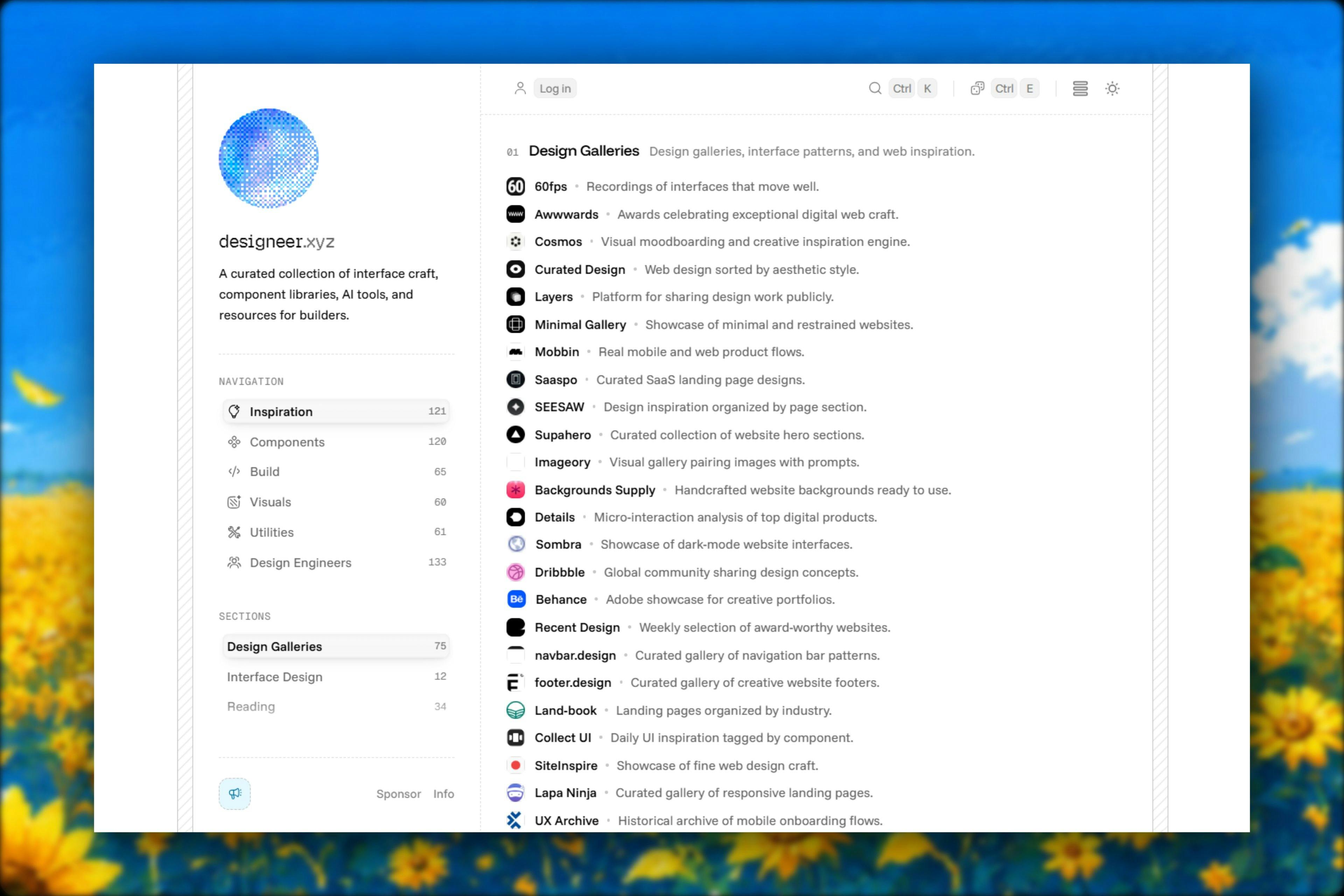
Designeer, built by Dhruv Jaradi, is a curated resource aggregation platform serving designers, developers, and Builders. Unlike algorithm-driven aggregators, it emphasizes human curation across design inspiration, component libraries, AI tools, coding agents, and MCP servers. The platform follows a "Discover-Learn-Build-Showcase" loop, aiming to evolve from a passive directory into a creator community. It ranked #8 on Product Hunt's Vercel Day with 70 votes. Its long-term challenge is sustaining quality and freshness across three domains while making its Showcase community truly work.
A Resource Aggregation Platform Built for Builders
In an age of information overload, designers and developers constantly jump between countless blogs, GitHub repositories, design sites, and tool directories, searching for usable inspiration, components, and tools. Designeer was created precisely to solve this fragmentation problem.
Built by Dhruv Jaradi, the product operates under the tagline "Bringing the best of the internet together." It earned 70 upvotes and ranked #8 during Product Hunt's Vercel Day event. The platform positions itself as a curated destination serving three distinct audiences: designers, developers, and the broader category of "Builders" — anyone who creates.
What Exactly Does It Aggregate?
The core value proposition of Designeer lies in the word "curated." Unlike aggregators that rely on algorithms to indiscriminately scrape content, Designeer emphasizes human-selected resources that are genuinely worth paying attention to. According to the platform's official description, it covers a wide range of content types:
- Design inspiration: Reference materials for designers looking for a creative starting point
- Component libraries and design systems: Reusable resources for front-end developers
- AI tools: A collection of the hottest productivity tools right now
- Coding agents: A recently emerged category of AI-powered programming assistants
- MCP servers: Resources related to the Model Context Protocol, reflecting the platform's awareness of the latest AI infrastructure trends
- Creators worth learning from: Not just tools, but people as resources
This list makes clear that Designeer isn't content with being a simple design site or tool directory. It aims to span design, development, and AI — becoming a comprehensive gateway for the Builder community.
MCP and Coding Agents: Tapping Into New AI-Era Needs
Worthy of separate attention is the fact that Designeer explicitly lists MCP servers and coding agents as content categories. Both are newly formed categories that emerged alongside the explosion of large language model applications.
MCP (Model Context Protocol), as a protocol standard for connecting AI models with external tools and data sources, is rapidly forming an ecosystem — but related resources remain scattered with no unified discovery channel. The same is true for coding agents: from command-line tools to IDE plugins, the options are multiplying, yet most developers struggle to determine which ones actually work well.
By incorporating these emerging categories into its curated scope, Designeer demonstrates that it has identified real pain points in the current tech landscape. For developers trying to keep pace with the AI-powered coding wave, a human-vetted resource gateway can save enormous amounts of trial-and-error.
MCP (Model Context Protocol) was originally proposed and open-sourced by Anthropic in late 2024, with the goal of providing large language models with a standardized "context access" protocol — analogous to a universal USB interface — enabling AI models to connect to file systems, databases, API services, and other external tools in a consistent way, without requiring custom integration logic for each tool. As Claude, Cursor, Windsurf, and other tools have adopted MCP support, a server ecosystem (MCP Servers) has rapidly emerged around the protocol, allowing developers to extend an AI assistant's capabilities by installing different MCP Servers. Coding agents, meanwhile, refer to AI systems capable of autonomously planning and executing multi-step programming tasks; representative products include Devin, OpenHands, and GitHub Copilot Workspace — fundamentally different from earlier code-completion tools like the original Copilot. What these two categories share is an extremely fast pace of technical iteration, a constant stream of new tools, and a particularly acute "paradox of choice" problem for ordinary developers. This is precisely why human-curated resource directories hold real value in this space.
The Product Logic Behind "Discover. Learn. Build. Showcase."
The platform summarizes the complete user journey with four verbs: Discover, Learn, Build, and Showcase.
This closed-loop design is notably thoughtful. Rather than simply helping users "find things," it aims to help users continuously learn through the platform's creators and resources, put that knowledge into practice, and ultimately showcase what they've built. If the Showcase component actually takes hold, Designeer could evolve from a passive resource directory into a creator platform with genuine community characteristics — a direction many aggregation products have tried but struggled to achieve.
Positioning and Challenges
From a product categorization standpoint, Designeer sits under three tags simultaneously: Design Tools, Developer Tools, and Artificial Intelligence. Broad coverage is an advantage, but it can also be a liability. The greatest ongoing challenge for resource aggregation products remains: how to consistently maintain content quality and freshness. Curation requires significant human investment, and high-quality resources across the internet grow every single day. The ability to sustain an update cadence will directly determine the platform's long-term value.
The current metrics — 70 votes and 2 comments — indicate it's still in early stages, with limited community discussion. Whether it can stand out among the many similar aggregation sites will ultimately depend on the distinctiveness of its curated content and whether the Showcase community can genuinely come to life.
Resource aggregation products have plenty of historical precedents: early Sidebar.io focused on design news, Hacker News relies on community voting to filter technical content, and Product Hunt itself is a form of aggregated discovery. These products typically face two evolutionary paths: either maintaining a small-but-precise editorial strategy that builds a dedicated audience through word of mouth (like the Dense Discovery newsletter), or introducing community contribution mechanisms to scale content volume — which brings an exponential increase in quality control difficulty. A positioning that spans design, development, and AI means Designeer's potential user base is large enough, but it also means maintaining content freshness across three separate verticals, each with audiences that don't entirely agree on what constitutes a "high-quality resource." Finding the right balance between breadth and depth is a structural tension that no comprehensive aggregation platform can avoid.
Summary
Designeer addresses a genuine need: in today's hyper-fragmented information landscape, Builders need a trusted, curated, all-in-one gateway. Its coverage of emerging AI categories like MCP and coding agents demonstrates a sharp awareness of current trends. That said, as a product built around "curation," its success ultimately depends on sustained investment in content operations and whether it can evolve from a resource directory into a sticky creator community. For developers who keep a close eye on design and AI tools, it's worth bookmarking and watching.
Related articles

Anthropic Files S-1: $16.3B Revenue, $80.7B Net Loss in Half a Year — Who Controls the Company?
Anthropic files S-1 for a Nasdaq IPO: H1 2026 revenue of $16.3B, an $80.7B net loss from valuation remeasurement rather than cash burn, founders' Class F shares holding 50.1% voting power, and no price or date yet.

Anthropic Files S-1: The Truth Behind $16.3B Revenue and $80.7B Loss
Anthropic's S-1 reveals $16.3B revenue and $80.7B net loss in H1 2026, with $72.4B from accounting effects. The filing also discloses $265.6B compute commitments, cloud deal details, and a 50.1% founder voting control structure, while IPO pricing remains blank.

Anthropic Financials Leaked: Revenue Far Exceeds Compute Costs, Claude Inference Gross Margin Hits 68%
Leaked Anthropic financials show revenue roughly twice total compute costs, Claude inference gross margin at 68%, while frontier training burns $2.8B per quarter. This article breaks down the two accounts and analyzes shifts in AI company valuation logic.