Does Context Compression Weaken Refusal Alignment? Study Reveals Semantic Fidelity Is Not Behavioral Alignment
Context compression preserves semantics but systematically weakens model refusal alignment, study finds.
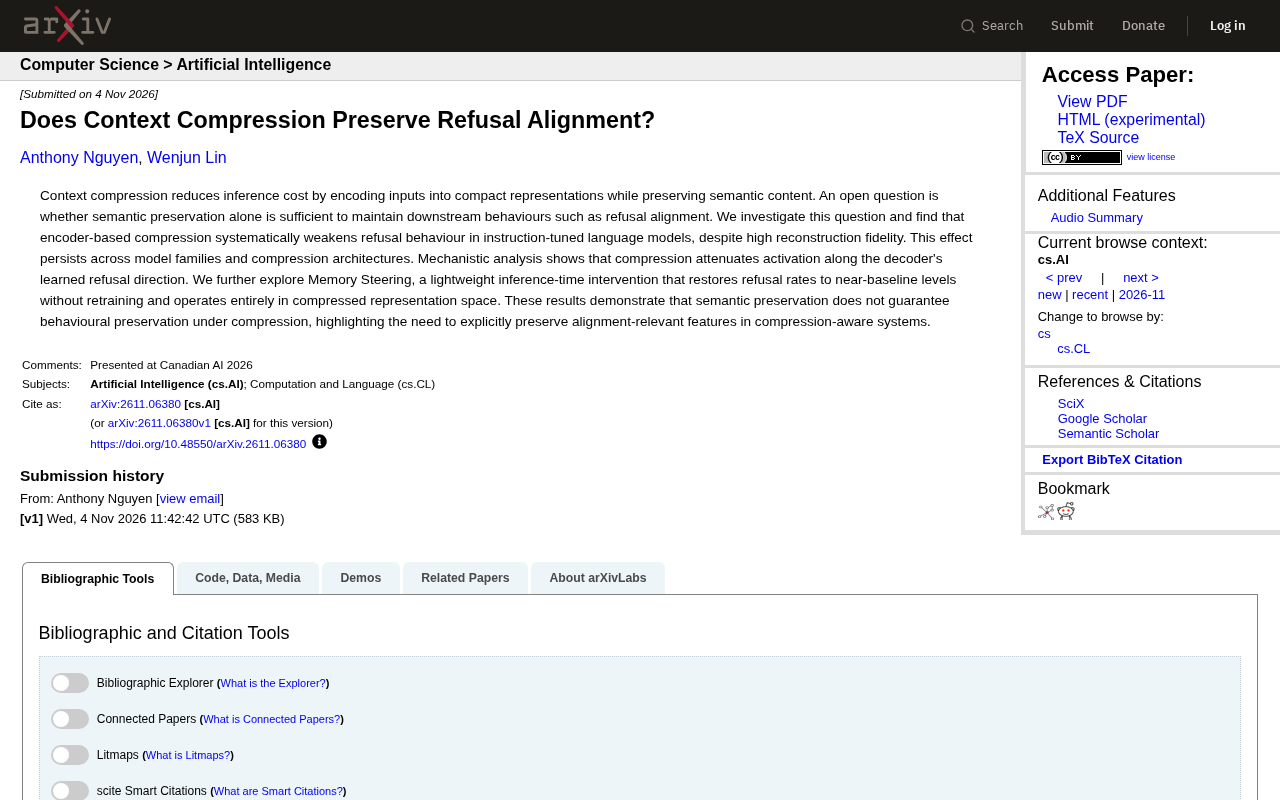
A study reveals that encoder-based context compression systematically weakens refusal behavior in instruction-tuned LLMs despite high reconstruction fidelity. This effect persists across model families and compression architectures, indicating a fundamental property of compression methods. Mechanistic analysis shows compression attenuates activations along the learned refusal direction, meaning compression optimizes semantic reconstruction rather than behavioral fidelity—so high fidelity and behavioral degradation can coexist. The researchers propose Memory Steering, an inference-time intervention operating in the compressed representation space that restores refusal rates to near baseline without retraining. The work emphasizes that semantic preservation does not guarantee behavioral preservation, and compression-aware systems should explicitly preserve alignment-related features.
The Hidden Cost of Context Compression: Refusal Alignment Is Systematically Weakened
As large models face increasingly long context windows, context compression is widely seen as an effective way to reduce inference costs—encoding inputs into compact representations while preserving semantic content as much as possible. But a new study raises a critical question: Is semantic preservation sufficient to maintain downstream behaviors, such as refusal alignment? The answer may be no.
The study finds that encoder-based compression systematically weakens refusal behavior in instruction-tuned language models, despite high reconstruction fidelity. This effect persists across different model families and compression architectures, indicating it is not a problem of individual implementations but a property of the compression methods themselves.
This finding has significant implications for safety- and compliance-sensitive applications. Refusal alignment is the model's first line of defense against harmful requests. If compression silently weakens this defense, compression-aware systems need to re-examine their design assumptions.
Mechanistic Analysis: Compression Attenuates Activations Along the Refusal Direction
To explain this phenomenon, the researchers conducted a mechanistic analysis. The results show that compression attenuates activations along the refusal direction learned in the decoder. In other words, the features in the model's internal representations associated with refusal behavior are weakened during compression.
This explains why high reconstruction fidelity and behavioral degradation can occur simultaneously: semantic content is preserved, but alignment-related features are not treated equally. Compression algorithms optimize for semantic reconstruction, not behavioral fidelity—and the gap between the two is precisely the problem.
Why Semantic Fidelity Is Not Enough
The conventional view holds that as long as the compressed representation can accurately reconstruct the original input, downstream task performance should be unaffected. But this study shows that this assumption does not hold for alignment behavior. Refusal behavior depends on specific directional features in the representation space, and these features are easily lost or attenuated during compression.
Refusal direction is a concept proposed in mechanistic interpretability research: in aligned language models, the activation difference between refusing harmful requests and complying with them can be projected onto a low-dimensional direction, and moving activations along this direction can significantly change the model's refusal tendency. This direction is typically obtained by taking the mean difference or training a linear probe on intermediate-layer activations from a large set of positive and negative sample pairs, and it generalizes across prompts. The existence of a refusal direction indicates that refusal alignment is not dispersed across all semantic dimensions but concentrated in a specific direction. Therefore, if a compression algorithm only optimizes overall reconstruction error, it may cause disproportionate damage to this narrow direction.
Reconstruction fidelity is typically measured by perplexity, token-level accuracy, or cosine similarity, reflecting whether the compressed representation can restore the semantic content of the original input. Such metrics are less sensitive to anisotropy in the representation space: even if a certain direction is weakened, overall similarity may remain at a high level. Thus, when evaluating compression quality, reconstruction fidelity and behavioral fidelity are two orthogonal dimensions that need to be measured separately.
Memory Steering: A Lightweight Fix Without Retraining
To address this problem, the researchers further explored Memory Steering—a lightweight inference-time intervention method. It can restore refusal rates to near-baseline levels without retraining, and operates entirely within the compressed representation space.
The value of this approach lies in its practicality: it does not require modifying the compression architecture or retraining the model, but intervenes at the inference stage, reducing deployment costs. For systems that have already adopted compression, this is a pluggable remediation path.
Implications for Compression-Aware Systems
The findings send a clear signal: semantic preservation does not guarantee behavioral preservation. Compression-aware systems need to explicitly preserve alignment-related features rather than merely optimizing semantic reconstruction metrics. This imposes new requirements on the design of future compression methods—alignment awareness should become part of compression quality assessment.
Inference-time intervention refers to a technical approach that directly edits activation values during forward propagation without modifying model weights. Representative methods include activation steering and contrastive activation addition (CAA). The basic approach is to construct an intervention vector and add or subtract it proportionally to the residual stream at a specified layer, thereby pushing model behavior in the desired direction. Because it requires no gradient updates or training data, such methods have low deployment costs and can be toggled on or off at any time, making them suitable as patches for systems already in production. Memory Steering follows this line of thinking, but the intervention target is the compressed representation space, requiring the identification of operable activation locations between the compression encoder and decoder.
Frequently Asked Questions
Q: Does context compression affect all models? A: The study finds that the effect persists across different model families and compression architectures, indicating it is not an incidental phenomenon specific to certain models.
Q: Does Memory Steering require retraining the model? A: No. It is an inference-time intervention that operates entirely within the compressed representation space.
Q: How can one determine whether compression has harmed alignment? A: Looking only at reconstruction fidelity is insufficient; behavioral metrics such as refusal rate need to be evaluated additionally.
One-line Summary
A study finds that context compression preserves semantics but systematically weakens the model's refusal alignment behavior.
Paragraph Summary
This article introduces a study on the hidden cost of context compression. Although encoder-based compression achieves high reconstruction fidelity, it systematically weakens the refusal behavior of instruction-tuned language models, and this effect persists across model families and compression architectures, so it is not a flaw of individual implementations. Mechanistic analysis shows that compression attenuates activations along the refusal direction learned in the decoder, indicating that compression optimizes for semantic reconstruction rather than behavioral fidelity, so high fidelity and behavioral degradation can coexist. To address this, the researchers propose Memory Steering, an inference-time intervention method operating in the compressed representation space that restores refusal rates to near-baseline levels without retraining. The article thus emphasizes that semantic preservation does not guarantee behavioral preservation, and compression-aware systems should explicitly preserve alignment-related features.
Related articles

A $100 New York Dinner Party? The Creative No-Utensils Challenge Menu
Food creator Zainab hosts a $100 no-utensils dinner party for five in NYC, designing a desi menu around keema with dal, paneer peppers, cucumber salad, and ice cream sandwiches—showing budget menu design thinking.

A Five-Year Quest: Deconstructing the Persimmon Cake Recipe
NYT food columnist Eric Kim shares a five-year persimmon-cardamom cake recipe, covering Fuyu persimmon selection, whipped cream folding, butter browning, and baking tips, with full details and failure attribution.

Naming the World's Most Famous Sourdough: Hunter Schafer and Michelle Yeoh's Fermentation Experiment
Starting from Hunter Schafer and Michelle Yeoh's sourdough conversation, this article explores the anthropomorphic tradition in fermentation culture, the technical logic of starters as living systems, and the emotional needs behind the home baking trend.