Eagle-4 Released: Outpaces DFlash2 and DSpark in Inference Speed, 3.59× Speedup Measured on Qwen3.8-27B
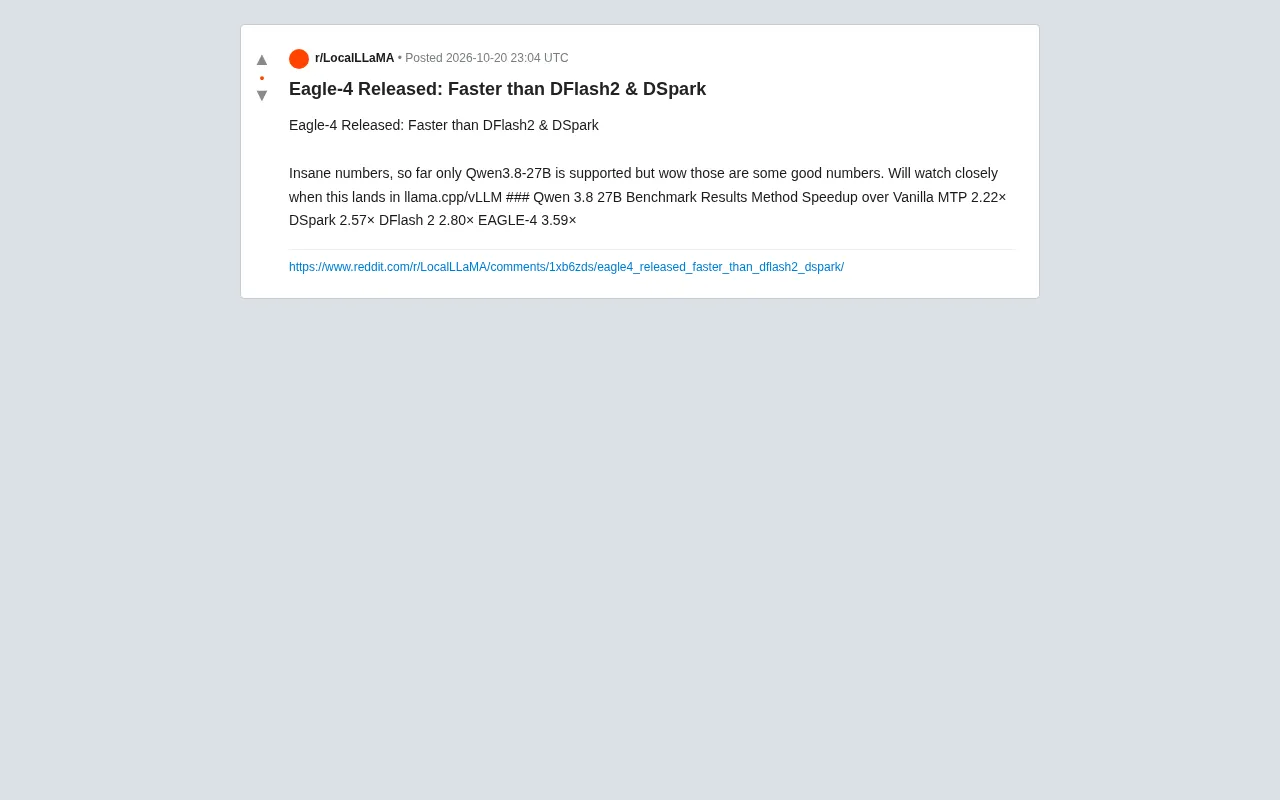
Eagle-4 is released, achieving a 3.59× inference speedup on Qwen3.8-27B, surpassing DFlash2 and DSpark.
A hot post in the Reddit community shows that Eagle-4 has been officially released, achieving a 3.59× inference speedup over the baseline on the Qwen3.8-27B model, comprehensively leading DFlash2 (2.80×), DSpark (2.57×), and MTP (2.22×). The Eagle series continues the speculative decoding approach, using a lightweight draft model to generate candidate tokens that are then verified by the target model. Eagle-4's leap in acceleration is presumed to come from substantive improvements in draft acceptance rate or parallel verification efficiency, but the original post does not disclose technical details. The current limitation is that it supports only the single Qwen3.8-27B model and has not yet been integrated into llama.cpp or vLLM. The community has reacted positively to the numbers, and the progress of subsequent framework adaptation and the scope of model coverage will determine whether it can translate from paper results into a production-usable solution.
The field of large model inference acceleration has seen a new breakthrough. A hot post in the Reddit community shows that Eagle-4 has been officially released, achieving a 3.59× inference speedup over the baseline method on the Qwen3.8-27B model, significantly ahead of the previously impressive DFlash2 and DSpark. Although it currently supports only a single model, this number is enough to get developers excited about future integration.
Performance Comparison: Eagle-4 Leads Across the Board
According to the benchmark data published in the post, on the Qwen 3.8 27B model, the speedup ratios of each method are as follows:
| Method | Speedup vs. Vanilla |
|---|---|
| MTP | 2.22× |
| DSpark | 2.57× |
| DFlash 2 | 2.80× |
| EAGLE-4 | 3.59× |
Eagle-4 not only surpasses the previously much-discussed DFlash2 (2.80×) and DSpark (2.57×), but also leaves MTP's 2.22× far behind. From 2.80× to 3.59×, it may look like less than a doubling, but in the field of inference acceleration, every marginal gain means a large amount of engineering optimization and algorithmic innovation.
MTP (Multi-Token Prediction) is a class of acceleration solutions that has a similar goal to speculative decoding but a different implementation path. Its approach is to add additional prediction heads to the model during training, so that the model predicts tokens at multiple future positions simultaneously in one forward pass, and at inference time these predictions can be submitted and verified as candidates in one go. The advantage of MTP is that it requires no independent draft model and has a simple deployment pipeline, but because the candidate tokens lack autoregressive dependencies among themselves, the acceptance rate is usually lower than that of dedicated speculative decoding methods, so in such comparisons the speedup tends to be at a lower level (2.22× here).
It should be noted that the speedup ratios of all methods in the table use Vanilla (original autoregressive decoding) as the 1× baseline, and are highly dependent on test conditions—including batch size, generation length, sampling temperature, and hardware configuration. Scenarios with small batches, long outputs, and low-temperature sampling are usually friendlier to speculative methods and yield higher speedups; whereas under high concurrency and large batches, GPU utilization is already saturated and marginal gains narrow significantly. Therefore, when comparing across methods, one should pay attention to whether they were measured under the same evaluation configuration.
Technical Background: The Consistent Approach of the Eagle Series
The core idea of the Eagle series methods is a variant of speculative decoding—using a lightweight draft model to quickly generate candidate tokens, which are then verified by the target large model, thereby improving throughput without sacrificing generation quality. As the latest iteration of this series, Eagle-4 most likely made further improvements in draft model structure, training strategy, or verification mechanism.
Although the original post does not disclose specific technical details, the substantial jump in speedup suggests that Eagle-4 has made a substantive breakthrough in the acceptance rate of draft tokens or the efficiency of parallel verification. This also explains why it stands out in comparisons with methods such as DFlash2 and DSpark that are likewise based on speculative decoding.
Speculative Decoding is a technique that accelerates autoregressive generation without changing the output distribution of the target large model. Its basic process is: use a "draft model" with far fewer parameters than the target model to quickly autoregressively generate γ candidate tokens, then have the target large model perform a single parallel forward pass to verify these γ tokens, accept the prefix that is consistent with the target model's distribution, and after the first rejected position have the target model produce one correct token. Since a single forward pass of the large model can verify multiple tokens, the generation process changes from "one token per step" to "multiple tokens per step on average," thereby achieving more than 2× end-to-end acceleration.
The speedup of this method depends on two key quantities: the acceptance rate of draft tokens and the per-step overhead of the draft model. The higher the acceptance rate and the cheaper the draft, the more pronounced the acceleration. The Eagle series is precisely centered on improving the acceptance rate: early Eagle introduced feature-level drafting (using the target model's hidden-layer features rather than only tokens as draft input), and Eagle-2 further introduced a dynamic draft tree structure so that one verification can cover multiple candidate paths. This also explains why improvements in this direction often manifest as gains in acceptance rate and parallel verification efficiency.
Current Limitation: Only Qwen3.8-27B Supported
The post clearly states that Eagle-4 currently supports only the Qwen3.8-27B model. This means users of other mainstream models (such as the Llama series and Mistral series) cannot yet benefit directly. For a newly released technology, such single-model support is not uncommon—teams usually need to adapt and tune for a specific model architecture to achieve the claimed acceleration effect.
However, the poster himself also said he would closely monitor progress on bringing Eagle-4 to llama.cpp and vLLM. These two inference frameworks are the most widely used deployment solutions in the open-source community, and once Eagle-4 is integrated, its influence will quickly expand from a single model to the broader ecosystem.
llama.cpp and vLLM are currently the two most important inference deployment solutions in the open-source community, but they have different positioning: llama.cpp is implemented in C/C++, focusing on quantized inference and local deployment on CPUs, Apple Silicon, and consumer GPUs, with an ecosystem covering a large number of model formats; vLLM targets high-throughput server-side scenarios, with PagedAttention and continuous batching at its core, and is the mainstream choice for cloud batch inference.
The two differ greatly in how they support speculative decoding: vLLM has built-in multiple speculative decoding backends (such as n-gram, independent draft models, and EAGLE-style draft heads) and needs to coordinate with the scheduler and KV cache management; llama.cpp implements it through draft model parameters or its own speculative sampling. For Eagle-4 to land in these two frameworks, in addition to model weight conversion, it is also necessary to implement draft tree construction and parallel verification kernels, and to correctly handle differences in acceptance length across sequences under continuous batching—this is precisely the main engineering difficulty that makes benchmark numbers hard to reproduce directly.
Community Reaction and Future Outlook
Judging from the wording of the Reddit post, the community reacted positively to Eagle-4's numbers—the comment "Insane numbers" reveals surprise at the magnitude of the acceleration. Considering that DFlash2 and DSpark had already accumulated some reputation in the community, Eagle-4's ability to comprehensively surpass them will undoubtedly attract more developers' attention.
The key next milestone is engineering deployment. No matter how impressive the benchmark numbers are, if they cannot be stably reproduced in llama.cpp or vLLM, their help to actual production environments will be limited. Whether Eagle-4 can quickly complete framework adaptation and whether it will expand support to more models will determine whether it can transform from a "paper champion" into a "practical weapon."
For teams concerned with large model inference efficiency, Eagle-4 is worth adding to the watch list. Especially in scenarios with deployment needs on Qwen series models, a 3.59× speedup means considerable cost savings and response speed improvements.
One-line Summary
Eagle-4 is released, achieving a 3.59× inference speedup on Qwen3.8-27B, surpassing DFlash2 and DSpark.
Paragraph Summary
A hot post in the Reddit community shows that Eagle-4 has been officially released, achieving a 3.59× inference speedup over the baseline on the Qwen3.8-27B model, comprehensively leading DFlash2 (2.80×), DSpark (2.57×), and MTP (2.22×). The Eagle series continues the speculative decoding approach, using a lightweight draft model to generate candidate tokens that are then verified by the target model. Eagle-4's leap in acceleration is presumed to come from substantive improvements in draft acceptance rate or parallel verification efficiency, but the original post does not disclose technical details. The current limitation is that it supports only the single Qwen3.8-27B model and has not yet been integrated into llama.cpp or vLLM. The community has reacted positively to the numbers, and the progress of subsequent framework adaptation and the scope of model coverage will determine whether it can translate from paper results into a production-usable solution.
Related articles

Cursor AI in Practice: Weighing Efficiency Gains Against Costs in an AI IDE
An in-depth look at Cursor AI IDE's interface layout, four modes (Agent/Plan/Debug/Ask), model selection, and Git context integration, with hands-on demos weighing subscription costs against going direct to Claude.

Free Landing Page Design Rules Library: A Practical Guide for Claude Code and Cursor
A free landing page design skill for Claude Code and Cursor: MIT licensed, nearly 9,000 stars, asks about offer/audience/action before planning 12 sections with hard font and spacing constraints.

Cursor Keeps Writing Wrong Code? The Problem May Be Context, Not Prompts
Cursor keeps writing wrong code? The problem may be context, not prompts. Learn how to supply relevant files, full error messages, and expected results, plus a plan-first, small-step, test-driven workflow to reduce AI coding errors—while remembering code review remains the developer's job.