From Frontend to AI Agent Development: Career Paths and Skill Roadmap

Pure frontend roles haven't vanished—they've become composite JDs requiring full-stack and Agent skills.
The article notes that pure frontend roles haven't disappeared but hiring formats have shifted: standalone frontend JDs are giving way to composite requirements like "AI frontend" and "Agent full-stack." The turning point is the capability upgrade behind tools like Codex and Claude Code, which compressed the value of CRUD work, hitting junior/mid-level frontend, backend, testing, and ops first. Employers aim to replace four-to-six-person teams with one or two AI-savvy people. Developers should move from pure frontend experts to full-chain leaders of "Agent + big frontend." The article offers three transition paths—AI Agent development engineer, FDE, and remote work or independent contracting—and stresses supplementing full-stack, Agent development, and solution architecture design skills.
Are Pure Frontend Roles Disappearing, or Just Getting New Names?
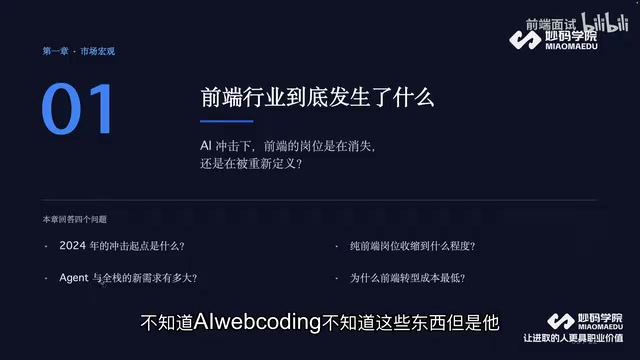
In a Bilibili talk, a frontline AI architect raised a sharp observation: frontend roles haven't disappeared, but the hiring landscape has completely changed. Browse job boards and standalone "frontend developer" JDs are increasingly rare, replaced by "AI frontend," "frontend Agent direction," and "Agent full-stack."
This isn't an illusion. According to the architect's analysis, AI's impact on coding roles started with code completion tools like Cursor and GitHub Copilot, but the real turning point that shrank headcount was the massive capability upgrade behind tools like Codex and Claude Code—generating complete project code and automating validation loops, which sharply compressed the value of work like CRUD page-building.

Junior and mid-level frontend, backend, testing, and ops roles are hit first. The reason is straightforward: these roles' daily work is highly pattern-based—copy-paste, framework templating, CRUD—exactly what AI excels at.
Why Have All the JDs Become "Agent Full-Stack"?
Understanding the employer-side motivation is more useful than anxiety. The architect points out that bosses are calculating: hire one or two people who know AI to replace the workload of what used to be a four- or five-person R&D team.
Previously, a six- or seven-person R&D team in a tier-1 city with an average monthly salary of 20K, plus social insurance and housing fund, cost over 100K RMB per month. Now employers are weighing "what AI can replace"—even if they don't fully understand the specific boundaries of Agent development, they'll still write AI, Agent, and full-stack requirements into the JD.
This is somewhat like the integrated development model around 2015 when frontend and backend weren't separated; later, finer specialization spawned a large number of frontend roles. Now the trend has reversed—roles are shrinking again and concentrating into the composite form of "Agent + full-stack."
For developers, this means that simply deepening a frontend expert track is no longer enough. The architect's direction is clear: Agent + big frontend—position yourself as a generalist who can lead the entire chain of frontend, backend, and testing, rather than an expert in one layer.
Agent development refers to building software systems around large language models that can autonomously plan, call tools, and execute multi-step tasks. Its core includes: model invocation (interacting with LLMs via APIs), toolchain orchestration (letting models call external capabilities such as search, databases, and code execution), and automated workflows (managing multi-step reasoning and retries with state machines or graph structures). Unlike traditional "call an API to build a feature," Agent development emphasizes the model as the decision-making hub, and systems must handle new problems like hallucinations, context management, and cost control. Common frameworks include LangChain, LlamaIndex, AutoGen, etc., but enterprises value understanding of underlying principles more than framework proficiency. For frontend transferees, Agent development is the key step to building "model + tools + process" thinking.
Three Actionable Transition Paths
Path 1: AI Agent Development Engineer
The most direct employment direction. The core capability is supplementing Agent development skills on top of big frontend—understanding model invocation, toolchain orchestration, and building automated workflows. Suitable for most frontend developers with 3-5 years of experience who want a stable transition.
Path 2: FDE (Forward Deployed Engineer)
If you already have some business experience and strong communication skills, you can try an FDE role. This type of role requires facing customer scenarios directly and landing AI capabilities in specific business contexts, with equal emphasis on technical depth and business understanding.
FDE (Forward Deployed Engineer) was first adopted at scale by data companies like Palantir and has recently become popular again in Silicon Valley and major domestic tech companies due to AI deployment needs. Its essence is a "business interface person who understands technology": stationed on-site or deeply interfacing with customers, quickly understanding business pain points, and using AI capabilities (such as RAG, Agent workflows) to build demonstrable prototypes and drive them into production. Unlike pure R&D, FDEs need engineering implementation, requirement translation, and customer communication skills simultaneously, and are often called "solution consultants who can write code." For frontend developers, existing UI interaction and business understanding experience is a natural advantage; after supplementing model invocation and backend integration skills, they can be qualified. This role demands high overall capability, but the career ceiling is also higher, with potential to grow into a solution architect or product technical lead.
Path 3: Remote Work and Independent Contracting
Developers with stronger capabilities and business accumulation can pursue remote work or take on their own contracts. This path demands the most overall capability but offers the greatest freedom.
The architect specifically reminds: everyone has limited energy, and when working overtime every day, you should realize even more that learning is an investment in yourself. Continuous output without input means that when you're forced to change jobs, you'll find your technical and architectural design skills haven't kept up. The key to the information gap lies in—what to learn, what not to learn, and in what order.

Skill Supplementation: From "Using Frameworks" to "Leading the Chain"
Transition isn't about tearing down frontend knowledge and starting over, but changing the structure of your capabilities. In the past, the frontend advancement path was learning frameworks, principles, and engineering—with the goal of becoming a frontend expert; now that goal needs to be upgraded to the composite capability of "Agent + big frontend."
What exactly is missing? The architect outlines several directions: full-stack development capability (at least covering backend APIs and the data layer), Agent development capability (model invocation, tool orchestration, automated loops), and solution architecture design capability. There are still people landing packages of 300K-400K+ RMB, and the gap often lies in these composite capabilities.
On language choice, Java, Python, and Node.js all have their applicable scenarios; the architect suggests deciding based on the target role's tech stack rather than agonizing over "which language is best."
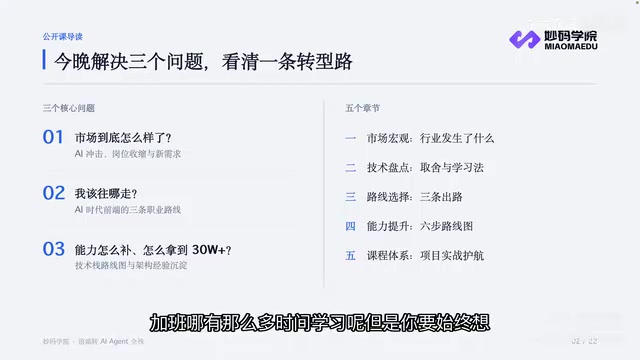
Solution architecture design capability refers to the ability, under given business constraints, to weigh technical choices, decompose system modules, define interfaces and data flows, and evaluate cost, performance, and maintainability. For the "Agent + big frontend" composite role, this means not only writing pages or calling models, but also answering: when to use RAG instead of fine-tuning, how to design Agent failure fallback strategies, how to divide boundaries between frontend/backend and model services, and how to monitor and evaluate results. This capability usually comes from participating in complete projects from 0 to 1, not from merely learning frameworks. Transferees are advised to actively seek opportunities to own small projects end-to-end, accumulate cases of architectural decisions, and be able to explain design choices with trade-off thinking in interviews—this is exactly the core gap assessed for roles paying 300K-400K+ RMB.
Editor's Observation
The value of this talk is that it pulls the emotional discussion of "frontend is dead" back to concrete paths. What needs to be viewed calmly: the growth in demand for Agent full-stack roles is a fact, but companies' expectation of "one person doing the work of five" also means a higher overall capability threshold, and the transition window won't stay open forever. For frontend developers, supplementing full-stack and Agent capabilities one step earlier is more meaningful than standing by.
One-line Summary
Pure frontend roles haven't disappeared—they've transformed into composite JDs requiring full-stack and Agent capabilities.
Paragraph Summary
The article points out that pure frontend roles haven't disappeared, but the hiring format has shifted: standalone frontend JDs are decreasing, replaced by composite requirements like "AI frontend" and "Agent full-stack." The turning point is the capability upgrade behind tools like Codex and Claude Code, which compressed the value of CRUD work, hitting junior/mid-level frontend, backend, testing, and ops first. Employers' motivation is to replace a four-to-six-person team with one or two people who know AI. Developers should shift from pure frontend experts to full-chain leaders of "Agent + big frontend." The article offers three transition paths: AI Agent development engineer, FDE, and remote work or independent contracting, emphasizing supplementing full-stack, Agent development, and solution architecture design capabilities.
Related articles

A New Paradigm for Text Editing in Compose: TextFieldState Replaces the Old API
Jetpack Compose introduces the TextFieldState API to fix dropped characters and cursor jumps from async input. The old value/onValueChange callbacks will be deprecated in 1.13. This article covers InputTransformation, OutputTransformation, four state hoisting patterns, and new formatted text editing capabilities.

Remote Compose: A New Document-Driven Paradigm for Cross-Platform UI on Android
Remote Compose transmits compact binary documents instead of screen pixels, enabling efficient UI rendering on remote surfaces like Wear OS and widgets. This article covers its document creation API, expression animations, size optimization techniques, and Wear OS progress.

How Crashlytics Eliminates Android Memory and Responsiveness Issues
Through the Chroma Clip case study, this article explains how Firebase Crashlytics uses Application Exit Info, Profiling Manager, GWP ASAN, and ARM MTE to pinpoint ANRs, OOMs, memory limit terminations, and native memory corruption—solving the challenge of stack traces that don't point to the real culprit.