From Prompt to Agent: The Four-Stage Evolution of Industrial-Grade AI Agents

From native LLMs to Agents: the four-stage evolution powering enterprise-grade AI deployment.
This article traces the four-stage evolution of LLMs — from native models and prompt engineering through RAG to Agents — arguing that while prompt engineering and RAG improve answer quality, Agents enable proactive reasoning and autonomous execution. Through four core capabilities (translation, tool calling, memory management, and task planning), Agents transform LLMs from Q&A tools into "digital employees" that can run complete business workflows, making them the key entry point for enterprise digital transformation.
Why Enterprise LLMs Must Move Toward Agents
There's a common misconception among people learning about large language models: many assume that mastering prompt engineering, memorizing a few prompt templates, or building a local RAG knowledge base is enough to deploy LLMs in production. Then comes the interview, and when asked "Can you build an automated intelligent system that handles orders and follows up with customers?" — many people freeze.
The reason is this: prompt engineering and RAG are fundamentally about making a model answer questions well, while Agent is about making a model think proactively and solve problems autonomously. These are two entirely different technical paths. When traditional enterprises undergo digital transformation, what they need is rarely a simple Q&A chatbot. They need a system that reduces costs, replaces repetitive manual labor, and drives entire business workflows end-to-end. Only Agents can meet that demand.
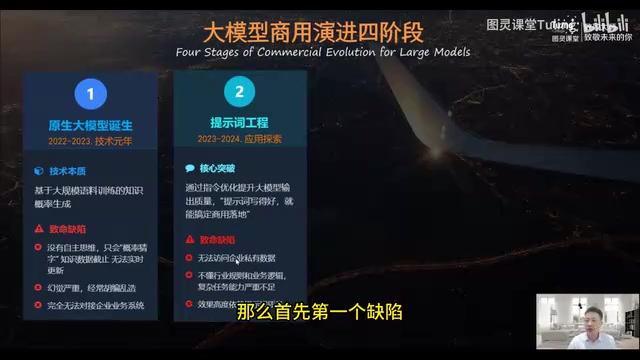
The Four Stages of LLM Deployment
To understand the value of Agents, you first need to trace the complete path from model creation to production deployment. This path can be broken into four stages, each increasing in complexity.
Stage 1: Native LLM
This is where everything begins. Native large language models learn from massive amounts of publicly available internet data to generate responses. When ChatGPT launched, people marveled at how it could write articles, generate code, and seem to know everything. But the limitations quickly became apparent: no autonomous reasoning ability — only concept generation; knowledge has a cutoff date, so asking about anything after that date often produces severe hallucinations — the model will confidently make things up; and most critically, it cannot integrate with enterprise business workflows. For real enterprise-grade commercial deployment, native models fall far short.
Stage 2: Prompt Engineering
To improve output quality, the industry turned to optimizing prompts. For a time, "write better prompts and you can deploy commercially" became a widely circulated claim, and techniques like structured instructions and chain-of-thought reasoning were studied extensively. But prompt engineering has three core flaws: it cannot access proprietary enterprise data, it cannot handle business processes, and output quality depends heavily on how carefully a human crafts the prompt.
By 2026, prompt engineering had been downgraded from a "core skill" to a baseline competency for LLM application engineers — much like how using a computer requires knowing how to type, but typing proficiency doesn't make you an IT engineer.
Stage 3: RAG (Retrieval-Augmented Generation)
To solve the private data problem, RAG emerged — and it remains the most common approach for traditional enterprises deploying LLMs today. The logic is straightforward: store domain-specific, repetitive business data (including tables and images) from industries like finance, law, or manufacturing into a knowledge base; before answering, the model retrieves relevant content from that knowledge base and incorporates it into the response.
RAG does solve the private data access problem, and most knowledge distribution systems today are built on it. But RAG's inherent limitations are equally clear: it can only passively retrieve information when asked — it won't think proactively; it cannot handle complex business logic or decompose tasks; and it only supports single-turn question-and-answer. Take e-commerce as an example: the full workflow from customer inquiry, order placement, inventory check, to address change is simply beyond what RAG can handle. This is why many enterprises spend significant resources building Q&A systems that end up having limited real business impact.
A deeper look at RAG's technical architecture: When documents are ingested, they are split into chunks and converted into high-dimensional vectors by an embedding model, then stored in a vector database (e.g., Pinecone, Milvus, Chroma). When a user submits a query, the system vectorizes the question and uses algorithms like cosine similarity to retrieve the most relevant text chunks, which are then injected into the prompt and sent to the LLM to generate a response. This "retrieve first, then generate" mechanism allows the model to reference proprietary enterprise documents while reducing hallucinations — because the model now has citable, traceable context. The dominant RAG engineering frameworks today include LangChain and LlamaIndex, both of which provide end-to-end toolchains covering document loading, chunking, vectorization, and retrieval — making them the go-to starting points for enterprises building knowledge Q&A systems.
Stage 4: The Agent Revolution
At this stage, large language models gain the ability to plan, execute, and reason — evolving from a Q&A tool into a "digital employee" capable of calling various tools to complete complex tasks and supporting multi-agent collaboration across enterprise workflows. This is precisely why traditional enterprises undergoing digital transformation are increasingly choosing the Agent approach.

What Exactly Is an Agent?
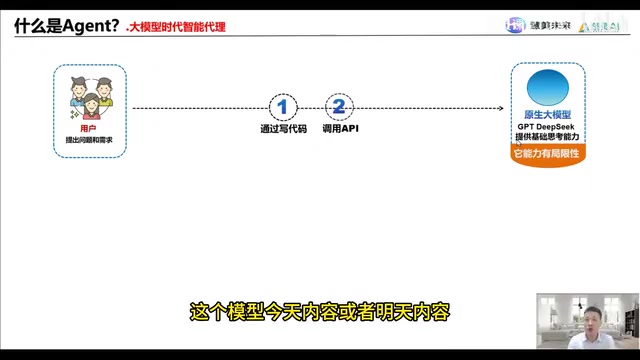
Think of an Agent as a "proxy" for the large language model — a bridge between the user and the native model. Here's an analogy: when a Chinese speaker and an English speaker need to communicate, they need a translator. The Agent is that translator. The user expresses a need; the Agent interprets the intent, invokes various tools, completes complex tasks, and returns the final result to the user.
What happens without an Agent? Native LLMs have several obvious shortcomings: no memory — they can't recall what was discussed earlier in a conversation; a knowledge cutoff — they can't answer questions about recent events; no internet access — they can't query real-time data; and no ability to read local files or call external tools. Yet real enterprise scenarios almost always require multi-turn dialogue, tool operations, and real-time data. Native models simply can't handle this — Agents are essential to fill the gap.
The Four Core Capabilities Agents Provide
Agents primarily extend LLMs with four key capabilities:
- Translator: Converts natural language requests into instructions the model can understand, and transforms model outputs into actionable results users can actually use.
- Tool Expert: Helps the model call APIs and other tools, enabling it to search the web, manipulate files, and integrate with enterprise systems — turning it from "can only talk" into "can actually do things."
- Memory Manager: Helps the model remember context, user preferences, and conversation history, enabling coherent multi-turn interactions without losing track.
- Task Planner: Breaks complex problems into smaller steps and executes them sequentially; when issues arise, proactively selects alternative approaches — just like a real person would.
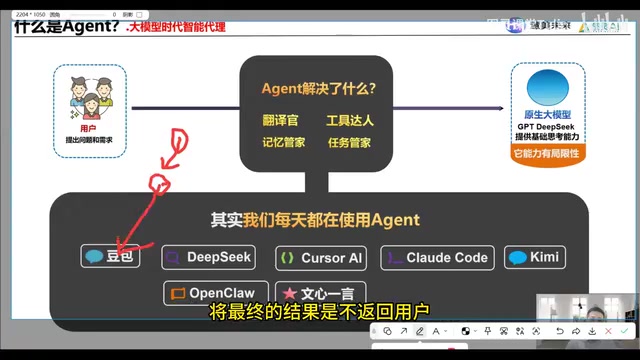
In fact, we all use Agents every day. When you send a message to an AI assistant, it doesn't go directly to the native model — it passes through the Agent layer first, which processes and enriches it before returning a response. Tools like Cursor and Claude Code that developers use daily work the same way: they can remember your entire project structure and call the compiler to debug code — that's Agent-powered tool calling and memory management at work.
The technical mechanics behind Agent behavior: The core operating mechanism of an Agent is typically called the ReAct (Reasoning + Acting) loop. After receiving a task, the model first reasons about what to do next, decides which tool to call or what action to take (Act), observes the result (Observe), then continues reasoning based on that result — repeating until the task is complete. This loop gives Agents the appearance of "autonomous decision-making." Function Calling (also called Tool Use) is the technical foundation that allows Agents to "take action." OpenAI, Anthropic, and other leading model providers all natively support this at the API level: developers predefine tool names, parameters, and functional descriptions; the model decides during inference when and which tool to call, generates structured parameters, and external code actually executes the call before returning results. This mechanism transforms LLMs from pure language generation systems into execution engines capable of interacting with the real world.
The Four Major Agent Deployment Tracks
The Agents that are generating real revenue and achieving commercial deployment today generally fall into a few core categories. These are also the most stable monetization tracks available. Whether you're looking to transition into a high-paying role, take on freelance projects, or build your own AI product startup, you can find your positioning here.
Tool-Based (Enterprise Customer Service) Agents
A typical example is an intelligent customer service system for an automotive brand — a dedicated AI assistant embedded in a brand's app and website. When users want to buy a car, it can handle everything from vehicle models, pricing, and configurations to after-sales support, available 24/7 to replace human agents. Enterprises of any significant scale in China are either already building or preparing to build this type of agent — it's one of the most common entry points for digital transformation.
Role-Based (Digital Human) Agents
This is the form most people encounter when scrolling through short-form video — digital human presenters, virtual influencers, and live-stream shopping hosts. Technically, it combines Agent capabilities with digital human technology. Short-video companies and e-commerce platforms are already deploying these at scale.
Function-Based Agents
These are defined by their singular focus — doing one thing deeply and doing it well. AI writing tools are a classic example. By concentrating on a single function, these agents can more easily build a competitive edge.
A fourth category worth watching: Beyond the three types discussed above, a rapidly growing category in the enterprise market deserves attention: workflow automation agents (also called Agentic RPA). The key difference from traditional RPA (Robotic Process Automation) is that traditional RPA relies on fixed rules and scripts — it breaks down when page layouts change or unexpected situations arise. Agent-powered automation, by contrast, can understand intent, dynamically plan steps, and autonomously adjust strategy when a process branches or fails. Typical use cases include automated procurement approvals, financial reconciliation, and contract information extraction — processes that are fairly structured but still contain edge cases. This category commands some of the highest per-project rates in the B2B market and represents one of the most accessible freelance project types for LLM application engineers.
Closing Thoughts
From native LLMs to prompt engineering, RAG, and finally Agents — this evolutionary path leads to a clear conclusion: the real barrier to enterprise-grade deployment lies in Agent capability. Prompt engineering and RAG are foundational; but tool calling, state management, task orchestration, and multi-agent collaboration are the core competencies that matter at industrial scale. For anyone looking to enter this field, rather than staying at the level of prompt writing and knowledge base construction, it's worth investing your energy in Agent development — where the commercial value is substantially higher.
Related articles

DeepSeek Harness Quick Start Guide: From Installation to 5 Real-World Cases
What is DeepSeek Harness? Based on a Bilibili tutorial, this article covers how this AI Agents software works, installation and setup, four working modes, and five real-world cases: a 3D racing game, official website, music player, science animation, and self-developed plugin—plus token money-saving tips.

Breaking Down DeepSeek's Super-agent Architecture: How Router+Worker Solves the Multi-Session Management Bottleneck
An analysis of DeepSeek's Super-agent paper: how the Router+Worker two-tier architecture uses Fast Pass, Chain of Recall, and storage-compute separation to solve multi-AI-session management bottlenecks, and how much it truly alleviates the human attention bottleneck and what engineering trade-offs it makes.

19K Stars in 5 Days: Why DeepSeek's Open-Source AI Programmer Went Viral
DeepSeek's open-source AI programmer hit 19K GitHub stars in 5 days. Why it went viral: the agent boom, AI writing its own code, and the shift from Q&A tools to AI employees.