GAN8 vs JEV: Single-Head Probability Model Battles Eight-Logic Voting Architecture

Four experiments show when single-head probability models fail against multi-framework logic architectures — and why merging them backfires.
A Reddit user ran four comparative experiments pitting the single-head probability model JEV against the eight-framework voting architecture GAN8. On classic logic problems where features approximate labels, both tied. But on structural compositional tasks like parity checking — where single-head models cannot represent the structure — GAN8 hit 100% accuracy versus JEV's peak of 67%. Multi-framework architectures have limits too: they can't invent unseen logic rules, where hand-written priors outperform. Most counterintuitively, combining both models decreased performance, as the high-confidence generalist systematically drowned out the specialist. The key lesson: route by structure, don't average.
In the world of decision-making AI models, a debate is unfolding over a fundamental question: how many "minds" should constitute judgment? A Reddit user ran four rounds of comparative experiments, pitting two radically different architectures against the same set of problems head-to-head. JEV represents minimalist single-head probabilistic judgment; GAN8 represents a multi-framework architecture where eight abstract logic systems each cast independent votes. The results weren't a simple win or loss — they revealed a core issue in decision model design that's easy to overlook: can judgment really be compressed into a single energy, a single threshold, a single confidence score?
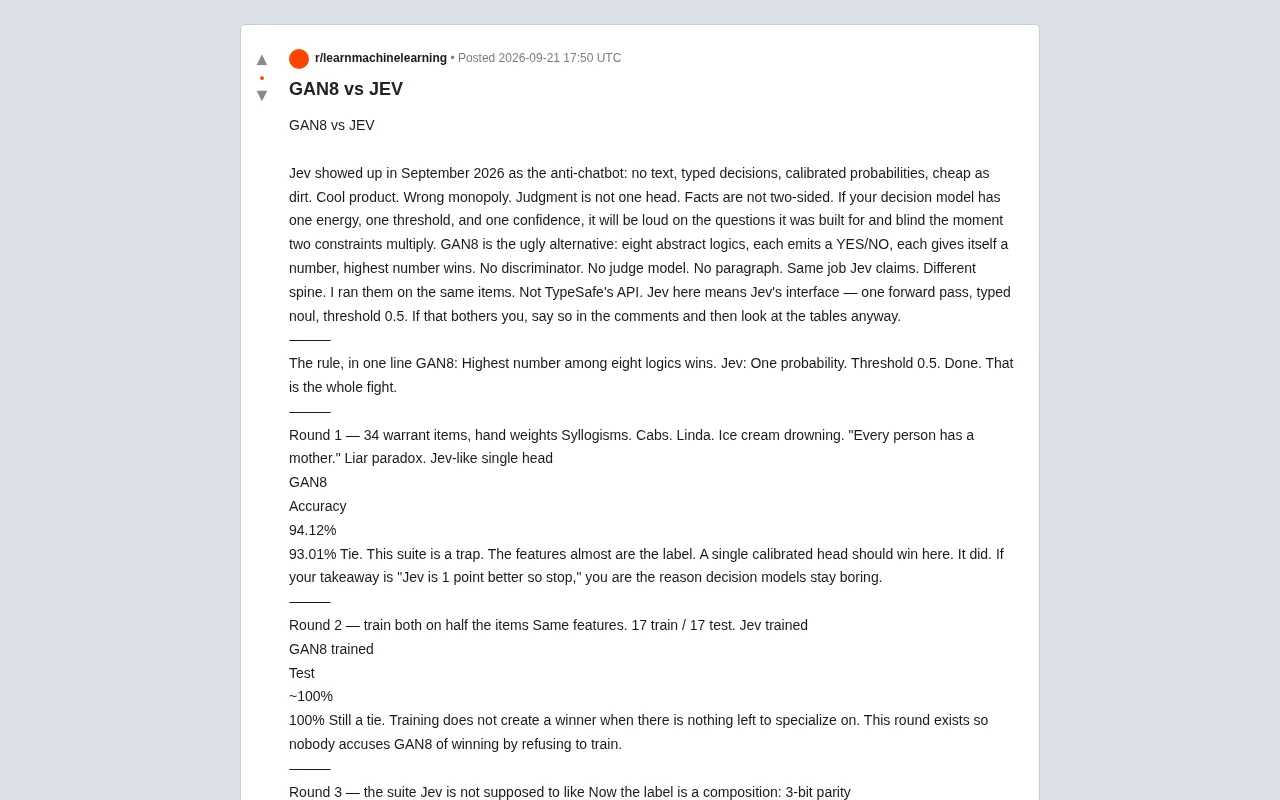
Two Architectures, Two Philosophies
JEV is described as an "anti-chatbot" product: no text output, only typed decisions with calibrated probabilities, and extremely cheap to run. Its rule can be summarized in one sentence — one forward pass, one probability, threshold 0.5, done. It's a clean, pragmatic engineering philosophy.
GAN8 is what the author calls the "ugly alternative": eight abstract logic frameworks, each independently rendering a YES/NO verdict and scoring its own confidence, with the highest scorer winning. No discriminator, no referee model, no explanation paragraphs. It does the same job JEV claims to do, but with a completely different skeleton.
The author's core challenge is sharp: judgment is not a single mind, and facts are not simply black or white. If your decision model has only one energy, one threshold, one confidence score, it will perform loudly on the problems it was designed for — but the moment it encounters a scenario where two constraints multiply together, it goes instantly blind.
Single-head probability models work by mapping all input features to a scalar confidence value, then applying a fixed threshold (typically 0.5) for binary classification. This design is informationally equivalent to assuming that "the decision boundary can be defined by a single hyperplane or its nonlinear transformation." When labels have a strong one-to-one correlation with features, this assumption holds and the model excels. But when a label is actually the logical product of multiple independent constraints (e.g., "condition A is true AND condition B has even parity"), a single energy function must simultaneously encode two structures that are orthogonal in feature space — theoretically causing one to be suppressed. GAN8's multi-framework voting mechanism sidesteps this limitation: each framework handles only the geometric structures it specializes in, and the final result is each framework "speaking" in its domain of expertise, rather than forcing one head to cover all dimensions. This is why the author describes GAN8's advantage as "irreducible frameworks" rather than "more parameters" — the difference lies in the structure of representational capacity, not its size.
Rounds One and Two: The "Trap" of Apparent Parity
Round one featured 34 logic reasoning problems covering classic judgment tasks: syllogisms, the taxicab problem, the Linda fallacy, the liar's paradox, and others. The JEV-like single-head model scored 94.12% accuracy; GAN8 scored 93.01% — nearly identical.
The author candidly called this a trap: the features were almost equivalent to the labels themselves, and a well-calibrated single-head model should naturally win here. He specifically warned: if your takeaway is "JEV is only 1 percentage point stronger, so we're done here," then you are precisely the reason decision models stagnate.
Round two had both models train on half the problems (17 train / 17 test), yielding test accuracy of approximately 100% and exactly 100% respectively — still a draw. The author's explanation: when there's no structure to specialize in, training itself doesn't create a winner. This round existed only to preempt the objection that "GAN8 wins by refusing to train."
Round Three: Structural Compositional Tasks Reveal the Truth
The real watershed came in round three. Labels were no longer simple features but a composition: 3-bit parity check, any fatal flaw triggers rejection, Bayesian rare-class judgment of whether it falls on the correct side of 0.5, and genuine recognition vs. "looks like recognition." This was a compositional family JEV had never encountered during training.
The critical setup: JEV's head had no XOR column, while one of GAN8's logic frameworks directly implemented parity checking. Test results:
- IID test (21 questions): JEV hand-weighted 76.2%, JEV linear trained 71.4%, JEV MLP 85.7%, GAN8 95.2%
- Unseen combinations (10 questions): JEV hand-weighted 80.0%, JEV linear 50.0%, JEV MLP 60.0%, GAN8 60.0%
- Full test (31 questions): JEV hand-weighted 77.4%, JEV linear 64.5%, JEV MLP 77.4%, GAN8 83.9%
On pure parity tasks, the gap was most extreme: JEV linear 33%, JEV MLP 67%, GAN8 100%.
The author's interpretation deserves careful consideration: this isn't "GAN8 is smarter" — it's "eight irreducible frameworks, on the one framework that a single energy cannot contain, defeating a single energy." When the structure itself is something a single head cannot represent, the advantage of a multi-framework architecture becomes irreplaceable.
Parity is a classic concept in computer science and information theory: given a set of binary bits, the parity value is 0 if the number of 1s is even, and 1 if it's odd. A 3-bit parity check means the label is determined by the XOR of three binary features. XOR has a famous property: it is completely non-separable by a single-layer linear model — in 2D space, XOR's four points cannot be correctly separated by a single line. This is precisely the core counterexample Minsky and Papert raised in Perceptrons (1969), the historical catalyst that drove research into multilayer neural networks. In this experiment, JEV's head had no explicit XOR column, meaning it had to rely on MLP nonlinear layers to implicitly learn this structure. GAN8's framework, by contrast, directly encodes parity as a first-order logic rule, requiring no induction from data. This explains why the gap reached the extreme level of 100% vs. 67% on pure parity tasks.
GAN8's Limits: It's Not a Silver Bullet
To the author's credit, GAN8 isn't placed on a pedestal. On unseen rule combinations, GAN8 did not win — hand-written JEV priors (such as "fatal flaw overrides the claim") transferred at 80% accuracy, while trained JEV overfit to single-flaw templates and completely failed, with GAN8 failing alongside it.
His sober conclusion: eight generators won't spontaneously invent a ninth algebra. Anyone selling "just add more frameworks and compositional generalization will emerge automatically" is selling perfume. This is a warning shot across the bow of AI product design that reflexively piles on modules.
Round Four: Combining Them Makes Things Worse
The most counterintuitive finding came in round four — combining both models decreased performance rather than improving it:
- Using JEV as a 9th framework, taking the highest score: Overall 81.5%, but parity accuracy dropped back to 50%. The generalist drowned out the specialist.
- JEV-first, hand off only when confidence falls below 0.7: Collapsed into JEV — roughly 70% of problems never left JEV, ECE approximately 0.25. The so-called "intelligent tiering" didn't upgrade anything.
The author's recommendation was pointed: if you're going to combine them, route — don't average, and don't let a confident generalist serve as arbiter. Use the parity framework when parity bits are active; otherwise use JEV. Letting a high-confidence generalist arbitrate only destroys the entire system.
The phenomenon of "generalists suppressing specialists" in model fusion has mature theoretical explanations in ensemble learning. When a high-confidence generalist model is mixed with multiple specialist models, if the fusion strategy is weighted averaging or highest-confidence-wins, the generalist will systematically dominate outputs because it achieves higher confidence on most samples — specialists only get a voice when the generalist's confidence is extremely low. This runs directly counter to the design intent of Mixture of Experts (MoE) architectures — MoE routers are trained to "identify which expert's domain the current input belongs to," rather than having all experts compete on a single confidence ranking. The author's suggested "route by structure" approach is essentially lightweight MoE thinking: use a low-cost structural detector to determine whether the current problem triggers a specific framework (e.g., whether parity bits are active), rather than having model output confidence double as the routing signal. The reason combining both systems failed is fundamental: confidence measures "how certain am I within my own distribution" — not "am I the right model to answer this type of question."
Conclusion: Different Sports, Different Skeletons
This comparison ultimately didn't crown an absolute winner, but staked out clear positions for each:
- JEV is the right interface — no tokens, typed probabilities, fast, cheap.
- GAN8 is the right skeleton — when the world contains more than one type of geometric structure.
The author also clarified that TypeSafe-hosted models are indeed faster and cheaper than LLMs for bounded software decisions — but that's a claim about latency and schema, which is a completely different sport from beating eight named constraints on parity.
For developers building decision-making AI systems, this experiment provides a pragmatic mental model: single-head models suit scenarios where features approximate labels; multi-logic architectures suit structural problems where constraints multiply; and blindly fusing both often fails on both fronts. It's worth noting that this article is based on a single Reddit source's experimental record, and the specific data and methodological details await further independent replication and verification.
Related articles
AWS AgentCore Gateway: Connecting AI A…
AWS AgentCore Gateway: Connecting AI Agents to Enterprise Backends with MCP
How AWS AgentCore Gateway acts as a primary MCP server to aggregate REST APIs, Lambda, and existing MCP services? Analyzing its AST real-time mapping, zero cold start, semantic search for tool overload, session isolation, and key injection security design, plus the architectural approach to decoupling enterprise AI agents from backends.

One Link Gives Figma AI a New Skill: Hands-On with MCP Connectors
Paste one MCP server link and the AI Agent in Figma gains new tool capabilities. We break down the setup flow, 20+ one-click apps, read/write permissions and execution policies, and the public HTTPS requirement.

Cognition SWE-2 in Practice: One Prompt to Handle the Whole Product Launch Process
Analyzing a YouTube creator's prompt for using Cognition SWE-2 to launch a product: a landing page, seven-email sequence, and non-buyer follow-up tool, plus how the 'test and report' constraint changes AI delivery quality.