Gaussian Process Bandit Optimization for Black-Box Leverage Constraints

GP-UCB shares information across adjacent configurations via Gaussian processes, significantly improving sequential decision efficiency for discrete weight allocation under a shared budget.
This article examines sequential decision-making for allocating discrete weights to competing market segments under a shared budget. Given combinatorial action spaces, delayed noisy feedback, and adjustment frequency constraints, classical multi-armed bandits are inefficient due to independent arm evaluation. The authors propose GP-UCB, which shares information across adjacent configurations via a Gaussian process prior to greatly reduce exploration cycles. Using a high-fidelity synthetic simulator, they test kernels in static, drifting, and reactive environments and find the composite Matérn+Linear kernel most robust. A large-scale production RCT then shows GP-UCB statistically significantly outperforms the ε-greedy baseline, illustrating a complete validation chain from simulator to production RCT.
Title
Gaussian Process Bandit Optimization for Black-Box Leverage Constraints
Meta Description
This article introduces the application of the Gaussian Process Upper Confidence Bound (GP-UCB) algorithm to discrete weight allocation under a shared budget. In the face of delayed feedback, noise, and adjustment constraints, GP-UCB shares information across adjacent configurations via a Gaussian process prior, substantially reducing exploration cycles. The paper uses a high-fidelity simulator to identify a composite Matérn + Linear kernel as the most robust choice, and validates in a production RCT that it is statistically significantly better than the ε-greedy baseline.
Article Content
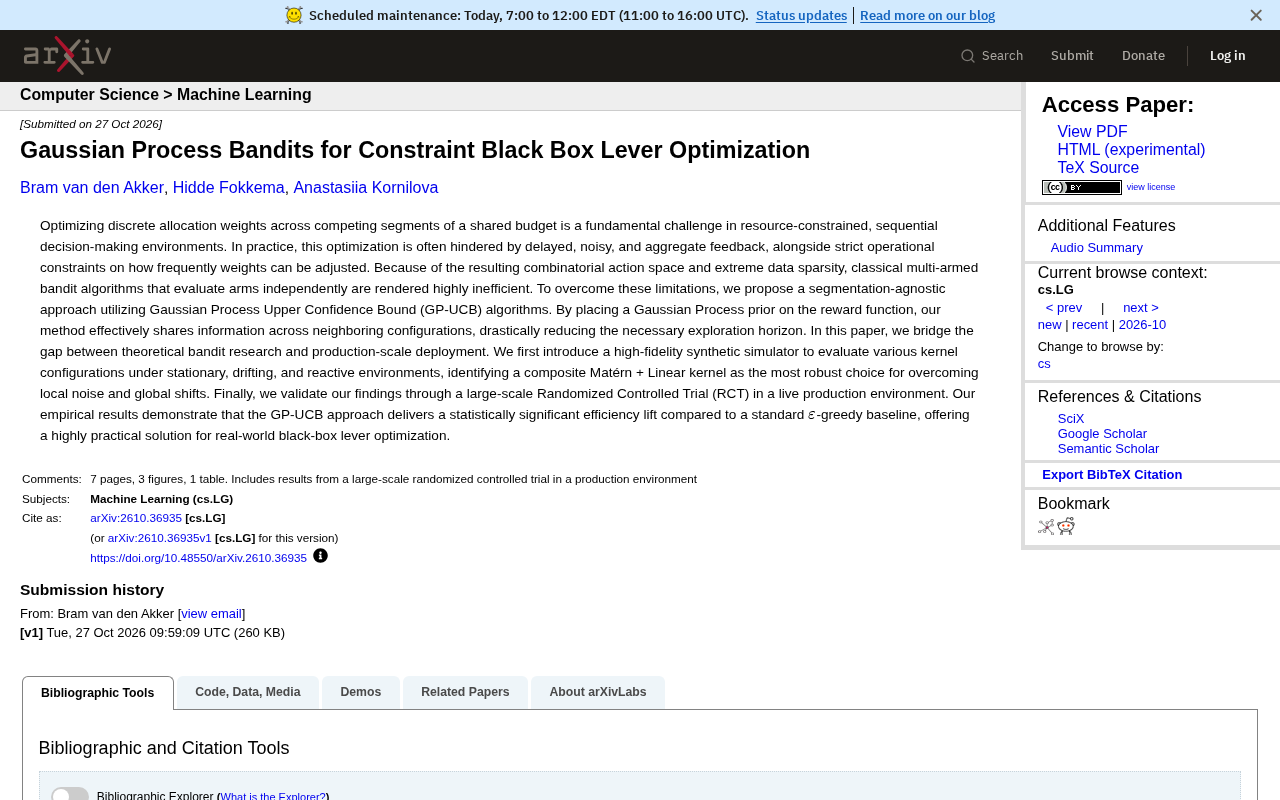
How to allocate discrete weights to competing market segments under a shared budget is a fundamental challenge in resource-constrained sequential decision-making environments. Real-world optimization is often hindered by delays, noise, and aggregated feedback, while the frequency of weight adjustments is subject to strict operational constraints. The resulting combinatorial action space and extreme data sparsity make classical multi-armed bandit algorithms that evaluate each arm independently inefficient. To overcome these limitations, researchers propose a segment-agnostic method leveraging the Gaussian Process Upper Confidence Bound (GP-UCB) algorithm. By placing a Gaussian process prior over the reward function, the method can effectively share information across adjacent configurations, thereby greatly reducing the required exploration cycles.
From Theory to Production: Bridging GP-UCB
The core contribution of this paper is bridging the gap between theoretical bandit research and production-scale deployment. The authors first introduce a high-fidelity synthetic simulator to evaluate various kernel configurations in static, drifting, and reactive environments, and identify the composite Matérn + Linear kernel as the most robust choice for overcoming local noise and global shifts. Finally, they validate the findings through a large-scale randomized controlled trial (RCT) in a real production environment. Empirical results show that compared with the standard ε-greedy baseline, the GP-UCB method achieves a statistically significant efficiency improvement, providing a highly practical solution for real-world black-box leverage optimization.
Problem Background: Why Classical Bandits Fall Short
In shared-budget allocation scenarios, decision-makers must distribute limited resources among multiple competing segments, with each segment receiving a discrete weight. Feedback signals are often delayed, noisy, and aggregated—you cannot immediately know the exact gain from a specific weight adjustment. Worse still, operations impose strict limits on the frequency of weight adjustments, preventing frequent trial and error.
Under this setting, the action space explodes combinatorially: assuming K segments and each segment's weight chosen from M discrete values, the total number of configurations is M^K. Classical multi-armed bandit algorithms (such as ε-greedy) treat each configuration as an independent arm and must explore them one by one, which is extremely inefficient under data sparsity. Because adjacent configurations are in fact similar, independent evaluation completely ignores such structural information.
The multi-armed bandit problem is a classic framework in sequential decision-making: at each round, the decision-maker pulls one of several "arms," receives a random reward, and aims to balance exploration (trying unknown arms to gain information) and exploitation (choosing the currently best-looking arm) to maximize cumulative reward. Classical algorithms such as ε-greedy explore randomly with probability ε and choose the currently estimated best arm with probability 1-ε; UCB (Upper Confidence Bound) selects arms based on an upper confidence bound and has a theoretically logarithmic regret bound. However, these algorithms typically assume that each arm's reward distribution is independent and that the action space is small. When the action space explodes combinatorially (e.g., M^K configurations) and feedback is sparse, evaluating each arm independently causes exploration cost to grow linearly with the number of actions and fails to exploit structural similarity among actions, leading to a sharp drop in efficiency.
How GP-UCB Shares Information
The core idea of GP-UCB is to model the reward function using a Gaussian process prior. A Gaussian process assumes that rewards of adjacent configurations are correlated, with this correlation defined by a kernel function. As a result, an observation of one configuration simultaneously updates beliefs about neighboring configurations, and information propagates smoothly across the configuration space. Compared with evaluating each arm independently, GP-UCB needs to explore far fewer configurations to find a near-optimal solution.
The paper particularly emphasizes the choice of kernel function. They build a high-fidelity synthetic simulator and test different kernel configurations in three environments: static (reward distribution does not change over time), drifting (reward distribution changes slowly), and reactive (reward distribution responds to decisions). Results show that the composite Matérn + Linear kernel performs most robustly. The Matérn kernel excels at capturing local variations, while the Linear kernel models global trends; combining the two resists both local noise and global shifts.
Gaussian Process (GP) is a stochastic process defined over a continuous domain, where the function values at any finite set of points follow a joint Gaussian distribution. It is fully determined by a mean function and a kernel function (covariance function); the kernel encodes the correlation of function values between different input points—the closer the points, the more similar the function values. In Bayesian optimization, a GP is often used as a surrogate model for the objective function: given observed points, the posterior mean and variance at any unobserved point can be computed analytically, representing the prediction and uncertainty, respectively. GP-UCB incorporates this posterior uncertainty into decision-making, selecting the point with the largest "posterior mean + β × posterior standard deviation" as the next exploration target, where β controls the aggressiveness of exploration. This strategy theoretically guarantees sublinear regret and, through the kernel function, enables information propagation over continuous space, thereby avoiding independent exploration of each discrete configuration.
Matérn and Linear kernels are two commonly used kernel functions in Gaussian processes. The Matérn kernel controls the smoothness of sample paths via the parameter ν; a smaller ν allows the function to vary more rapidly and is better at capturing local fluctuations and noise, with common forms including ν=1/2 (exponential kernel), ν=3/2, and ν=5/2. The Linear kernel has the form k(x,x')=σ²·xᵀx', assuming the objective function is approximately linear and capable of modeling global trends and shifts. When the two are combined (typically by addition), the kernel possesses both local adaptivity and global trend capture: the Matérn component explains local nonlinear variations, while the Linear component absorbs overall drift, resulting in robustness across static, drifting, and reactive environments. Kernel selection and hyperparameter calibration are key steps in GP-UCB deployment, typically performed in a simulator by maximizing marginal likelihood or via cross-validation.
Production RCT Validation
After theoretical analysis and simulator experiments, the research team conducted a large-scale randomized controlled trial in a real production environment. They compared the GP-UCB method with the standard ε-greedy baseline, measuring efficiency improvement. Results show that GP-UCB is statistically significantly better than the baseline, validating the method's effectiveness in actual deployment. The significance of this result lies in that it not only proves GP-UCB's advantage in synthetic environments but also demonstrates its operability under real business constraints.
The paper does not disclose specific efficiency improvement figures but emphasizes the conclusion of "statistical significance." For practitioners, this means GP-UCB can serve as a reliable choice for black-box leverage optimization, especially in scenarios with delayed feedback, high noise, and constrained adjustments.
Implications for Practitioners
If you are dealing with similar resource allocation problems—such as advertising budget allocation, recommendation system traffic control, or any scenario requiring sequential decision-making in a discrete action space—GP-UCB offers a path worth considering. The key point is: do not treat each action independently; instead, exploit structural similarity among actions to accelerate learning. The choice of a composite kernel (Matérn + Linear) stands out for robustness and can serve as a default starting point. Of course, before deployment, calibration in a simulator for your specific environment is necessary, as kernel performance may vary with environmental characteristics.
Another implication of the paper is methodological: the complete validation chain from simulator to production RCT is a standard paradigm for industrial-grade bandit algorithm deployment. Rapidly iterating on kernel configurations in a high-fidelity simulation first, then confirming effectiveness with an RCT in production, this combination both controls risk and ensures the credibility of conclusions.
One-line Summary
GP-UCB leverages Gaussian processes to share information across adjacent configurations, significantly improving the efficiency of sequential decision-making for discrete weight allocation under a shared budget.
Paragraph Summary
This article explores the sequential decision-making problem of allocating discrete weights to competing market segments under a shared budget. Faced with combinatorial action spaces, delayed noisy feedback, and adjustment frequency constraints, classical multi-armed bandit algorithms are inefficient because they evaluate each arm independently. The authors propose using the Gaussian Process Upper Confidence Bound (GP-UCB) method, which shares information across adjacent configurations via a Gaussian process prior, greatly reducing exploration cycles. The study builds a high-fidelity synthetic simulator, tests kernel configurations in static, drifting, and reactive environments, and identifies the composite Matérn+Linear kernel as most robust. Finally, a large-scale production randomized controlled trial validates that GP-UCB achieves statistically significant efficiency gains over the ε-greedy baseline, demonstrating a complete validation chain from simulator to production RCT.
Related articles

GitHub Daily · October 30: Skills Ecosystem Explodes, Agents Start Provisioning Their Own Computers
GitHub Daily Oct 30: Skills ecosystem hits three layers (official, personal, vertical), agents get their own computers, and cross-session memory becomes essential.
AWS AgentCore Gateway: Connecting AI A…
AWS AgentCore Gateway: Connecting AI Agents to Enterprise Backends with MCP
How AWS AgentCore Gateway acts as a primary MCP server to aggregate REST APIs, Lambda, and existing MCP services? Analyzing its AST real-time mapping, zero cold start, semantic search for tool overload, session isolation, and key injection security design, plus the architectural approach to decoupling enterprise AI agents from backends.

One Link Gives Figma AI a New Skill: Hands-On with MCP Connectors
Paste one MCP server link and the AI Agent in Figma gains new tool capabilities. We break down the setup flow, 20+ one-click apps, read/write permissions and execution policies, and the public HTTPS requirement.