GBrain: A Universal Interface That Gives Every AI Shared Memory and Tools

GBrain bridges AI silos with a shared, readable Markdown memory layer reusable across any AI tool.
GBrain is an early-stage product that caught attention on ProductHunt by offering a unified shared memory and tool integration layer for AI tools like Claude, ChatGPT, and Cursor. Connect an account once (e.g., Gmail) and reuse it in any AI client without reconfiguring. Memory is stored as a human-readable, editable, portable Markdown folder — avoiding the opacity of black-box vector databases. It also supports self-hosted inference and team shared workspaces. With MCP-style interoperability standards on the rise, GBrain's direction is clear, though real-world sync accuracy and cross-tool compatibility still need validation.
In an era of increasingly fragmented AI tools, one pain point keeps coming up: every AI assistant lives in its own silo. Notes you write in Claude Code are invisible to ChatGPT; credentials you configure in Cursor have to be set up all over again in the next tool. GBrain — ranked #8 on ProductHunt — targets exactly this fractured experience, aiming to give all AI tools a unified memory layer and tool integration layer.
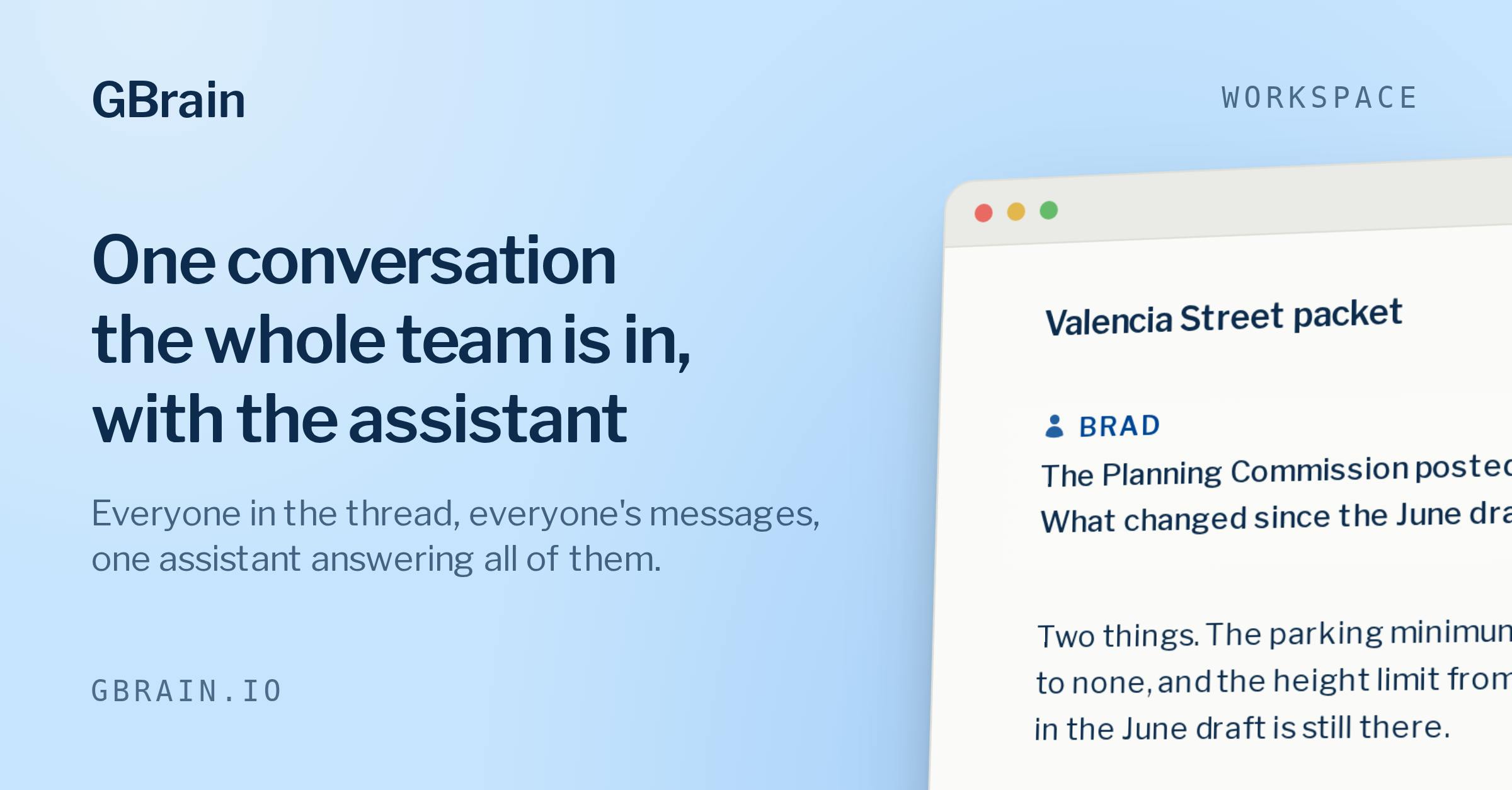
The Core Idea: Bridging AI Silos
GBrain's positioning is captured in its tagline: "Plug your own memory, tools, and skills into any AI." It gives users a single memory store that any AI can access, along with a set of already-connected accounts.
The most intuitive use case: write a note in Claude Code, and ChatGPT can immediately see it. Connect Gmail once, and Cursor can search your emails directly — no need to stuff another API key into a config file. This "connect once, use everywhere" design essentially abstracts the context and permissions scattered across individual AI clients into a shared middle layer.
For developers and knowledge workers who switch between multiple AI tools every day, this solves a very real problem of repetitive work — no more re-feeding background information or re-authorizing every time you pick up a new tool.
Memory Is a Markdown Folder You Can Actually Read
GBrain makes a noteworthy design choice: its memory is not a black-box vector database, but rather "a folder of Markdown files that you can read, correct, and take with you."
This decision carries several implications. First, memory content is human-readable — users can directly inspect what the AI has actually stored. Second, it's editable — if the AI got something wrong or stored outdated information, users can manually fix it. Third, data is portable — Markdown is an open format, so there's no platform lock-in.
At a time when data sovereignty and explainability are increasingly valued, using plain-text files to store AI memory is a pragmatic and transparent approach. It reduces user distrust of the "AI memory black box" and makes migration and backup straightforward. Compared to solutions that encode memory as invisible embeddings, GBrain puts control back in the user's hands.
Most existing AI memory solutions rely on vector databases: they encode a user's historical information as high-dimensional numerical vectors, then retrieve relevant memories by computing semantic similarity at query time. This approach offers high retrieval efficiency, but is completely opaque to users — you can't directly inspect what the system has remembered, can't precisely delete or modify a specific piece of information, and can't easily migrate data across platforms. GBrain's choice of plain Markdown files sacrifices some semantic retrieval precision in exchange for full auditability and portability. This trade-off is especially significant in enterprise compliance scenarios: IT administrators can review an AI's memory the same way they'd review ordinary documents, without having to trust a black-box embedding storage system.
Self-Hosted Inference and Team Shared Workspaces
GBrain offers deployment flexibility: users can either use its own inference service or run it on their own inference infrastructure ("Run it on your own inference or ours"). For teams with data compliance requirements or those looking to control costs, this is a meaningful plus — sensitive data can stay within your own infrastructure.
Another team-oriented feature is the shared workspace. An entire team can share a single workspace, meaning memory, connected accounts, and tools are all collaborative. This pushes GBrain from a personal productivity tool into a team collaboration scenario. The product currently offers $100 off the first month for team workspaces (via its ProductHunt exclusive link).
Positioning and Market Observations
GBrain is listed under the Productivity, Artificial Intelligence, and Business categories, and was built by a team that includes Jamie Mercurio. On ProductHunt it received 91 upvotes and ranked #8 for the day, with 3 comments — a product with modest traction but not yet a breakout hit.
From an industry perspective, the "AI memory and tool interoperability layer" that GBrain is targeting is a heating-up space. With the emergence of standards like MCP (Model Context Protocol), how to let different AI clients share context and tools is becoming a hot topic. GBrain's differentiation — readable Markdown memory + unified account connections + self-hosting option — is a clear and well-reasoned value proposition.
One caveat: this article is based on GBrain's ProductHunt product description. Actual memory sync accuracy, cross-tool compatibility range, and security all remain to be validated through real-world use. For heavy users of multiple AI tools, it's worth adding to your watchlist.
MCP (Model Context Protocol) is a protocol standard proposed and open-sourced by Anthropic in late 2024, with the goal of standardizing how AI models connect to external tools and data sources. Analogous to what USB did for hardware ecosystems, MCP attempts to provide a universal plug for the AI tool ecosystem — tool developers only need to implement an MCP server once to be callable by any MCP-compatible AI client (such as Claude, Cursor, etc.), without needing to adapt separately for each client. A growing number of AI clients have announced MCP support, which provides the technical foundation for "cross-AI middleware" products like GBrain: if all AI clients read from the same memory and tools via MCP, GBrain only needs to maintain a single MCP-compliant service to cover the entire compatible ecosystem.
Summary
What GBrain is trying to do is clear: prevent your memory, tools, and skills from being locked into a single AI, and instead turn them into universal capabilities that can plug into any AI. Using Markdown files to store memory ensures transparency and portability; connecting once and reusing everywhere reduces repetitive work; self-hosting and team workspaces expand the applicable use cases. For users who frequently switch between Claude, ChatGPT, and Cursor, this is a well-directed attempt worth watching.
Related articles

Say Goodbye to AI Influencer Faces: A Complete Guide to Creating Visual Assets for AI Comic Dramas from Scratch
Bilibili creator shares a full workflow for zero-basics AI comic drama visual assets: use Doubao Work skills with script-first, visual references, and real-person texture to escape AI influencer faces, then lock character and scene consistency with asset sheet layouts, weapon detail images, scene nine-grids, and cinematic color palettes.

The AI Production Pipeline Behind Great Videos: From Research to Agent Validation
AI video production isn't just a model race. This article breaks down a transferable four-step pipeline: researching professional workflows, organizing a skill checklist, configuring agents, and experimental validation—and explains how general-purpose LLMs like DeepSeek can replace paid tools to run the entire process.

Get Started with Hermes Agent in 20 Minutes: Build Your AI Assistant with Zero Code
Zero-code tutorial to get started with Hermes Agent in 20 minutes: deploy a VPS with Hostinger in one click, connect Nels Portal models, link Telegram for notifications, and set up scheduled monitoring tasks and cross-session memory preferences to build an always-on personal AI assistant.