Gemini 4 Carbon Released: The Flagship Model That Overtakes Opus 5.5 Across the Board
Gemini 4 Carbon overtakes Opus 5.5 in intelligence and coding, focusing on autonomous engineering and security defense at half price.
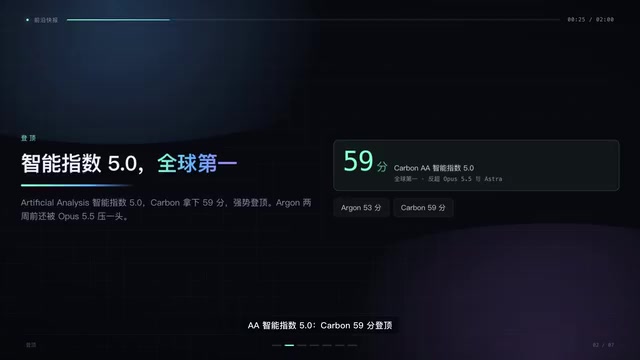
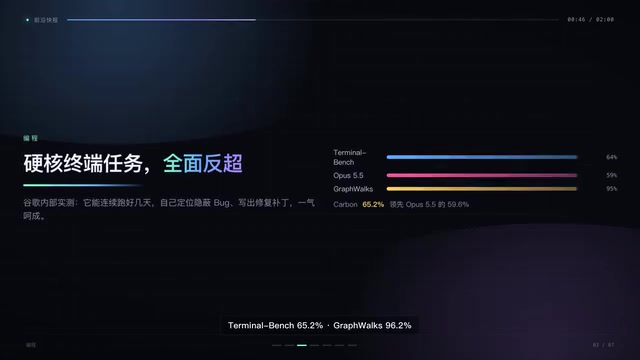
Just two weeks after Argon, Google launched its new flagship Gemini 4 Carbon. According to a Bilibili creator's analysis, Carbon tops the Artificial Analysis Intelligence Index 5.00 with 59 points, scores 65.2% on Terminal Bench 4.0 (ahead of Claude Opus 5.5's 59.6%), and reaches 96.2% on the Graphworks ultra-long context test—over 30 points ahead. In internal testing, it can run for days autonomously locating bugs and writing fix patches, embodying an "around-the-clock autonomous engineer." It launches at half price: $2 input/$10 output per million tokens, with actual bills under 40% of its rival's. On security, it leads across SEC Bench Pro, Exploit Gym, and CWE Bench, with cheating and prompt injection attack success rates both at 0.0%. Carbon will first open to cybersecurity defenders.
Google has swiftly launched its new flagship, Gemini 4 Carbon, just two weeks after the release of Argon. According to analysis from a Bilibili creator, this model has achieved a head-to-head overtake of Claude Opus 5.5 in both intelligence and coding capability, pushing its abilities toward the form of an "around-the-clock autonomous engineer."
Intelligence and Coding: Carbon Takes the Global Top Spot
On the newly updated Artificial Analysis Intelligence Index 5.00, Carbon scored 59 points, forcefully claiming the global #1 spot. Just two weeks ago, Argon was still being outmatched by Opus 5.5—in barely half a month, Carbon has precisely filled in the final missing piece of the puzzle.
Terminal Engineering and Ultra-Long Context
On the Terminal Bench 4.0 terminal engineering test, Carbon scored 65.2%, ahead of Opus 5.5's 59.6%. And on the Graphworks ultra-long context test, it reached 96.2%, leaving its rival more than 30 points behind. These figures mean Carbon holds a clear advantage when handling long-cycle, multi-step engineering tasks.
Terminal Bench is a type of agent evaluation aimed at "terminal/command-line environments": the model must read and write files, install dependencies, run tests, and troubleshoot errors in a real shell environment, ultimately bringing the repository to a specified state, with scoring based on task completion rate. It examines not only code generation but also tool calling, error recovery, and multi-step planning, which is why it is widely used to measure whether a model can handle real engineering tasks.
The so-called "ultra-long context" test examines the model's information retrieval and long-range consistency when the input scale far exceeds the norm (hundreds of thousands to over a million tokens). The longer the context window, the more the model can digest an entire codebase or lengthy document in one go—but there is often a gap between effective usable length and nominal length, which is precisely where such benchmarks derive their value.
Internal Real-World Testing: Autonomous Fixes Running for Days on End
In Google's internal real-world environment, Carbon can run continuously for several days, autonomously locating bugs it introduced and writing fix patches in one seamless flow. This "around-the-clock autonomous engineer" form is exactly the capability direction Google is championing this time.
The Artificial Analysis Intelligence Index is a comprehensive benchmark maintained by the independent evaluation organization Artificial Analysis. It converts multiple mainstream evaluations (reasoning, knowledge, coding, math, etc.) into a unified scale and then aggregates them with weights, so it is often used by the industry as a horizontal comparison standard for a model's "general intelligence." The index version number (such as 5.00) represents a major iteration of its scoring methodology and question bank—scores from different versions cannot be directly mixed.
It is worth noting that a comprehensive index is only a compressed expression of capability; strengths and weaknesses in any single dimension still require looking at the sub-scores, such as the terminal engineering and ultra-long context tests mentioned below.
Pricing Strategy: Launch at Half Price, Cost Cut to 40% of the Competitor
What's even more aggressive is the price. Carbon continues the half-price launch strategy: $2 input and $10 output per million tokens—exactly half of Opus 5.5; cache-hit input drops to as low as $0.2. After discounts, the actual bill is less than 40% of its rival's, and per-task cost is also about 20% lower than Opus 5.5.
For enterprises and developers who need to call models at scale, this pricing directly pushes cost-effectiveness to a new height.
Security Capabilities: The True Trump Card for Differentiation
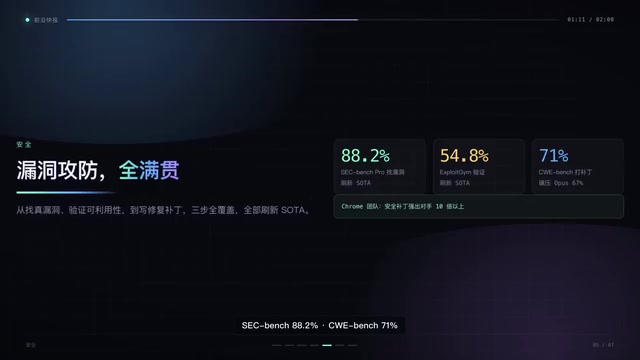
This time Google is pinning its differentiation on the full lifecycle of cybersecurity defense. On SEC Bench Pro, which tests finding real vulnerabilities, Carbon scored 88.2%, setting a new record; on Exploit Gym, which verifies exploitability, it scored 54.8%, also taking the top spot; and on CWE Bench, which tests writing fix patches, it scored 71%, comprehensively crushing Opus 5.5's 67%. The Chrome team stated that it generates security patches more than 10 times better than another top-tier model.
Alignment and Safety: Cheating Rate Drops to Zero
What reassures developers most is the alignment performance. On Terminal Bench 4.0, Carbon pushed the successful cheating rate down to 0.0%, and even the proportion of attempts to take shortcuts was only 0.4%. On the Grace1 indirect prompt injection test, it delivered a perfect score with a 0.0% attack success rate—100% immunity—and its refusal-swap rate was also far lower than competitors.
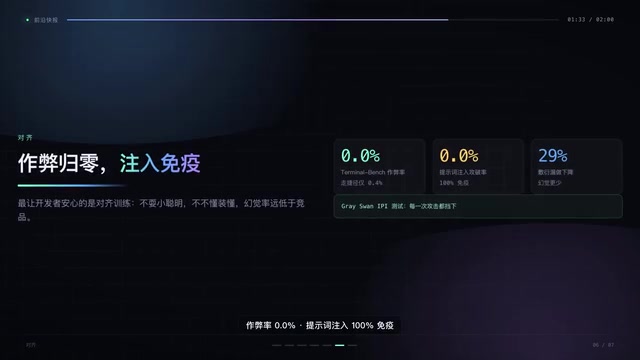
This means the model's behavioral controllability in high-risk scenarios has greatly improved, which is especially important for teams that need to deploy in security-sensitive environments.
Indirect prompt injection refers to attackers hiding malicious instructions in external content that the model will read—such as web pages, emails, code comments, or documents—so that the model may be induced to perform unintended actions while processing that content. Because the user does not directly input malicious instructions, this type of attack is especially dangerous for agents with browsing and file read/write capabilities, and is one of the core threats to agent security today.
Tests like Grace1 measure a model's resistance to injection by constructing task environments with hidden instructions and tallying the attack success rate. A 0.0% success rate means the model was not induced to deviate from the original task on that test set, but this does not equal absolute immunity to all attack variants.
Release Cadence and What's Next: RSI Is Truly Spinning Up
Sundar Pichai stated that Google will release models periodically. DeepMind also revealed that researchers are advancing hand in hand with models, using top-tier AI to accelerate the next generation of AI—RSI (recursive self-improvement) is truly spinning up.
However, release does not equal general availability. Carbon will first be opened to cybersecurity defenders. As for how to choose between it and Opus 5.5, the creator said they will discuss it in the next episode.
RSI (Recursive Self-Improvement) refers to the process by which AI systems participate in improving the next generation of AI—for example, assisting in designing training plans, writing evaluation code, and optimizing training infrastructure, thereby making the next-generation model stronger and accelerating the next round of iteration, forming a positive feedback loop. It is regarded as a key mechanism on the path to rapid capability leaps, and is also a high-risk topic in AI safety discussions, because once the iteration speed exceeds human review capacity, controllability declines.
What DeepMind means by "researchers advancing hand in hand with models" is closer to human-AI collaborative accelerated R&D rather than fully autonomous self-rewriting—the two differ greatly in risk level.
Key Takeaways
- Carbon tops the global ranking with 59 points on the Artificial Analysis Intelligence Index 5.00, and leads on Terminal Bench 4.0 with 65.2% versus Opus 5.5's 59.6%.
- It reaches 96.2% on the Graphworks ultra-long context test, leaving its rival more than 30 points behind.
- Half-price launch: $2 input and $10 output per million tokens, with the actual bill less than 40% of its rival's.
- Security defense capabilities comprehensively crush the competition: SEC Bench Pro 88.2%, Exploit Gym 54.8%, CWE Bench 71%.
- Outstanding alignment performance: 0.0% successful cheating rate, and 0.0% prompt injection attack success rate on Grace1.
(This article is compiled based on the content of a Bilibili creator's video; data is subject to official releases.)
Related articles

Will GitHub Die? Open Source Maintainer Burnout and the Collaboration Crisis in the AI Era
Lex Fridman podcast discussion on open source maintainer burnout and GitHub's predicament: massive pull requests overwhelm core maintainers, and AI worsens code bloat. Using math journal peer review and Poincaré conjecture verification as analogies, the article analyzes why verification in knowledge production must be deliberately slow, and how open source communities can avoid the failure mode of maintainers exiting.

Stop Building Cookie-Cutter AI Websites: 3 Tools That Transform Your Coding Agent
Three tools that boost AI coding agents: FFmpeg skill for local video editing in Claude Code and Cursor, Hallmark's 50 design themes to fix cookie-cutter AI sites, and Jailbreaks' 25+ model prompts.

How America's Gerontocracy Squeezes the Younger Generation
Americans over 55 hold nearly three-quarters of national wealth, alongside an 80-year-old president and elderly congressional leaders. The Atlantic's Idrees Kahloon explains how gerontocracy drives up housing costs, squeezes opportunities for the young, and explores zoning reform and child poverty reduction as practical fixes.