Google Custom Search API Deprecation: Migration Guide for LangChain's Search Wrapper

Google's Custom Search API retirement will break LangChain's search wrapper — here's how to migrate.
Google plans to shut down the Custom Search JSON API on January 1, 2027, and has already stopped new registrations — directly breaking LangChain's widely used `GoogleSearchAPIWrapper`. The article presents a zero-intrusion workaround: replace the wrapper's internal `search_engine` client to point to any compatible third-party endpoint, with no changes needed to agent logic. A community PR has also been submitted to add native endpoint configuration to the wrapper. Long-term, migrating to Tavily or Brave Search is the healthier path, though it requires adapting to different return formats. The article recommends building a search abstraction layer to decouple backend implementations from agent logic for future-proofing.
Background: Google Custom Search JSON API Is Being Retired
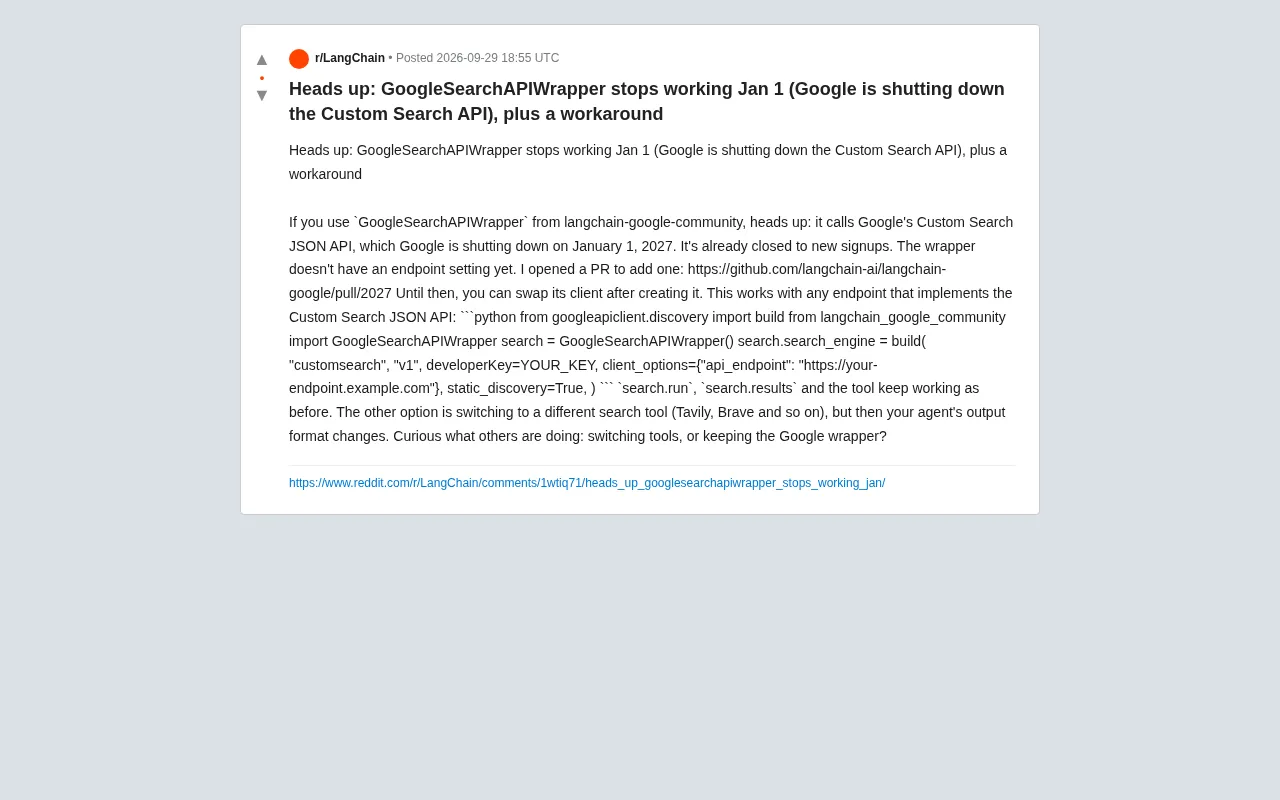
If your AI application or agent project relies on GoogleSearchAPIWrapper from langchain-google-community, this news deserves your attention. As flagged by a developer on Reddit, this wrapper calls Google's Custom Search JSON API under the hood — and Google has announced plans to shut down the interface on January 1, 2027. The service has already been closed to new registrations.
For developers who have embedded Google Search as a retrieval tool in their LLM agents, this means that once the API is retired, commonly used methods like search.run and search.results will simply stop working. Since GoogleSearchAPIWrapper currently offers no built-in configuration option to point to a custom endpoint, you can't just flip a parameter to redirect to an alternative service — which makes migration all the more urgent.
The Google Custom Search JSON API is a programmatic interface that lets developers call Google Search from their own applications, returning structured JSON results (including titles, links, snippets, and more). It succeeded Google Site Search (shut down in 2016) and currently requires developers to create a "Programmable Search Engine" and obtain an API key. The free tier is capped at 100 queries per day. Because it's the closest legitimate programmatic interface to actual Google Search results available today, a wide range of AI toolchains — including mainstream frameworks like LangChain and LlamaIndex — rely on it as their default Google Search backend. Its retirement will have cascading effects across the open-source AI ecosystem.
Temporary Fix: Swap Out the Underlying Search Client
While official support catches up, the Reddit poster shared a practical stopgap: after creating a GoogleSearchAPIWrapper instance, directly replace its internal search_engine client. This approach works with any third-party endpoint that implements the Custom Search JSON API spec.
Here's the code:
from googleapiclient.discovery import build
from langchain_google_community import GoogleSearchAPIWrapper

search = GoogleSearchAPIWrapper()
search.search_engine = build(
    "customsearch",
    "v1",
    developerKey=YOUR_KEY,
    client_options={"api_endpoint": "https://your-endpoint.example.com"},
    static_discovery=True,
)
The biggest advantage of this approach is interface compatibility: once the client is swapped, search.run, search.results, and any tools built on top of them continue to work exactly as before — no changes needed to your upper-level agent logic. For production projects that make heavy use of this wrapper, this is essentially a zero-intrusion patch.
The poster has also submitted a PR (#2027) to the langchain-google repository to natively add endpoint configuration support to the wrapper. If merged, developers will be able to specify an alternative endpoint via a standard parameter rather than manually replacing internal objects.
Long-Term Options: Weighing a Switch to Other Search Tools
Beyond keeping the Google wrapper alive, another path is migrating entirely to a different search tool — such as Tavily or Brave Search. These tools are designed natively for LLM retrieval use cases, have active community support, and offer better long-term maintainability.
That said, this path isn't cost-free. The poster specifically notes that switching search tools causes changes in the agent's output format. Different search APIs return different result structures, field names, and snippet lengths — which may require reworking your prompt templates, result parsing logic, and how downstream components process retrieved content. For agents that have been carefully tuned around Google's result format, the hidden cost of this migration is not trivial.
Ultimately, the two approaches represent a genuine trade-off:
- Keep the Google wrapper + swap the client: Minimal code changes, consistent interface, but you're dependent on the stability and compliance of a third-party compatible endpoint.
- Migrate to Tavily/Brave Search or similar: Healthier long-term, but requires absorbing the refactoring work that comes with output format differences.
Tavily is a search API purpose-built for LLM and AI agent workflows. Its results are specially optimized: built-in summarization, relevance-ranked outputs, and structured snippets ready for RAG pipelines — reducing the parsing work developers need to do themselves. Brave Search, by contrast, is built on an independent crawler, offering results that don't rely on Google or Bing, with a stricter stance on privacy. Its API is natively integrated into frameworks like LangChain. Both offer free tiers suitable for personal projects and production environments, and both have corresponding Wrapper implementations in LangChain. The primary migration cost lies in adapting to each tool's different return field structures.
Practical Recommendations for Developers
When facing a deprecation like this, the safest move is to assess early how deeply your project depends on Google Custom Search. If usage is lightweight, migrating directly to Tavily or Brave Search might be the cleanest once-and-done solution. If your agent logic is tightly coupled to Google's return format, the client-swap workaround can buy you time while you monitor progress on the official PR.
One important caution: if you adopt a third-party compatible endpoint, verify its data sources, terms of service, and reliability. Don't bet your production system on an uncontrolled intermediary service. For business-critical applications, the more fundamental strategy is to build an abstraction layer over your search implementation — decoupling the specific search backend from your agent logic — so you're prepared for any API retirement down the road.
The Google Custom Search API deprecation is yet another reminder: AI applications built on top of external cloud services should always have an exit plan for when the underlying interface changes.
Related articles

Will GitHub Die? Open Source Maintainer Burnout and the Collaboration Crisis in the AI Era
Lex Fridman podcast discussion on open source maintainer burnout and GitHub's predicament: massive pull requests overwhelm core maintainers, and AI worsens code bloat. Using math journal peer review and Poincaré conjecture verification as analogies, the article analyzes why verification in knowledge production must be deliberately slow, and how open source communities can avoid the failure mode of maintainers exiting.

Stop Building Cookie-Cutter AI Websites: 3 Tools That Transform Your Coding Agent
Three tools that boost AI coding agents: FFmpeg skill for local video editing in Claude Code and Cursor, Hallmark's 50 design themes to fix cookie-cutter AI sites, and Jailbreaks' 25+ model prompts.

How America's Gerontocracy Squeezes the Younger Generation
Americans over 55 hold nearly three-quarters of national wealth, alongside an 80-year-old president and elderly congressional leaders. The Atlantic's Idrees Kahloon explains how gerontocracy drives up housing costs, squeezes opportunities for the young, and explores zoning reform and child poverty reduction as practical fixes.