Google Launches New Gemini Enterprise Agent: One Prompt Box to Handle Everything

Google's new Gemini enterprise agent unifies all workplace AI tasks—Q&A, code, images—in a single prompt box with persistent memory.
Google officially launched the Gemini enterprise agent to over 700 enterprise customers at NASA Hangar One, positioning it as a "unified work agent" rather than another chatbot. Its core value lies in consolidating Q&A, knowledge work, image generation, and code execution into a single prompt box, replacing the fragmented AI tool-switching that plagues enterprise users. Among its six architectural principles, persistent execution and consistent memory ensure seamless cross-device continuity, multi-agent orchestration enables AI to take on specific roles as a "colleague," and model choice flexibility uses dynamic routing to balance quality and cost. Google's move aims to upgrade Gemini from a consumer conversational product into a full enterprise productivity platform, competing head-on with Microsoft Copilot and OpenAI's enterprise offerings.
One Universal Agent, Reimagining How Enterprises Work
At the historic NASA Hangar One, during Google Cloud's "Gemini at Work" event for over 700 customers, Google officially unveiled its new Gemini enterprise agent. This isn't just another chatbot — it's Google's redefinition of the "workplace AI assistant": a single, universal work agent that understands your full business context, capable of answering questions, handling knowledge work, generating images and media, and even writing and executing code — all from the same prompt box.
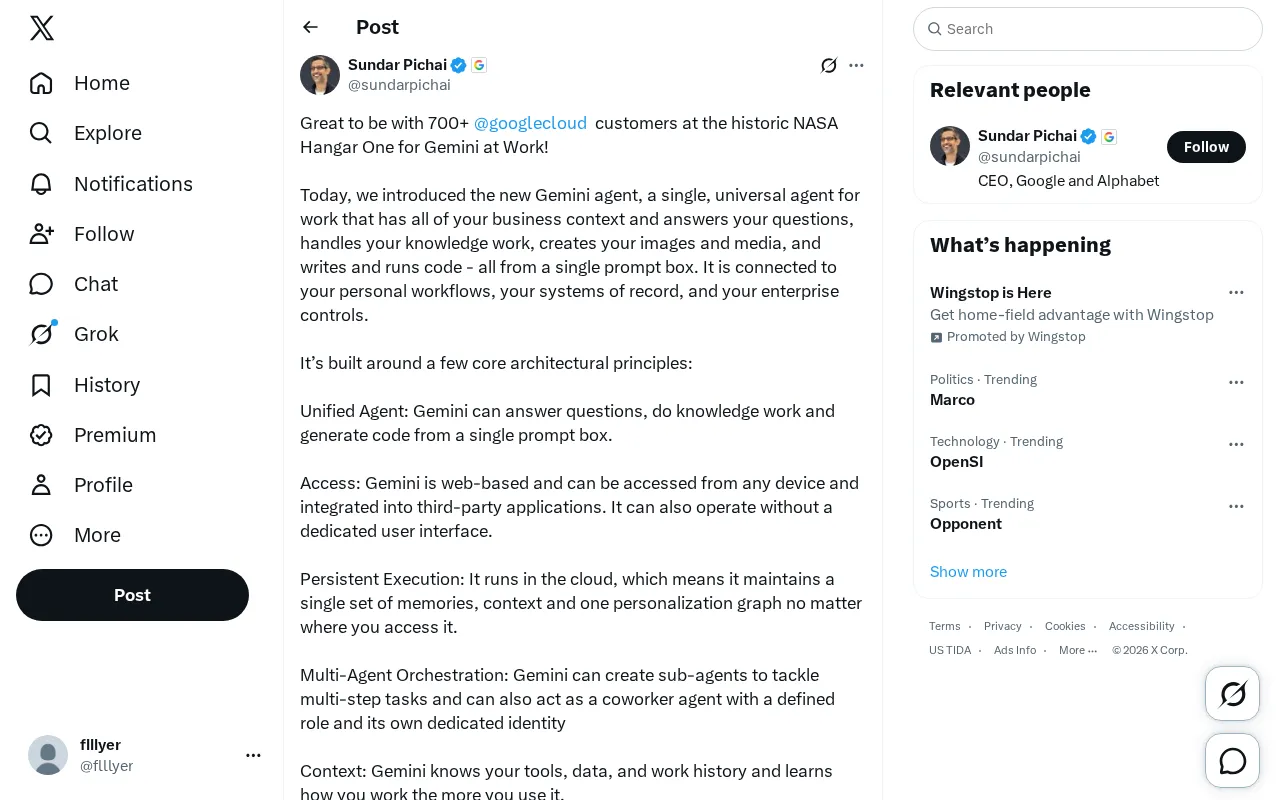
The key word here is "unified." Enterprise users have long faced a fragmented landscape of AI tools: one product for Q&A, another for writing code, yet another platform for image generation. The core value Google is emphasizing this time is consolidating these capabilities into a single entry point — bridging personal workflows, enterprise systems of record, and enterprise-grade governance controls.
Six Architectural Principles: From Tool to "Colleague"
Google has established several core architectural principles for the Gemini agent that together define how it differs from traditional AI assistants.
Unified and Ubiquitous Access
Unified Agent means that Q&A, knowledge work, and code generation all happen within the same prompt box — users no longer need to switch between different tools for different tasks. On the access side, Gemini is web-based, accessible from any device, integrable into third-party applications, and capable of running without a dedicated user interface. This design lets AI capabilities embed naturally into existing work environments rather than becoming yet another app that needs to be opened separately.
Persistent Execution and Memory Consistency
Persistent Execution is an easily overlooked but critically important feature. Gemini runs in the cloud, meaning it maintains the same memory, context, and unique personalization graph regardless of where you access it. In other words, a task you start on your phone can be seamlessly continued on your computer — the AI's understanding of you doesn't reset when you switch devices or entry points.
Multi-Agent Orchestration
Multi-Agent Orchestration reveals Google's approach to handling complex tasks. Gemini can create sub-agents to handle multi-step tasks, and can also operate as a "colleague agent" with a defined role and dedicated identity. This opens up significant possibilities: AI is no longer just a passive tool responding to commands, but a collaborator that can take on specific responsibilities within a team.
The concept of multi-agent orchestration stems from the "Orchestrator-Subagent" pattern in AI system design: a primary agent is responsible for task decomposition and scheduling, distributing subtasks to specialized sub-agents for separate execution, then consolidating the results. The advantages of this architecture lie in parallel processing of complex workflows, isolated failure boundaries, and allowing each sub-agent to focus on what it does best (such as code execution, data retrieval, or document drafting). Compared to a single large model handling every step, an orchestration architecture typically delivers higher reliability and debuggability for long-horizon tasks. Google has previously laid infrastructure groundwork in Agent Space and Vertex AI platforms; moving orchestration capabilities to the front of the Gemini product layer for enterprise users signals that this technical approach is transitioning from research into large-scale deployment.
Contextual Understanding and Model Flexibility
What truly wins over enterprise users is often the depth of an AI's understanding of their business context. Google emphasizes that Gemini knows your tools, data, and work history, and the more you use it, the better it understands how you work. This kind of personalization through continuous learning is the essential path for enterprise AI to evolve from "general capability" to "dedicated assistant."
Another notable design choice is Model Choice Flexibility. Gemini orchestrates across multiple models to deliver the best quality while reducing cost. This reflects a pragmatic judgment: not every task requires the most powerful (and most expensive) model — intelligent model scheduling is itself a means of improving efficiency and reducing costs. For enterprises deploying AI at scale, the balance between cost control and quality assurance is critical.
Model choice flexibility involves a technical mechanism the industry calls "Model Routing": the system dynamically decides which model to invoke based on task complexity, latency requirements, and cost budgets. For example, simple information retrieval might route to a lightweight smaller model, while code generation requiring deep reasoning would call a more powerful flagship model. This aligns with the "small model + tool calling" combination strategy that has emerged in the large language model space in recent years. For enterprises, the practical value of this mechanism lies in token cost control — API call costs for flagship models are typically 10x or more those of smaller models, and smart routing can compress overall enterprise AI usage costs several-fold without significantly sacrificing output quality.
Enterprise AI Competition Enters a New Phase
This launch makes clear that Google is shifting the Gemini narrative fully from "consumer-grade conversational model" to "enterprise productivity platform." The combination of connecting personal workflows, systems of record, and enterprise governance controls squarely targets the workplace AI market being contested by OpenAI, Microsoft Copilot, and other competitors.
Choosing to hold the event at NASA Hangar One — a venue that symbolizes exploration and engineering ambition — alongside the attendance of over 700 Google Cloud customers, signals Google's intent to position this product as the new benchmark for enterprise AI. As AI evolves from "can chat" to "can work, has memory, can collaborate, understands the business," enterprise procurement decision-making will shift accordingly — it's no longer about trying something new, but about choosing the infrastructure that defines how work gets done.
Google has published more technical details on its official blog. As these universal work agents become reality, "getting everything done from a single prompt box" may be gradually shifting from a marketing slogan into an actual reality.
Related articles

Will GitHub Die? Open Source Maintainer Burnout and the Collaboration Crisis in the AI Era
Lex Fridman podcast discussion on open source maintainer burnout and GitHub's predicament: massive pull requests overwhelm core maintainers, and AI worsens code bloat. Using math journal peer review and Poincaré conjecture verification as analogies, the article analyzes why verification in knowledge production must be deliberately slow, and how open source communities can avoid the failure mode of maintainers exiting.

Stop Building Cookie-Cutter AI Websites: 3 Tools That Transform Your Coding Agent
Three tools that boost AI coding agents: FFmpeg skill for local video editing in Claude Code and Cursor, Hallmark's 50 design themes to fix cookie-cutter AI sites, and Jailbreaks' 25+ model prompts.

How America's Gerontocracy Squeezes the Younger Generation
Americans over 55 hold nearly three-quarters of national wealth, alongside an 80-year-old president and elderly congressional leaders. The Atlantic's Idrees Kahloon explains how gerontocracy drives up housing costs, squeezes opportunities for the young, and explores zoning reform and child poverty reduction as practical fixes.