Governing MCP Servers at Scale: How Postman Fabric Gateway Solves the Control Problem

Postman Fabric Gateway uses a unified gateway and progressive tool disclosure to govern AI agents at MCP scale.
When an AI agent connects to 20 MCP servers and invokes 600 tools, tool discovery, access control, and observability all break down simultaneously. Postman's Fabric Gateway addresses this with two mechanisms: an Agent Gateway that consolidates identity resolution, policy enforcement, request routing, and telemetry into a single point; and Progressive Tool Disclosure, which exposes only three meta-tools — search, get, and execute — so models load schemas on demand rather than flooding the context window. The backend remains unchanged, but the agent's view is deliberately narrowed, giving teams back control over how tools are discovered and used.
When an AI agent needs to connect to 20 MCP servers and invoke 600 tools, developers are no longer dealing with an integration problem — they're dealing with a control problem. This governance challenge at scale is precisely the core pain point that Postman's Fabric Gateway is designed to address.
From One MCP Server to Twenty: A Qualitative Shift in Complexity
The single MCP (Model Context Protocol) server scenario is straightforward: the agent connects, authenticates, sees a small set of tools, and makes calls. The entire path from request to response is clear and traceable, making troubleshooting painless.
But when you scale up to 20 MCP servers with 30 tools each, things deteriorate quickly. Every connection means a new set of credentials, a new policy surface, a new log stream, and more tool schemas for the model to factor in.
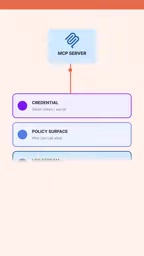
This proliferation makes three things simultaneously difficult: finding the right tool, determining whether the agent is permitted to use it, and reconstructing the full sequence of events after a call is made. Tool discovery, access control, and observability all break down at once.
MCP (Model Context Protocol) is an open protocol standard proposed by Anthropic in late 2024, designed to establish a unified interface for interactions between AI agents and external tools and data sources. Its design logic is analogous to USB-C: regardless of whether the underlying service is a database, a code execution environment, or a third-party API, the agent discovers and invokes tools through the same protocol without needing to build a custom adapter for each integration. An MCP server is essentially a lightweight tool-hosting process responsible for declaring the schemas of available tools (including names, parameter types, and descriptions) and executing the corresponding logic when an agent makes a call. The MCP client is typically embedded in an AI agent or reasoning framework, and handles schema parsing, call request generation, and response processing. The widespread adoption of this protocol is the technical backdrop that has made large-scale tool integration a real-world governance problem — as more and more services expose their capabilities as MCP servers, the governance burden on the agent side grows linearly.
Agent Gateway: A Unified Governance Entry Point
The solution is to insert an Agent Gateway between the MCP client and the servers. Instead of connecting directly to a scattered collection of servers, the client connects to a single governance point.
This gateway takes on four responsibilities: identifying the caller, enforcing policies, routing requests, and capturing telemetry — all in one place. Security enforcement and logging are consolidated rather than spread across 20 separate connections.
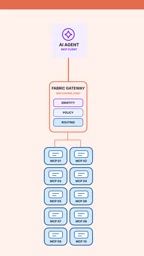
This means security teams only need to maintain a single enforcement point, and every request has a fully traceable path. What was once a fragmented governance surface gets compressed into a single manageable layer.
Progressive Tool Disclosure: Solving the Context Competition Among 600 Schemas
A single connection alone doesn't solve the problem of 600 tool definitions simultaneously competing for space in the model's context window. Exposing all schemas to the agent at once actually causes the model to drown in choices.
Fabric Gateway's approach is Progressive Tool Disclosure. The client starts with a minimal interface containing just three tools:
- search: lets the agent find relevant tools on the server via semantic search;
- get: returns the schema for the tool the agent selected;
- execute: triggers the actual call.
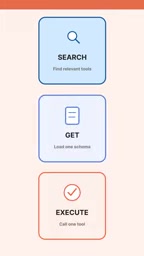
The agent uses search to semantically locate the tools it needs, get to retrieve their detailed definitions, and execute to invoke them. The gateway handles mapping that call to the correct MCP server.
The Same Backend, a Narrower View
The key insight is that the backend is still the same 20 servers and the same 600 tools — but the agent only sees what it actually needs at any given moment.
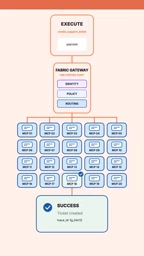
This design delivers three benefits: the model's context is no longer crowded out by a flood of schemas, security has a single enforcement point, and every request has a traceable path.
The context window is the maximum number of tokens a large language model can process in a single inference pass — one of the most critical scarce resources in current AI agent architectures. Tool schema definitions — including tool names, functional descriptions, parameter names, and type annotations — all consume this limited space. For models like GPT-4o or Claude 3.5 Sonnet, a detailed tool schema typically consumes 200 to 500 tokens. A complete schema set for 600 tools could reach 100,000 to 300,000 tokens, which not only approaches or exceeds the context limits of mainstream models but also significantly degrades tool selection accuracy — the presence of large numbers of irrelevant tools causes attention dilution, making the model more likely to select the wrong tool or produce hallucinated calls. Progressive disclosure is fundamentally an on-demand loading strategy, analogous to lazy loading in frontend development: specific schemas are only injected into the context when the model actually needs them, distributing the cognitive cost of tool selection across multiple interaction turns rather than piling everything up at the start of a conversation.
Control, Not More Tools
It's worth being clear about what Agent Gateway actually provides: it doesn't give agents more tools — it gives teams control over those tools, including how they're discovered and how they're used.
As the tool ecosystem that AI agents connect to continues to expand, the three core challenges of tool discovery, access control, and observability will only become more acute. For teams building multi-MCP-server architectures, a unified governance gateway layer may be transitioning from a "nice to have" to a "must have." Postman has integrated these capabilities into Fabric Gateway, aiming to close the governance gap as AI agents scale up.
Related articles

Will GitHub Die? Open Source Maintainer Burnout and the Collaboration Crisis in the AI Era
Lex Fridman podcast discussion on open source maintainer burnout and GitHub's predicament: massive pull requests overwhelm core maintainers, and AI worsens code bloat. Using math journal peer review and Poincaré conjecture verification as analogies, the article analyzes why verification in knowledge production must be deliberately slow, and how open source communities can avoid the failure mode of maintainers exiting.

Stop Building Cookie-Cutter AI Websites: 3 Tools That Transform Your Coding Agent
Three tools that boost AI coding agents: FFmpeg skill for local video editing in Claude Code and Cursor, Hallmark's 50 design themes to fix cookie-cutter AI sites, and Jailbreaks' 25+ model prompts.

How America's Gerontocracy Squeezes the Younger Generation
Americans over 55 hold nearly three-quarters of national wealth, alongside an 80-year-old president and elderly congressional leaders. The Atlantic's Idrees Kahloon explains how gerontocracy drives up housing costs, squeezes opportunities for the young, and explores zoning reform and child poverty reduction as practical fixes.