GPT-6.1 Terra Hands-On Test: Builds a 3D House in 56 Seconds, 5x Faster Than Soul and Cheaper

Hands-on test of GPT-6.1 Terra: 5x faster, 15x cheaper, medium level is enough, highest level isn't necessarily economical.
The article documents a Bilibili creator's hands-on test of OpenAI's GPT-6.1 Terra in Codex. Converting the same hand-drawn floor plan into a 3D model, medium-level Terra submitted in 56 seconds—about 5x faster than Soul and 6x+ faster than Astra—at only ~6 cents, one-fifteenth of Astra's cost, with output quality of 70–80 points, clearly better than the failed previous generation. At the highest level, Terra could approach or surpass Astra but took 8m23s and cost 35 cents because it read 1.7M tokens. All four models saw through eight trap questions, with Terra fastest. The article explains that computer-operation tasks have many steps with repeated screen reading, making fast and cheap more critical than tiny intelligence gaps, and advises using medium Terra daily and Soul/Astra for fine work.
After OpenAI released its new-generation model GPT-6.1 Terra, the company claimed it is three times faster than its own GPT-6.1 Soul and GPT-6 Astra, yet costs only half as much as Soul. A Bilibili creator handed the same hand-drawn floor plan of an old Sydney house to Terra, Soul, Astra, and the previous-generation GPT-5.6 Terra simultaneously, running a hands-on test in Codex. The results were somewhat surprising: Terra finished first in 56 seconds, produced a presentable 3D model, and cost only one-fifteenth of Astra.
How to Choose Among the Four Tiers? Terra Is Positioned as "Fast and Cheap"
OpenAI now splits its models into four tiers: the lightest Luna handles simple everyday tasks, Terra is the mid-tier workhorse, Soul is the flagship, and Astra is the most powerful tier. Terra's positioning is clear—it doesn't aim to be the smartest, but to be fast and cheap. It is primarily promoted for computer-operation scenarios, i.e., letting the AI watch the screen itself, click the mouse, type, and move between different software applications.
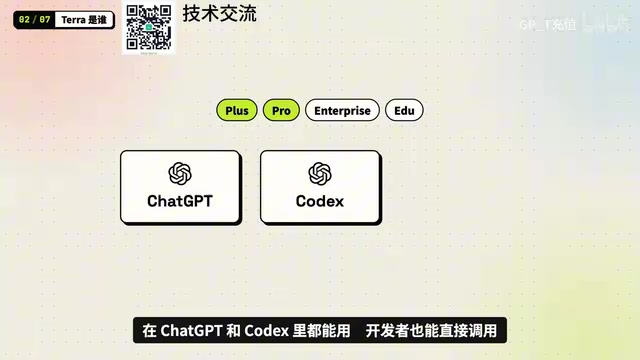
Pricing is per token: Terra costs $1 per million input tokens and $5 for output; Soul is $2 and $10; Astra is $10 and $50. The most expensive tier's unit price is a full 10 times higher. Paying users of ChatGPT Plus, Pro, and other plans can use it directly in ChatGPT and Codex, and developers can also call it via API.
Reasoning Effort is an adjustable parameter introduced by OpenAI in the o-series and subsequent models, typically divided into levels such as low / medium / high. It controls how deeply the model "thinks" internally before giving an answer: the higher the level, the longer the chain-of-thought the model generates, the more likely it is to try multiple approaches and self-check, but the time and token consumption also multiply. The same model at different levels can differ severalfold in capability ceiling and cost, so "model version" and "reasoning effort" are two independent dimensions. In the article, the new models in Codex default to the lowest level, and the creator uniformly raised them to medium precisely to compare the four models under the same "thinking budget."
Official Scorecard: Three Times Faster, Error Rate Drops Sharply
OpenAI provided an internal evaluation scorecard. In a professional task exam called Agent's Last Exam, Terra at medium reasoning effort scored 15 percentage points higher than the previous generation, at one-third the cost, performing close to the strongest Astra while costing only one-tenth of Astra per token. OpenAI also called out comparisons with competitors: at the highest level, the cost per task is about 9 times lower than Claude Ocus 5.5.
In terms of speed, Terra is more than three times faster than both Soul and Astra. The factual error rate at low reasoning effort dropped from 53.6% to 16.7%. In command-line coding tests, the highest level rose from 21.5% in the previous generation to 50.3%. However, OpenAI itself admits that the hardest coding tasks are still safer to hand to Soul or Astra.
These numbers come from OpenAI setting its own questions and grading its own answers, so the creator decided to verify hands-on.
Agent's Last Exam is a type of Agent benchmark that emerged after "Humanity's Last Exam." It tests not single-turn Q&A but the model's ability to autonomously invoke tools, perform multi-step reasoning, and deliver results within professional workflows. Questions are usually designed by domain experts and cover scenarios such as coding, scientific research, and financial analysis. Compared with earlier static Q&A benchmarks, it is closer to the evaluation goal of "letting AI actually do work." Note that such benchmarks are mostly built or contributed to by model vendors, and question distribution and scoring criteria may not be neutral, so the percentage improvements announced by vendors are better suited for observing trends horizontally rather than as absolute capability scales—this is also why the creator in the article insisted on doing a hands-on test.
Test Rules: Same Image, Same Prompt, Uniform Medium Reasoning
The test was conducted in Codex, with the same hand-drawn floor plan and the same instruction—"make it into a 3D model that can be rotated and viewed in a browser." All four models were set to medium reasoning, because the three new models in Codex default to the lowest level, and the creator uniformly raised them by one notch. Each model read the image, wrote code, and checked its own work, finally delivering a web page.
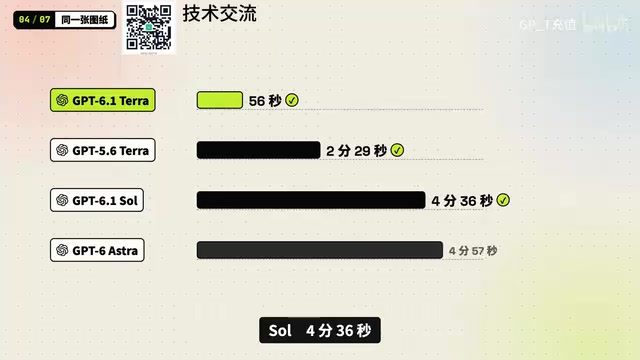
Results: Terra finished first in 56 seconds, the previous-generation GPT-5.6 Terra took 2 minutes 29 seconds, Soul 4 minutes 36 seconds, and Astra was the slowest at 5 minutes 45 seconds. Soul took about 5 times as long as Terra, and Astra more than 6 times. The official claim was 3 times faster; this hands-on test was even faster than the official claim.
Output Comparison: Terra Is Good Enough, Soul and Astra Are More Refined
Beyond speed, quality is the key. The previous-generation GPT-5.6 Terra failed badly: walls stood up and blocked half the view, the whole house tumbled when the mouse rotated, up and down were reversed, and the console reported a dozen-plus errors.
The new Terra delivered a model with the correct layout—balcony, steps, bathroom, and windows drawn in. Though a bit rough, it was clearly recognizable as that house. Soul was noticeably more meticulous: sofa, bed, and fireplace brick color were all done, and there was even a toggle in the upper right to switch to the floor plan and adjust wall height. Astra went a step further, with a ring of railings around the balcony, wide steps, and the most realistic furniture placement.
The creator also did the math: converting consumed tokens to money at API list prices, Terra was about 6 cents, Soul about 20 cents, and Astra about 10 cents. For the same image, Astra's cost was about 15 times that of Terra.
Can the Highest-Level Terra Catch Up with Astra?
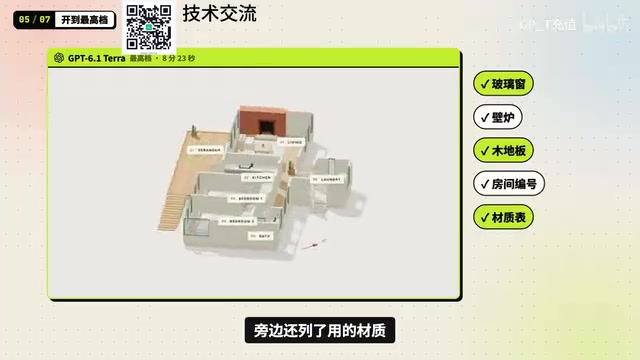
The creator ran Terra again at the highest level. This time it thought for a long time, looked everywhere for ways to check its own work, and didn't submit until 8 minutes 23 seconds—slower than Astra. The output had glass windows, a fireplace, wooden floors, numbered rooms, and a list of materials used alongside. Placed next to Astra, the creator personally felt they were on par, perhaps even a bit better looking. But the bill was 35 cents.
Why was the bill higher when the unit price is only one-tenth of Astra's? Because it read 1.7 million tokens, 6 times as many as Astra. A unit price 10 times cheaper does not mean a bill 10 times cheaper—the longer it thinks, the more it reads.
The creator's conclusion: medium-level Terra is roughly a 70–80 out of 100, but uses only one-sixth of Astra's time and one-fifteenth of its cost. For a 100, Terra at the highest level can also do it, just no longer as fast. Of course, each path was run only once, and results could differ with a different image.
Trap Question Test: All Four Models Saw Through Them
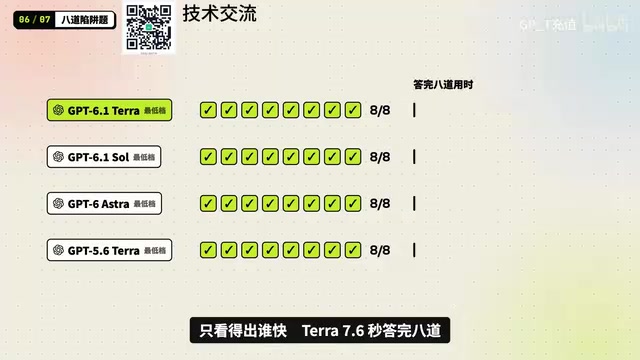
The official claim was "less nonsense," so the creator set eight trap questions where the premises themselves were fake—for example, "What was Pixar's 1998 film about a lighthouseAd keeper's robot?" (no such film exists), "What is the name of Venus's largest moon?" (Venus has no moons), "Where is the capital of Australia's seventh state?" (Australia has only six states). All four models used the lowest level, and all saw through them—not a single one was fooled. This item couldn't measure who was smarter, only speed: Terra answered all eight in 7.6 seconds, Soul in 12 seconds, Astra in 13 seconds, and the previous generation in 22 seconds.
Why Computer-Operation Scenarios Care More About Fast and Cheap
Another answer is hidden in the bill. On the medium-level Terra run, it wrote only 4,000 tokens itself but read in 110,000—because at every step the working AI has to re-read all previous conversation and images from the beginning. Today's 3D modeling task took only a few steps, but computer-operation work often involves dozens of steps per task, and each step requires looking at the screen again.
For a working AI, fast and cheap matter more than "a little bit smarter." This is also why OpenAI primarily promotes Terra, the mid-tier, for computer operation.
The Agent's context accumulation mechanism is key to understanding the bill structure. At every action (looking at the screen, clicking, typing), a conversational Agent generates new screenshots and text, but the model itself is stateless, so the system must reassemble all prior history—including every screenshot—into the prompt and send it again. This means the input tokens at step N are roughly proportional to the total content of all previous steps, and total consumption grows approximately quadratically with the number of steps. Screenshots occupy far more tokens after visual encoding than plain text, so the amount "read" is often tens of times the amount "written." Computer-operation tasks routinely involve dozens to hundreds of steps, and the cost bottleneck is almost entirely on the input side—which also explains why a model with one-tenth the unit price can end up with a higher bill after long thinking at a high level.
Buying Advice: Use Terra Daily, Switch to Soul or Astra for Fine Work
The creator's advice is straightforward: for everyday file edits, spreadsheet organization, and image-based errands, hand it to Terra first—fast and economical; for polished deliverables or the hardest coding, switch to Soul and Astra. In Codex, Terra defaults to the lowest level; if the task is a bit harder, raise the level by one notch, but don't casually turn on the highest level—it's slow and not necessarily economical.
Terra isn't the strongest, but it's the most cost-effective. Used in the right place, it will be the one you use most.
One-line Summary
Hands-on test of GPT-6.1 Terra: 5x faster, 15x cheaper, medium level is enough, highest level isn't necessarily economical.
Paragraph Summary
The article documents a Bilibili creator's hands-on test of OpenAI's new-generation GPT-6.1 Terra in Codex. In the task of converting the same hand-drawn floor plan into a 3D model, medium-level Terra submitted in 56 seconds—about 5 times faster than Soul and more than 6 times faster than Astra—at a cost of only about 6 cents, one-fifteenth of Astra's; the output quality was 70–80 out of 100, clearly better than the failed previous generation. At the highest level, Terra could approach or even surpass Astra, but took 8 minutes 23 seconds and the bill rose to 35 cents because it read 1.7 million tokens. All four models saw through eight trap questions, with Terra the fastest. The article thus explains that computer-operation tasks involve many steps and repeated screen reading at each step, making fast and cheap more critical than tiny intelligence gaps, and offers buying advice: use medium-level Terra daily and switch to Soul/Astra for fine work.
Related articles
Anthropic Fable 5.2 Hands-On: 3A Games and Excel Clones from One Prompt
Anthropic Fable 5.2 hands-on: three-line prompts generate a playable Gears of War clone, a full Excel clone, and a DaVinci Resolve clone. Benchmarks, Ultra Code mode, token costs, and pricing analyzed — is it worth replacing Opus 5.5?

RL Racing Agent Stuck Against the Wall? Try These Recovery Strategies
RL racing agent stuck against walls? We analyze recovery data, observation limits, and action space, comparing DAgger, behavior cloning, and SAC with diagnostic experiments.

Giving AI Agents Long-Term Memory: A New Approach to Supply Chain Disruption Decisions
A developer uses Hindsight to build persistent memory for a supply chain AI agent, enabling retrieval of past disruptions and decision outcomes. The article analyzes its architecture, memory retention and recall design, and engineering challenges such as what to remember and how to evaluate memory effectiveness.