Greta.sh: Let Your Website Automate SEO and AEO for Self-Growing Customer Acquisition

Greta.sh automatically discovers search queries, builds answer pages, and covers both Google and AI answer engine optimization.
The article introduces Self-Growing Websites by Greta.sh, ranked #9 on Product Hunt, which uses automation to solve the problem of websites launching to no visitors. Its core mechanism finds user search queries, auto-generates answer pages, and gets them displayed on Google and ChatGPT, covering both traditional search and generative answer engines. With MCP integration, users can issue build, grow, publish, and report commands directly in Claude, ChatGPT, or Cursor. The article also notes AEO lacks unified standards and auto-generated content quality remains unproven, suggesting it be treated as a content accelerator rather than a human strategy replacement.
A website that launches to no visitors is a common pain point for many developers and independent creators. Traditional SEO requires months of content refinement and link building, while the rise of AI search tools has introduced a new challenge: AEO (Answer Engine Optimization). Self-Growing Websites by Greta.sh, ranked #9 on Product Hunt, attempts to solve this problem through automation: letting the website find the questions users are searching for, generate answer pages, and gain exposure on platforms like Google and ChatGPT.
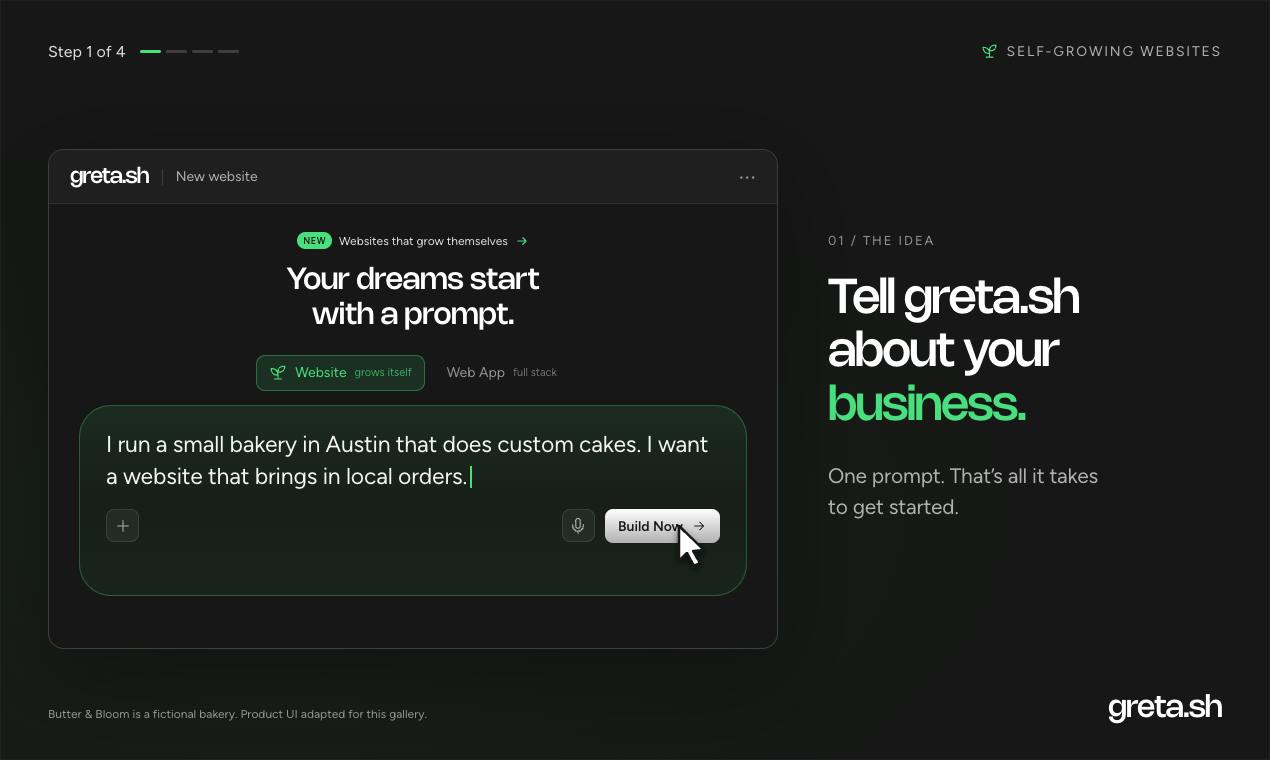
Core Mechanism: From Search Intent to Automatic Page Creation
Greta.sh's logic isn't complicated, but it hits the efficiency bottleneck of long-tail content production. According to its Product Hunt page, the product "finds what customers are searching for, writes pages that answer those questions," and then gets those pages displayed in Google, ChatGPT, and other AI tools. This means it covers both traditional search engines and generative answer engines as traffic entry points.
The automation value of this process lies in stringing together keyword research, content creation, publishing, and reporting into a single pipeline. For small teams lacking dedicated SEO staff, it eliminates repetitive work and trial-and-error cycles.
MCP Integration: Operate Directly in Claude, ChatGPT, or Cursor
Greta.sh offers MCP (Model Context Protocol) integration, allowing users to issue commands directly in Claude, ChatGPT, or Cursor to "build sites, grow, publish, or report." This effectively turns SEO operations into conversational actions—no need to switch to a separate dashboard; website growth actions can be completed within AI coding or writing environments.
MCP is an open protocol promoted by Anthropic for connecting AI assistants with external tools. Greta.sh's choice to support MCP indicates it targets users already accustomed to completing everything within AI workflows. From a product positioning standpoint, this is closer to an "AI-native" operations assistant than a simple SEO tool.
Technical Positioning of MCP: Model Context Protocol (MCP) was proposed by Anthropic in late 2024. It is an open, JSON-RPC-based client-server protocol that standardizes how AI assistants connect to external data sources and tools. Before MCP, every AI application needed to build a separate adapter layer to integrate an external service (such as a database, API, or local file system), creating an N×M integration burden. MCP abstracts this layer into a unified "tools/resources/prompts" interface: service providers only need to implement an MCP Server once, and any MCP-compatible client (Claude Desktop, Cursor, some IDEs and agent frameworks) can call it directly. For a SaaS like Greta.sh, supporting MCP means not having to build separate plugins or extensions for each AI platform—maintaining just one MCP endpoint allows users to invoke site-building and SEO capabilities within conversations. This also explains why it treats MCP as a core selling point rather than an add-on feature.
AEO: The Overlooked New Battleground
The product tagline specifically emphasizes AEO. As tools like ChatGPT and Perplexity become information access points, users no longer just click blue links—they read AI-generated answers directly. If brand content isn't cited by these answer engines, it's effectively absent from the new traffic distribution.
Greta.sh claims it can get pages "displayed" on platforms like ChatGPT, but the specific implementation isn't detailed on its Product Hunt page. Based on common industry practices, this typically involves structured content, Q&A format optimization, and accessibility for AI crawlers. That said, AEO still lacks unified measurement standards, making effectiveness verification harder than traditional SEO.
The Relationship Between AEO, GEO, and SEO: AEO (Answer Engine Optimization) is often used interchangeably with GEO (Generative Engine Optimization). Both aim to make content more likely to be cited by large language models when generating answers, rather than merely ranking in search result lists. Unlike traditional SEO, which relies on keyword density, backlinks, and click-through rate signals, AEO prioritizes content extractability—clear Q&A structures, explicit entity and fact statements, semantically parseable HTML, and page accessibility within training corpora or retrieval indexes. Some generative engines use RAG (Retrieval-Augmented Generation) to organize answers after real-time retrieval; in this case, whether a page can be recalled by the retriever and whether paragraphs can be directly excerpted matters more than overall ranking. Since different platforms' citation logic is undisclosed and frequently changing, AEO effectiveness can currently only be indirectly observed through metrics like brand term frequency in AI answers and citation links.
Use Cases and Limitations
Based on the product description, Greta.sh is best suited for: websites that have just launched and lack content accumulation; small teams looking to quickly cover long-tail search terms; and developers who already use Claude or Cursor and want to incorporate SEO into their AI workflows.
But it's not a panacea. Whether auto-generated content can consistently meet search engines' quality and originality standards is a question that needs observation. Google has long been cautious about AI-generated bulk content, and over-reliance on automation could result in pages being judged as low-value. Additionally, the 87 upvotes and 10 comments on the Product Hunt page indicate the product is still in its early stages, and long-term effectiveness requires validation from more users.
For teams wanting to try it, a reasonable expectation is: treat Greta.sh as a content production accelerator rather than a complete replacement for human strategy. Core brand narrative and product differentiation messaging still need human oversight.
Policy Boundaries of Search Engines on AI-Generated Bulk Content: Since 2023, Google has updated its search quality guidelines multiple times. Its core position is that "content quality is judged not by how it's produced, but by whether it's helpful and people-first," while explicitly targeting large-scale generated pages lacking original value and expert review as violations of its spam policies (scaled content abuse). The March 2024 core algorithm update and subsequent site reputation mechanisms have caused traffic to plummet for many sites producing purely AI-generated bulk content. Therefore, when using automated page-building tools like Greta.sh, what truly determines long-term survival isn't output volume, but whether each page adds unique information, whether it undergoes human fact-checking, and whether the site as a whole possesses topical authority. Treating auto-generation as first drafts and topic leads, then having humans add cases, data, and perspectives, is currently the more prudent approach.
One-line Summary
Greta.sh automatically discovers search queries and builds pages, covering both Google and AI answer engine optimization.
Paragraph Summary
The article introduces Self-Growing Websites by Greta.sh, ranked #9 on Product Hunt, which attempts to solve the problem of websites launching to no visitors through automation. Its core mechanism is finding the questions users search for, automatically generating answer pages, and getting those pages displayed on platforms like Google and ChatGPT, thereby covering both traditional search and generative answer engines as traffic entry points. The product offers MCP integration, allowing users to issue site-building, growth, publishing, and reporting commands directly in Claude, ChatGPT, or Cursor, positioning itself closer to an AI-native operations assistant. The article also notes that AEO lacks unified measurement standards, and the quality and compliance of auto-generated content remain to be seen, suggesting it be viewed as a content production accelerator rather than a replacement for human strategy.
Related articles

Glasshand: Giving AI Agents a Real iPhone and Mac
Glasshand lets AI agents rent real iPhones and Macs, supporting Claude Code, Codex, and more to post, book services, and test iOS apps on real devices. This article explains how it works, its use cases, and potential boundaries.

ChatGPT Images 2.6 Released: GIF Generation, Reference Image Reuse, and 50% Speed Boost
ChatGPT Images 2.6 released: prompt-to-GIF animation with frame-by-frame editing, reusable reference images for yourself, pets, or characters, 50% faster generation, plus Flare and Sunburst API model variants and SVG export for developers.

Rerun: Turn Your AI Subscription into an AI Coworker Team
Rerun, #3 on Product Hunt, turns your ChatGPT or Claude subscription into a team of AI coworkers that run on schedules or triggers, each with tools, a computer, and a shared workspace. It asks before risky actions, is open source (AGPL v3), and supports self-hosting.