Grimes Joins AI Film 'Gods Don't Give Gifts', Marking AI Film's First Theatrical Release

Grimes joins AI sci-fi film 'Gods Don't Give Gifts', claimed as the first AI film in theaters, testing AI cinema's commercial viability.
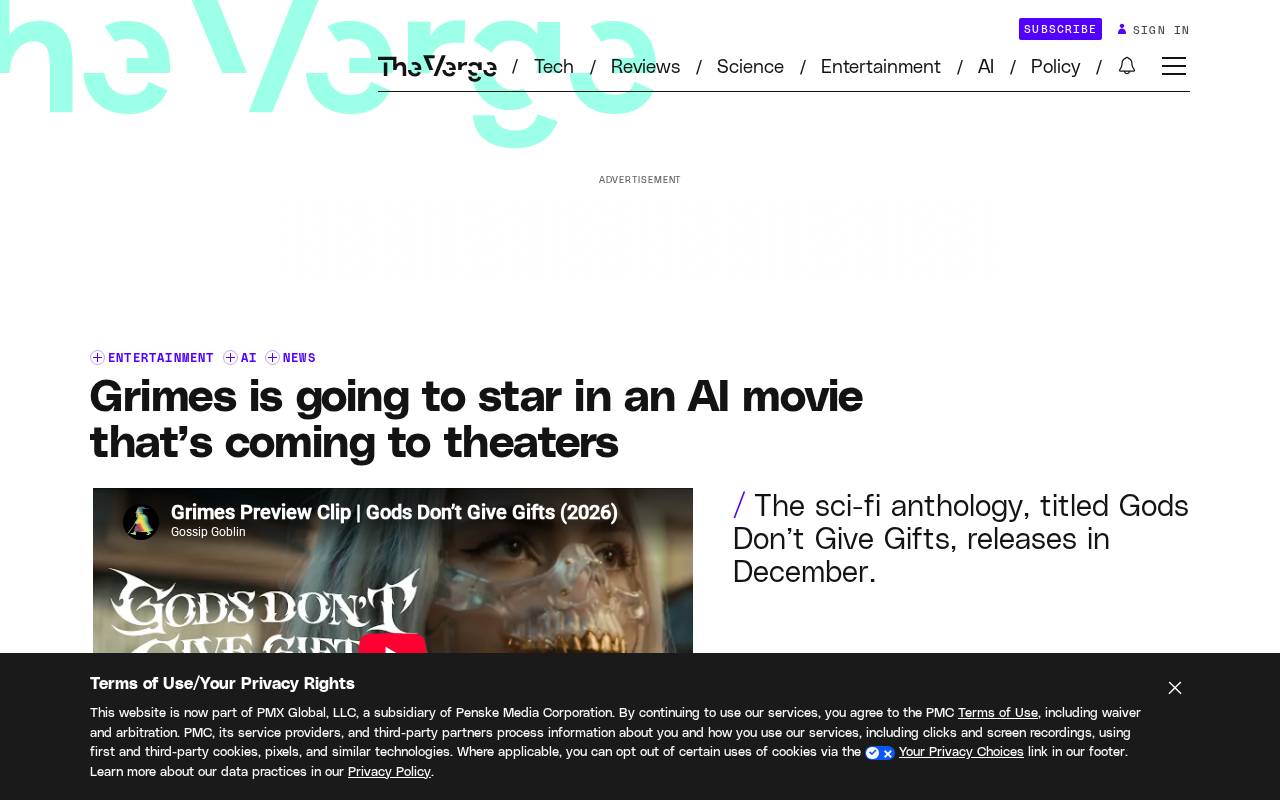
The sci-fi film 'Gods Don't Give Gifts' announces pop singer Grimes to star, promoted as "the first AI film to hit theaters," marking AI-generated content's move from experimental shorts to the traditional box office. Grimes's tech-oriented image aligns with AI themes and helps lower the barrier for mainstream audiences. The film's box office will be a key test: success could attract capital, while failure could delay commercialization. AI films still face challenges in originality, copyright, actors' rights, and theatrical technical standards.
AI-generated films are moving from experimental shorts to commercial cinema. The sci-fi film 'Gods Don't Give Gifts' has announced that pop singer Grimes will star, and it is being promoted as "the first AI film to hit theaters." This is not just a tech showcase but a critical test of AI cinema's commercial potential.
From Experiment to Theatrical Release: A Milestone for AI Films
Over the past few years, AI-generated content has mostly remained in the realm of short videos and proof-of-concept. 'Gods Don't Give Gifts' aims directly at theatrical distribution, marking the point where AI films begin to face the scrutiny of the traditional box office market. The film is described as "the first AI film to enter theaters," a label that is inherently newsworthy. Grimes's involvement brings star power to the project, helping to attract mainstream audiences and media attention.
AI-generated films typically refer to production workflows that use generative models for script assistance, storyboard design, visual synthesis, voiceover and music, and even editing. Current mainstream technical approaches include diffusion model-based video generation (such as Sora-like models), AI face-swapping and digital human synthesis, and using large language models to assist narrative structure. Unlike works completed entirely by AI independently, most so-called "AI films" are still led by human teams for creative direction and post-production, with AI handling high-cost, high-repetition tasks. This human-machine collaboration model determines that its cost structure differs from traditional films: upfront computing power and model invocation costs may be higher, but live-action shooting, location, and some labor costs drop significantly. Understanding this production paradigm is a prerequisite for judging whether AI films can form a sustainable business model within the theatrical system.
Why Grimes Is a Suitable Choice
Grimes has long focused on technology and futurist aesthetics, and her music and public image align closely with AI themes. Her casting not only raises the film's profile but also strengthens the connection between AI cinema and pop culture. For an AI film lacking traditional studio backing, celebrity involvement is an effective strategy to lower the cognitive barrier for audiences.
A Touchstone for Commercial Potential
Whether AI films can be profitable in theaters depends on production costs, distribution channels, and audience acceptance. The box office performance of 'Gods Don't Give Gifts' will serve as an industry reference. If successful, it could attract more capital into AI film production; if it fails, it could delay the large-scale commercialization of AI films. A specific release date has not yet been announced, but it has been confirmed that the film will be released in theaters.
Theatrical distribution is not simply a matter of sending a video file to a cinema; it requires compliance with DCI (Digital Cinema Initiatives) specifications, including specific resolution, color space, frame rate, and security encryption requirements. AI-generated content commonly suffers from unstable resolution, insufficient inter-frame consistency, and abnormal motion blur, necessitating additional upscaling, frame interpolation, and color grading processes to meet projection standards. Moreover, theatrical distribution involves print production, key management, scheduling negotiations, and box office revenue-sharing systems—all of which constitute implicit barriers for newcomers. Therefore, whether an AI film can reach theaters is itself a test of its engineering capabilities, not merely an artistic evaluation.
Challenges and Controversies Coexist
AI-generated films have always faced controversies over artistic originality, copyright, and actors' rights. While Grimes's involvement brings attention, it may also spark discussions about AI replacing human creators. Additionally, theatrical release requires meeting technical standards and audience expectations, and whether AI films can achieve theatrical-level audiovisual experience remains uncertain.
Impact on the Industry
The release of 'Gods Don't Give Gifts' will test the commercial viability of AI films and provide a reference for future projects. Regardless of the outcome, it marks an attempt for AI content to move from marginal experimentation to the mainstream market. As technology iterates and costs decrease, AI films are expected to find their place in specific genres and budget ranges.
(Note: This article is based primarily on RSS reports; specific details about the film's production and release date are limited, and it is recommended to follow subsequent official announcements.)
One-line Summary
Grimes joins AI sci-fi film 'Gods Don't Give Gifts', claimed to be the first AI film in theaters, testing the commercial viability of AI cinema.
Paragraph Summary
The sci-fi film 'Gods Don't Give Gifts' has announced that pop singer Grimes will star, and it is being promoted as "the first AI film to hit theaters," marking AI-generated content's move from experimental shorts and proof-of-concept to the traditional box office market. Grimes has long focused on technology and futurist aesthetics, and her public image aligns with AI themes; her star power helps lower the cognitive barrier for mainstream audiences. The film's box office performance will be a key test of AI cinema's commercial potential: success could attract more capital, while failure could delay large-scale commercialization. Meanwhile, AI films still face challenges related to artistic originality, copyright, actors' rights, and theatrical technical standards, and whether they can achieve cinema-level audiovisual experience remains to be verified.
Related articles
Anthropic Fable 5.2 Hands-On: 3A Games and Excel Clones from One Prompt
Anthropic Fable 5.2 hands-on: three-line prompts generate a playable Gears of War clone, a full Excel clone, and a DaVinci Resolve clone. Benchmarks, Ultra Code mode, token costs, and pricing analyzed — is it worth replacing Opus 5.5?

RL Racing Agent Stuck Against the Wall? Try These Recovery Strategies
RL racing agent stuck against walls? We analyze recovery data, observation limits, and action space, comparing DAgger, behavior cloning, and SAC with diagnostic experiments.

Giving AI Agents Long-Term Memory: A New Approach to Supply Chain Disruption Decisions
A developer uses Hindsight to build persistent memory for a supply chain AI agent, enabling retrieval of past disruptions and decision outcomes. The article analyzes its architecture, memory retention and recall design, and engineering challenges such as what to remember and how to evaluate memory effectiveness.