Hexagonal Splatting Primitives Hexels: Half the Memory, Better Quality Than 2DGS

Hexels uses planar hexagonal primitives and first-order color fields to significantly boost rendering and reconstruction quality at lower memory.
Hexels proposes replacing traditional circular or Gaussian splatting primitives with planar hexagonal surface elements, each carrying a first-order spatial color field to express internal appearance variation, covering local planar regions with fewer, larger primitives. Tested on 34 scenes, PSNR improves 4.53–7.38 dB over 2DGS under memory-matched conditions with lower training memory; per-primitive it beats 2DGS by up to 4.74 dB with 2.31× faster FPS. For 3D reconstruction, error drops 28.9% across 15 DTU scans and it achieves the highest average F1 on 6 Tanks and Temples scenes (34.38% vs 31.72%), and it also outperforms Image-GS on 2D image representation. The article positions it as a Pareto-frontier improvement within the surface-aligned primitives line of work—complementary rather than a full replacement—with the local planarity assumption's applicability in densely curved or high-frequency detail scenes still to be validated.
Introduction: When Splatting Primitives Meet Honeycomb Structure
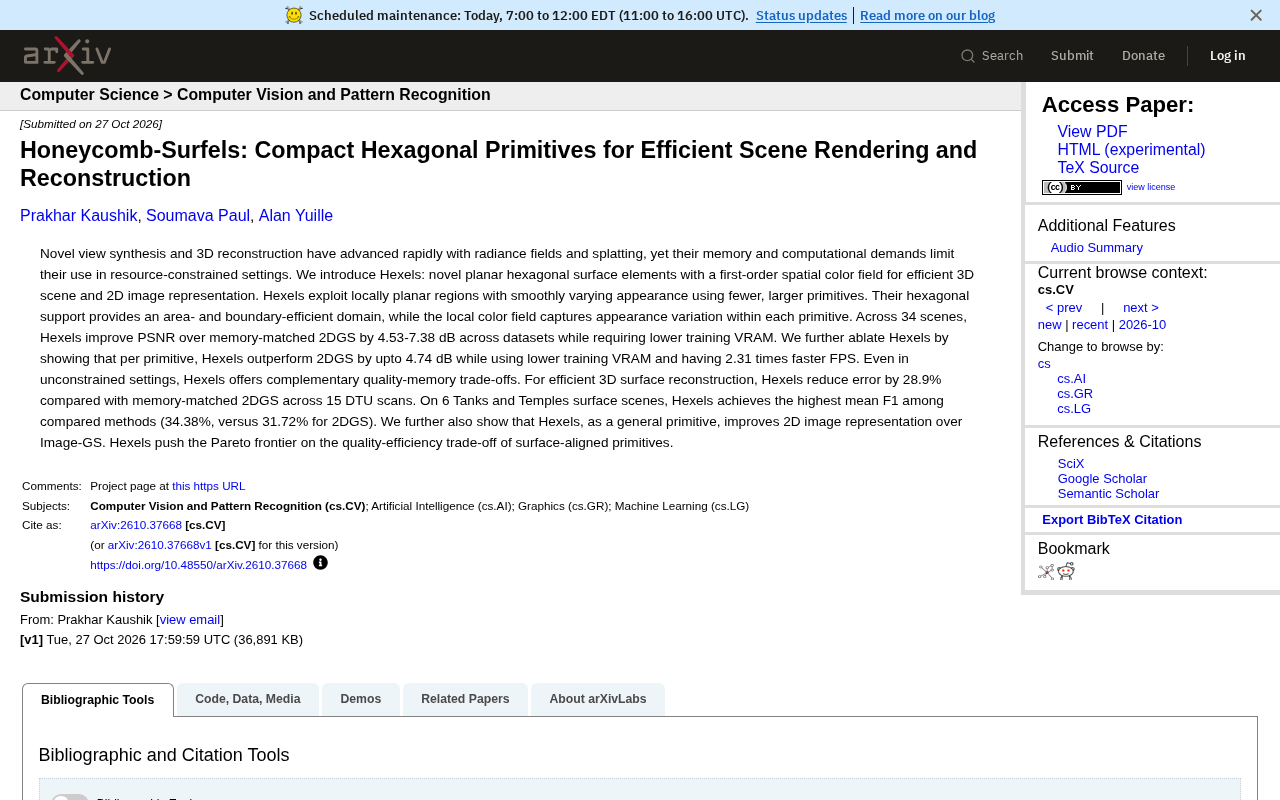
Novel view synthesis and 3D reconstruction have advanced significantly thanks to radiance fields and splatting techniques, but their memory and compute demands remain a persistent bottleneck for deployment in resource-constrained scenarios. A recent paper proposes Hexels (hexagonal surface elements), a new approach: replacing traditional circular or Gaussian primitives with planar hexagonal primitives to represent scenes and images using fewer, larger elements. According to the paper's experimental data, across 34 test scenes, Hexels improves PSNR by 4.53–7.38 dB over memory-matched 2DGS while requiring less training memory.
What makes this result noteworthy is that the quality gain is not simply bought by throwing more compute at the problem—it improves multiple metrics simultaneously under memory and speed constraints, directly pushing the Pareto frontier of surface-aligned primitives in the quality-efficiency trade-off.
Novel View Synthesis (NVS) refers to the task of generating images of a scene from arbitrary new viewpoints given a set of images with known camera poses, and is one of the core problems in 3D reconstruction and rendering. Radiance Field methods (such as NeRF) use neural networks to implicitly represent the color and density of every spatial point in a scene, achieving high rendering quality but incurring large training and inference costs. Splatting techniques instead represent a scene explicitly as a large number of differentiable primitives (such as the anisotropic Gaussian ellipsoids in 3D Gaussian Splatting), rendering quickly by projecting the primitives onto the image plane and blending them in depth order, balancing quality and real-time performance. Traditional splatting primitives are mostly 3D volumetric elements, and their compute and storage costs grow with the number of primitives, easily becoming a bottleneck in resource-constrained scenarios.
Why Hexagons? The Efficiency Dividend of the Local Planarity Assumption
Covering Smooth Regions with Fewer, Larger Primitives
The core observation behind Hexels is that real-world scenes contain many locally planar regions whose appearance varies smoothly. Traditional splatting methods tend to fit these regions with large numbers of small primitives, causing redundancy. Hexels takes the opposite approach, using planar hexagonal surface elements, where each primitive carries a first-order spatial color field to capture appearance variation within the primitive.
The cleverness of this design lies in the division of labor: the hexagon covers geometry, while the first-order color field expresses appearance. According to the paper, the hexagonal support region outperforms other shapes in area efficiency and boundary efficiency, covering the same local plane with fewer primitives. As the primitive count drops, memory footprint and training cost fall accordingly.
First-Order Color Field: Appearance Expressiveness Within a Primitive
If a large primitive were represented by only a single color, gradients in smooth regions would be flattened out. Hexels introduces a first-order spatial color field for each primitive, effectively establishing a linear color model within the primitive, thereby preserving appearance detail without increasing the primitive count. The paper's ablation studies show that on a per-primitive basis, Hexels outperforms 2DGS by up to 4.74 dB, while using less training memory and running 2.31× faster in FPS. This indicates that the efficiency advantage comes not only from having fewer primitives but also from the expressiveness of the primitives themselves.
A first-order spatial color field describes the color at any position within a primitive using a linear function (rather than a constant): c(u,v) = a·u + b·v + c, where (u,v) are the primitive's local planar coordinates and a, b, c are learnable parameters. Compared with storing a single RGB constant per primitive (zeroth order), a first-order model can express color gradients within the primitive's covered region without increasing the primitive count, effectively giving each large primitive a "local texture" capability. This contrasts with approaches such as 2DGS that use a single color or simple spherical harmonic coefficients: the latter either require primitives to be small enough to fit gradients, or require higher-order spherical harmonic coefficients that add parameters. The first-order color field significantly improves expressiveness at minimal parameter cost (just a few extra scalars per primitive).
Experimental Performance: The Triple Trade-off of Quality, Memory, and Speed
Comparison with 2DGS: A Clear PSNR Lead
The paper conducts a systematic comparison across 34 scenes. Under memory-matched settings, Hexels achieves PSNR 4.53–7.38 dB higher than 2DGS while requiring less training memory. Even in settings unconstrained by memory, Hexels offers complementary quality-memory trade-off options rather than dominating at only one end.
PSNR (Peak Signal-to-Noise Ratio) is the most commonly used fidelity metric in image reconstruction and rendering, computed as PSNR = 10·log10(MAX²/MSE), where MAX is the maximum pixel value (typically 1 or 255) and MSE is the mean squared error. A higher PSNR indicates that the rendered image is closer to the reference image, measured in decibels (dB). In the NVS literature, a 1 dB PSNR improvement is usually already significant, and a 4–7 dB improvement means several-fold error reduction—a substantial quality leap. Note that PSNR is more sensitive to smooth regions and does not fully align with human perception, so papers typically supplement it with perceptual metrics such as SSIM and LPIPS; however, this material does not disclose those figures.
3D Surface Reconstruction: 28.9% Error Reduction
On the 3D surface reconstruction task, Hexels achieves a 28.9% error reduction over memory-matched 2DGS across 15 DTU scans. On 6 Tanks and Temples surface scenes, Hexels obtains the highest average F1 score among compared methods (34.38%, versus 31.72% for 2DGS). These two sets of results demonstrate that hexagonal primitives are not only suitable for rendering but also competitive in geometric reconstruction accuracy.
DTU and Tanks and Temples are two commonly used benchmarks in 3D reconstruction. The DTU dataset, released by the Technical University of Denmark, contains high-precision point cloud ground truth acquired with a structured-light scanner in a controlled laboratory environment, and is often used to evaluate the geometric accuracy of surface reconstruction, typically measured by Chamfer distance (the average nearest-point distance from the reconstructed surface to the ground-truth surface and vice versa—lower is better). Tanks and Temples, in contrast, contains larger outdoor and indoor scenes closer to real-world conditions, and is commonly evaluated with the F1 score—the harmonic mean of precision (the fraction of reconstructed points falling within a ground-truth threshold) and recall (the fraction of ground-truth points covered by the reconstruction)—higher is better. Together they provide a fairly comprehensive picture of a method's geometric reconstruction capability in both controlled and in-the-wild scenes.
2D Image Representation: Outperforming Image-GS
The paper also validates Hexels' capability as a general-purpose primitive: on the 2D image representation task, it outperforms Image-GS. This shows that the hexagonal planar element design is not limited to 3D scenes and offers efficiency advantages in 2D representation as well.
Technical Positioning and Limitations: Complementary, Not a Replacement
From a technical standpoint, Hexels belongs to the surface-aligned primitives line of work, sharing the planarized-primitive direction with methods such as 2DGS, but achieving a better position on the Pareto frontier through the combination of hexagonal shape and first-order color field. Notably, the paper emphasizes a "complementary quality-memory trade-off," implying that Hexels does not fully replace existing methods in all scenarios.
The current material does not disclose specific training times or inference memory figures, nor does it describe performance in highly non-planar or texture-complex scenes. The local planarity assumption of hexagonal primitives may face challenges in regions with dense curvature or high-frequency detail, which requires further validation in future work.
Practical Implications: A New Option for Resource-Constrained Scenarios
For teams that need to perform 3D reconstruction and rendering on edge devices or under limited memory, Hexels offers an option worth watching. Its core value lies in covering local planes with fewer primitives and preserving appearance variation with a first-order color field, thereby achieving a better balance among memory, speed, and quality. The paper's figure of "2.31× faster FPS on a per-primitive basis" is particularly attractive for latency-sensitive applications.
However, there is still a gap between the paper and engineering deployment. How primitive sizes adapt to scene scale, how to efficiently rasterize hexagonal support regions, and how to integrate with existing splatting pipelines are all questions that must be answered in practical deployment. The Pareto frontier improvement driven by Hexels provides a new starting point for these engineering questions.
One-line Summary
Hexels uses planar hexagonal primitives and first-order color fields to significantly improve rendering and reconstruction quality at lower memory.
Paragraph Summary
Hexels proposes replacing traditional circular or Gaussian splatting primitives with planar hexagonal surface elements, each carrying a first-order spatial color field to express internal appearance variation, thereby covering local planar regions with fewer, larger primitives. Tested on 34 scenes, it improves PSNR by 4.53–7.38 dB over 2DGS under memory-matched conditions while using less training memory; on a per-primitive basis it beats 2DGS by up to 4.74 dB and runs 2.31× faster in FPS. For 3D reconstruction, it reduces error by 28.9% across 15 DTU scans and achieves the highest average F1 on 6 Tanks and Temples scenes (34.38% vs 31.72%), and it also outperforms Image-GS on 2D image representation. The article positions it as an improvement to the Pareto frontier within the surface-aligned primitives line of work—complementary rather than a full replacement—with the applicability of the local planarity assumption in densely curved or high-frequency detail scenes still to be validated.
Related articles

Will GitHub Die? Open Source Maintainer Burnout and the Collaboration Crisis in the AI Era
Lex Fridman podcast discussion on open source maintainer burnout and GitHub's predicament: massive pull requests overwhelm core maintainers, and AI worsens code bloat. Using math journal peer review and Poincaré conjecture verification as analogies, the article analyzes why verification in knowledge production must be deliberately slow, and how open source communities can avoid the failure mode of maintainers exiting.

Stop Building Cookie-Cutter AI Websites: 3 Tools That Transform Your Coding Agent
Three tools that boost AI coding agents: FFmpeg skill for local video editing in Claude Code and Cursor, Hallmark's 50 design themes to fix cookie-cutter AI sites, and Jailbreaks' 25+ model prompts.

How America's Gerontocracy Squeezes the Younger Generation
Americans over 55 hold nearly three-quarters of national wealth, alongside an 80-year-old president and elderly congressional leaders. The Atlantic's Idrees Kahloon explains how gerontocracy drives up housing costs, squeezes opportunities for the young, and explores zoning reform and child poverty reduction as practical fixes.