How AI Is Reshaping Specialty Chemicals Innovation: Lubrizol's Digital Practice
Lubrizol's case shows that AI innovation in specialty chemicals should start with data infrastructure, letting AI augment experts rather than replace them.
Using Lubrizol's digital transformation as an example, the article analyzes the contradiction in the specialty chemicals industry between increasingly complex formulations and the need for faster innovation. The core argument is that the primary obstacle to AI adoption is not algorithms, but the "data divide" created by scattered, inconsistently formatted data. Companies must first build data pipelines to integrate experimental data, material properties, and process parameters into structured assets, enabling a "data + experience dual-driven" approach where AI handles repetitive screening and pattern recognition while chemists focus on high-value hypothesis generation and experimental design.
The specialty chemicals industry is facing a fundamental contradiction: product formulations are becoming increasingly complex, while the market demands ever-faster innovation. Traditional R&D relies on expert experience and extensive physical experimentation, resulting in long cycles and high costs. The emergence of AI and cloud computing offers a way to break through this bottleneck, but the real challenge lies in connecting new technologies with reliable data, scientific expertise, and the practical constraints of product commercialization.
The "Data Divide" in Specialty Chemicals R&D
According to the source material, specialty chemicals manufacturer Lubrizol positions the core of its digital transformation as "enabling researchers to test ideas faster and make smarter decisions." This sounds simple, but it touches on an industry pain point: data generated in chemical R&D is often scattered across lab notebooks, historical formulation libraries, and experts' minds, with inconsistent formats and missing standards, making it difficult for AI models to use directly.
Lubrizol's practice shows that the first step in digital transformation is not deploying the most advanced algorithms, but rather building a solid data pipeline—integrating experimental data, material properties, and process parameters into structured assets that can be used for model training. Only on this foundation can machine learning help predict formulation performance and reduce trial-and-error iterations.
Data pipeline refers to the complete set of processes and toolchains that automatically collect, clean, transform, and load scattered, heterogeneous raw data into a target storage or analysis environment. In chemical R&D scenarios, it needs to interface with Laboratory Information Management Systems (LIMS), Electronic Lab Notebooks (ELN), historical formulation databases, and instrument output files, unifying experimental records, material property tables, and process parameters in different formats into structured, traceable data assets. Without a reliable data pipeline, machine learning models can only be built on incomplete or contradictory data, prediction results cannot be reproduced, and it becomes even harder to support formulation decisions. Therefore, the data pipeline is often regarded as the "invisible infrastructure" for enterprise AI adoption, and the quality of its construction directly determines the ceiling for subsequent modeling.
From "Experience-Driven" to "Data + Experience Dual-Driven"
Chemists' intuition remains irreplaceable, but AI can amplify the efficiency of that intuition. The source material emphasizes that Lubrizol's goal is to "combine new technologies with scientific expertise." This means AI's role is not to replace experts, but to take on repetitive screening and pattern recognition work, allowing researchers to focus their energy on high-value hypothesis generation and experimental design.
A typical implementation scenario is formulation optimization. Traditionally, adjusting a single component ratio might require multiple rounds of experimental validation; with the aid of digital tools, models can first learn the nonlinear relationships between components and performance from historical data, propose candidate formulations, and then hand them off to the lab for verification. This "simulate first, experiment later" closed loop can significantly compress R&D cycles.
"Nonlinear relationships" in formulation optimization refer to the fact that simple linear superposition often does not exist between component ratios, process conditions, and final performance. For example, two additives combined may produce synergistic effects or mutual cancellation, and the performance curve of a surfactant may change abruptly once the concentration exceeds the critical micelle concentration. Traditional trial-and-error methods struggle to cover high-dimensional formulation spaces, whereas machine learning models (such as Gaussian process regression, random forests, or neural networks) can capture such nonlinear mappings and interaction effects from historical data, and inversely recommend candidate formulations given performance targets. However, model extrapolation capability is limited, and prediction confidence is low for component combinations not covered by training data, so candidate formulations still require laboratory verification, forming an iterative cycle of "model screening—experimental confirmation—data feedback."
How Cloud Computing and Modeling Accelerate Time-to-Market
The source material mentions that Lubrizol is leveraging cloud computing and advanced modeling. Elastic cloud computing power makes large-scale molecular simulation and machine learning training possible, while advanced modeling combines physicochemical principles with data-driven models. For an industry like specialty chemicals with many product types and small batch sizes, this capability is especially critical—it allows companies to explore broader formulation spaces without increasing the burden of physical experiments.
However, the source material also implies a practical constraint: connecting new technologies with "the realities of product commercialization" is not easy. Model predictions in the lab need to go through pilot-scale scale-up, regulatory review, and customer validation, and any data breakpoint in the process will undermine AI's value. Therefore, digital tools must be embedded throughout the entire process from R&D to production, rather than existing in isolation.
Pilot-scale scale-up is a key step in moving a laboratory formulation toward commercial production, referring to the process of progressively scaling up a small-scale reaction or mixing process to pilot equipment and ultimately to industrial equipment. During scale-up, engineering factors such as heat transfer, mass transfer, and mixing efficiency change significantly, and formulations that performed excellently in the lab may exhibit stratification, agglomeration, or reduced yield in large reactors. For specialty chemicals, with small batch sizes and many product grades, the cost and cycle-time pressures of scale-up validation are particularly acute. If AI models are trained only on small-scale data, their predictions are prone to failure during scale-up. Therefore, digital tools need to incorporate process parameters from pilot and production stages and establish cross-scale data correlations, so that the "simulate first, experiment later" closed loop can truly extend into the commercialization phase.
Implications for the Industry
Lubrizol's case offers three reusable ideas: first, prioritize investment in data infrastructure rather than chasing algorithm trends; second, let AI augment rather than replace domain experts; third, form a closed loop between modeling and experimental validation. AI innovation in specialty chemicals is not a technology arms race, but a systematic upgrade centered on data governance and organizational collaboration.
For companies looking to follow suit, the starting point can be small: begin with a high-frequency, high-value formulation scenario, accumulate structured data, and then gradually expand model capabilities. The source material does not disclose specific quantified benefits, but "testing ideas faster" and "better decisions" are already reasonable returns on digital investment.
(This article is based on analysis of public information from RSS sources and does not introduce specific data beyond the original material.)
One-line Summary
Lubrizol's case shows that AI innovation in specialty chemicals should start with data infrastructure, letting AI augment experts rather than replace them.
Paragraph Summary
Using Lubrizol's digital transformation as an example, the article analyzes the contradiction in the specialty chemicals industry between increasingly complex formulations and the need for faster innovation. The core argument is that the primary obstacle to AI adoption is not algorithms, but the "data divide" created by scattered, inconsistently formatted data. Companies must first build data pipelines to integrate experimental data, material properties, and process parameters into structured assets. On this foundation, AI takes on repetitive screening and pattern recognition, forming a "data + experience dual-driven" approach alongside chemists' intuition, with formulation optimization's "simulate first, experiment later" closed loop as a typical scenario. Cloud computing and advanced modeling further expand the formulation exploration space, but model value must run through the entire process of pilot scale-up, regulatory review, and customer validation; otherwise, data breakpoints will weaken its impact. The article concludes with three industry implications: prioritize investment in data infrastructure, let AI augment experts, and form a closed loop between modeling and experimental validation.
Related articles

Codex and AI Coding Agents in Practice: A Complete Guide from Prompts to MCP
A Codex-centered guide to agentic coding: Task-Context-Output prompts, AGENTS.md project memory, plan mode, skills, characterization vs. spec tests, permissions and config.toml, MCP tool calls, plus secrets safety and context management.

GPT-6 Security Model and the AI Attack-Defense Escalation: This Week in AI
This week in AI: OpenAI's GPT-6 Saber found 948 Linux kernel root-escalation paths; Cursor deploys full apps from one sentence; Binance details a social engineering attack; C++26 fails ISO vote.
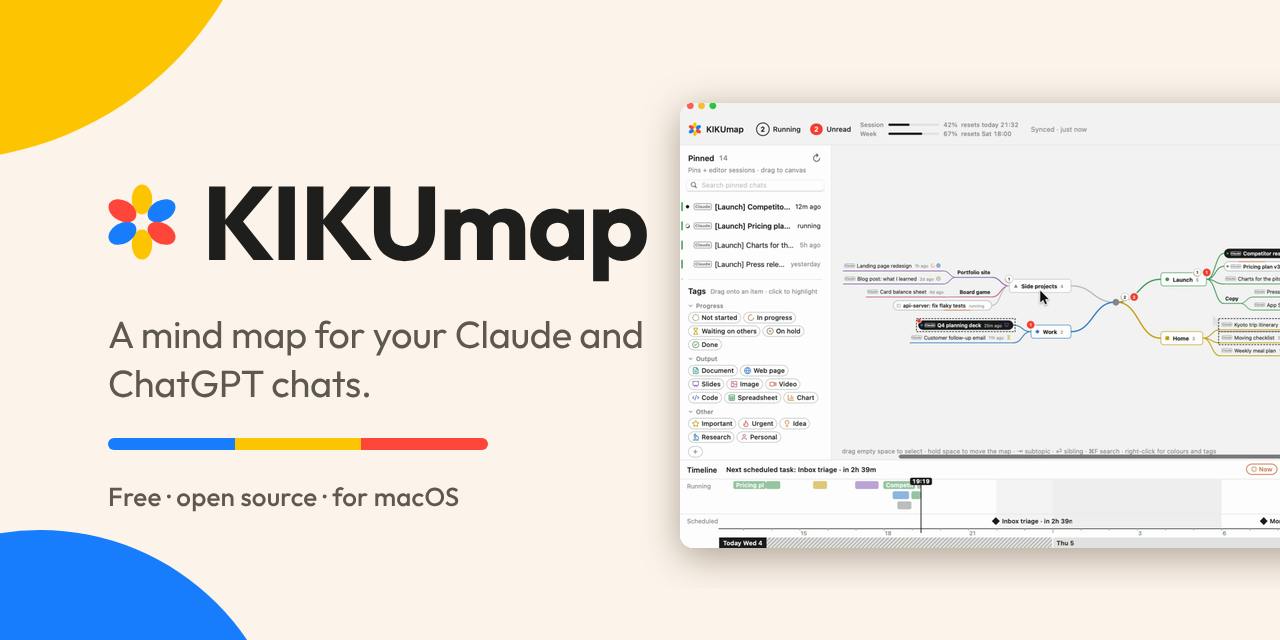
KIKUmap: Manage Your Claude and ChatGPT Conversations with Mind Maps
KIKUmap is a macOS menu bar app that visualizes Claude and ChatGPT conversations as mind maps with real-time status. Free and open source.