How Can AI Product Managers Make Agents Truly Understand the Business? An Analysis of Agent Skills in Practice

Agent Skills packages expert experience into Skill.md, enabling agents to execute according to a manual rather than improvising.
The article points out that the root cause of general-purpose agents "not understanding the business" is that function calling and MCP only solve tool-calling capability, not the problem of when, in what combination, and in what order to orchestrate tools—resulting in outputs lacking industry analytical frameworks and rigorous comparisons. Agent Skills uses Skill.md files to package industry experts' experience, processes, and execution standards into a "business manual" that agents can follow. Using chip industry analysis as an example, it explicitly plans a three-step process: dimension-by-dimension data collection, comparative analysis, and writing the report according to prescribed chapters. This paradigm shift from "tool calling" to "standard execution" delivers value in result consistency, industry knowledge accumulation, and reduced development and debugging costs, and suggests that AI product managers should make implicit business logic explicit and hand it to agents in a structured way.
Why Do General-Purpose Agents Always Seem to "Not Understand the Business"?
Many AI product managers have encountered this scenario: you hand a business problem to an agent, and it can search, call tools, and generate charts—but the output just isn't "professional enough" when placed in a real business context. The root cause isn't that the agent can't use tools; it's that it doesn't know when, in what combination, and in what order to orchestrate those tools.
According to an analysis by a Bilibili creator, function calling and the MCP protocol solve the problem of "what can be done"—enabling AI to call atomic capabilities like search and data generation. But a true business expert's value lies not just in operating tools, but in mastering business logic and business processes. When a general-purpose agent receives a task, it tends to follow a generic thinking pattern—search, summarize, conclude. The process itself may be flawless, but it lacks the industry-required analytical framework, rigorous data comparisons, and dimension-by-dimension statistics, so the conclusions naturally come out arbitrary.
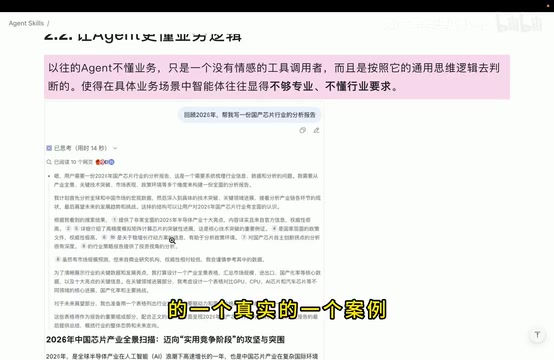
This is the core contradiction: "generic processing logic" doesn't match "professional requirements."
Function calling is the foundational mechanism by which large language models interact with external tools: developers predefine a set of functions (e.g., search, calculation, database queries), and the model determines whether to call a function, which one to call, and what parameters to pass based on the user's request, then continues generating based on the returned results. It addresses the boundary of what the model "can do," but the calling order and combination logic are still determined by the model's general reasoning. MCP (Model Context Protocol) is an open protocol proposed by Anthropic that aims to standardize how AI applications connect to external data sources and tools, exposing different tools to models through a unified interface. Both focus on "capability access" rather than "business orchestration," so even a general-purpose agent with a full toolkit can easily produce unprofessional conclusions due to a lack of industry process knowledge.
Agent Skills: Packaging Expert Experience into AI-Executable Manuals
The idea behind Agent Skills isn't to let the agent improvise, but to write industry experts' experience, processes, and execution standards into a file that AI can understand and follow—typically in the form of Skill.md. Essentially, it equips the agent with a detailed "business expert skill work manual."
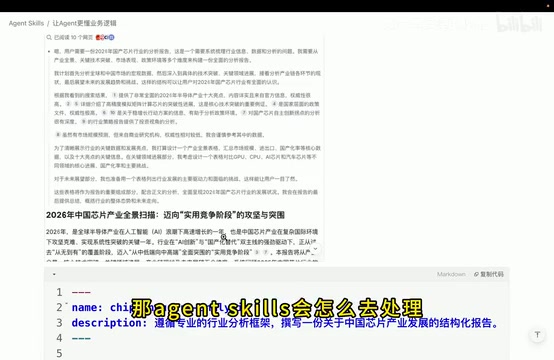
Take the task "analyze the development of the domestic chip industry" as an example. A Skill that encapsulates industry analysis expertise won't just say "used for analyzing industry requirements"—it will explicitly plan out a standard sequence of operations:
Step 1: Dimension-by-Dimension Data Collection
Collect information separately across dimensions such as design, manufacturing, packaging and testing, and equipment and materials. For each dimension, find out which companies are involved and their key information on revenue, industrial capabilities, and technological breakthroughs—searching category by category rather than doing one broad search.
Step 2: Data Analysis and Comparison
Organize the collected data into comparison tables by dimension, perform summarization and comparative analysis, and first derive preliminary conclusions.
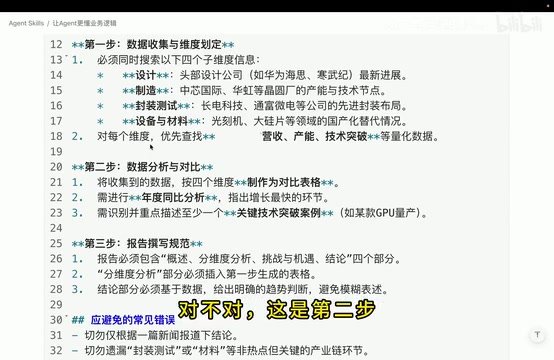
Step 3: Write the Industry Report According to Specifications
The report must be organized according to prescribed chapters—such as overview, dimension-by-dimension analysis, opportunities and challenges, and conclusion—and insert representative charts and tables in specific sections. The Skill also lists common mistakes at the end to help avoid risks.
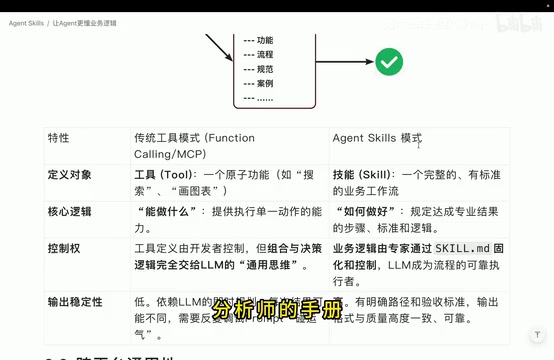
Skill.md is a skill description file written in Markdown, typically containing structured content such as the skill name, applicable scenarios, execution steps, output specifications, examples, and a list of common mistakes. It differs from fine-tuning and prompt engineering: fine-tuning changes model weights, prompt engineering relies on the context of a single conversation, whereas Skill.md is a reusable asset independent of the model that agents can load at runtime and follow step by step. This "file-as-skill" format lowers the barrier to knowledge encapsulation—business experts can codify processes into AI-readable instructions without writing code—and also facilitates version management and cross-platform migration.
Industry analysis frameworks are structured thinking tools commonly used by professional analysts, such as SWOT analysis, Porter's Five Forces, PEST analysis, and dimension-by-dimension breakdowns along the upstream, midstream, and downstream of an industry chain. General-purpose agents often lack awareness of such frameworks and tend to fall into a flat "search—summarize—conclude" process, resulting in missing analytical dimensions and lax comparisons. Agent Skills explicitly writes frameworks into Skill.md, forcing the agent to collect data by dimension, compare in tables, and organize reports by chapter—thereby transforming implicit analytical frameworks into executable checklists. This is precisely the key difference between a professional report and a generic summary.
Paradigm Shift: From "Tool Calling" to "Standard Execution"
The essential difference between the two models: the traditional tool-calling model hands tools to the AI and lets it decide how to analyze; the Agent Skills model tells the agent "you must execute step by step according to this top-tier industry analyst's manual."
This change directly addresses the core pain points of industry adoption:
Result reliability and consistency. No matter who invokes the skill, the output report follows the same professional standards and chapter order, with a fixed summary format, and can serve as a shared standard for a company, technical department, or team.
Industry knowledge accumulation. Industry experience and processes are solidified in a highly readable skill package. If the sources are multiple seasoned practitioners, new employees or other platforms can quickly load and use it, allowing years of accumulated capability to be passed on.
Lower debugging and development costs. Users no longer need multiple rounds of debugging and repeated "talking past each other" conversations—the agent can execute to professional standards in one go. This is a very popular pattern in AI coding and agent development.
Implications for AI Product Managers
The value of Agent Skills isn't just a technical solution—it's a product mindset: rather than expecting a general-purpose model to "figure out" business logic on its own, it's better to write the business logic down explicitly and hand it over in a structured way. The product manager's role in this process is to distill the processes, standards, and pitfalls scattered in business experts' heads into executable skill files—which is itself a high-quality injection of industry information.
When agents can reliably execute tasks according to professional manuals, AI products truly move from "usable toys" to "deployable business tools."
One-line Summary
Agent Skills packages expert experience into Skill.md, enabling agents to execute according to a manual rather than improvising.
Paragraph Summary
The article points out that the root cause of general-purpose agents "not understanding the business" is that function calling and MCP only solve the tool-calling capability, not the problem of when, in what combination, and in what order to orchestrate tools—resulting in outputs lacking industry analytical frameworks and rigorous comparisons. Agent Skills uses Skill.md files to package industry experts' experience, processes, and execution standards into a "business manual" that agents can follow. Using chip industry analysis as an example, it explicitly plans a three-step process: dimension-by-dimension data collection, comparative analysis, and writing the report according to prescribed chapters. This paradigm shift from "tool calling" to "standard execution" delivers value in three areas: result consistency, industry knowledge accumulation, and reduced development and debugging costs. It also suggests that AI product managers should make implicit business logic explicit and hand it to agents in a structured way.
Related articles
AWS AgentCore Gateway: Connecting AI A…
AWS AgentCore Gateway: Connecting AI Agents to Enterprise Backends with MCP
How AWS AgentCore Gateway acts as a primary MCP server to aggregate REST APIs, Lambda, and existing MCP services? Analyzing its AST real-time mapping, zero cold start, semantic search for tool overload, session isolation, and key injection security design, plus the architectural approach to decoupling enterprise AI agents from backends.

One Link Gives Figma AI a New Skill: Hands-On with MCP Connectors
Paste one MCP server link and the AI Agent in Figma gains new tool capabilities. We break down the setup flow, 20+ one-click apps, read/write permissions and execution policies, and the public HTTPS requirement.

Cognition SWE-2 in Practice: One Prompt to Handle the Whole Product Launch Process
Analyzing a YouTube creator's prompt for using Cognition SWE-2 to launch a product: a landing page, seven-email sequence, and non-buyer follow-up tool, plus how the 'test and report' constraint changes AI delivery quality.