Huashu Design 3.0: One Sentence Lets Agents Deliver Editable Designs

Huashu Design 3.0 generates six design directions from one sentence and lets you pick three, with multi-format delivery and preference learning.
Huashu Design 3.0 is an open-source project with over 26,000 GitHub stars, positioned as an HTML-native design skill that integrates into AI coding Agents like Claude Code, Codex, and Cursor. Its core interaction: users enter a one-sentence natural language description, the system generates six candidate design directions, and users pick three to deepen, forming a "diverge-converge" process. The project includes an 84-style library with samples and uses an "Appearance Ledger" to record historical preferences for personalized recommendations that improve with use, plus a design checkup feature for consistency. Deliverables cover web pages, App prototypes, editable PPTX, animations, and infographics, emphasizing a seamless design-as-code pipeline. Community interest is high, but multi-Agent compatibility and consistency in complex projects still need practical validation.
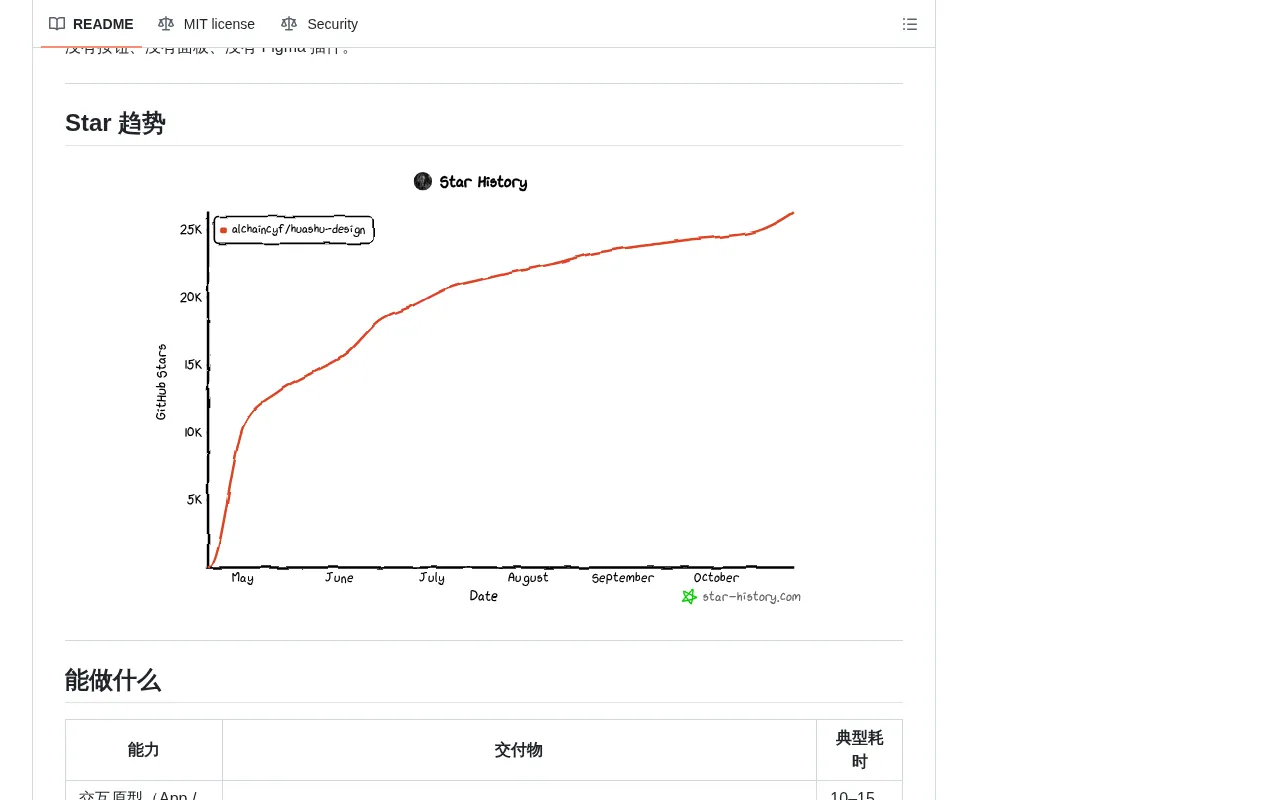
In today's world where AI coding assistants are increasingly widespread, having Agents directly produce deliverable design drafts has long been a shared aspiration of developers and designers alike. An open-source project on GitHub called alchaincyf/huashu-design recently released version 3.0, attempting to use one-sentence interaction to solve the last mile from idea to design delivery. The project has already gained over 26,000 stars, with 177 new stars today, showing its popularity.
One Sentence, Six Choices, Pick Three: Intelligent Convergence of Design Directions
The core interaction of Huashu Design 3.0 is extremely simple: enter a natural language description in any Agent such as Claude Code, Codex, or Cursor, and the system generates six candidate design directions. Users pick three from them, and the project then deepens the output based on these three directions. This "diverge-converge" process avoids the risk of a single solution while preventing decision paralysis caused by too many options.
According to the project description, this mechanism is backed by HTML-native design capabilities. All outputs use HTML as the native carrier, naturally suited for deliverables like web pages and App prototypes. For teams that need to quickly validate ideas, this lightweight, iterable approach is closer to the development workflow than traditional design tools.
What are Claude Code, Codex, and Cursor?
All three are AI coding Agents or IDE-integrated environments aimed at developers. Claude Code is a command-line coding assistant launched by Anthropic, Codex is the name for OpenAI's early code model and its derivative tools, and Cursor is a code editor with built-in AI capabilities. Their common feature is support for directly invoking external "skills" or tools within the coding environment. Huashu Design integrates with these Agents as an HTML-native skill, meaning users can trigger the design generation process in natural language conversation without switching platforms. This integration approach relies on the Agent's parsing of skill descriptions and invocation protocols, and different Agents' depth of compatibility may affect the actual experience.
84-Style Library and an Appearance Ledger That Understands You Better Over Time
Style diversity is another highlight of Huashu Design 3.0. The project includes a built-in library of 84 styles with samples, covering different visual languages that users can directly invoke or mix as references. More importantly, there's the "Appearance Ledger" mechanism: the system records users' historical choices and preferences, and as usage increases, recommendations gradually align with individual or team aesthetic habits.
This "understands you better over time" design turns a static style library into a dynamic personalization engine. Combined with the "design checkup" feature, the project can also perform consistency checks on outputs, helping non-professional designers spot potential issues. From the single-source documentation, these two features together form a closed loop: generation, preference learning, and quality feedback.
What is the "Appearance Ledger"?
The Appearance Ledger is a mechanism Huashu Design uses to record user design preferences. Whenever a user makes a choice from the six candidate directions, or invokes or mixes samples from the style library, the system distills these behaviors into preference data. As usage increases, the ledger gradually builds an aesthetic profile of the individual or team, and subsequent generated candidate directions prioritize these historical choices. Unlike traditional static style libraries, the Appearance Ledger turns every interaction into a reusable personalization signal, giving recommendations dynamic adaptability. Its effectiveness depends on the richness of recorded dimensions and the convergence strategy of the recommendation algorithm; specific implementation details have not yet been disclosed in public information.
Editable PPTX and Animations: Deliverables Beyond Web Pages
In addition to web pages and App prototypes, Huashu Design 3.0 also supports generating editable PPTX, animations, and infographics. This means the designs produced by the Agent are no longer "dead" images but source files that can continue to be adjusted in office software or animation tools. For presentations or marketing materials that need frequent revisions, this capability significantly reduces rework costs.
The project positions itself as an "HTML-native design skill," emphasizing seamless integration with the Agent ecosystem. Developers can complete the entire chain from requirement description to design delivery without leaving the coding environment. This "design as code" approach is blurring the boundary between design and development.
What HTML-native design skill means
HTML-native means using HTML as the native carrier for design output, rather than creating in other design tools first and then exporting to HTML. This approach gives design drafts the structure and styling of web pages by nature, allowing them to be rendered, debugged, and iterated directly in the browser. For Agents, HTML is a text format that's easy to generate and modify, facilitating incremental adjustments through natural language instructions. At the same time, HTML can be exported to PPTX, infographics, or animation frames using conversion tools, allowing the same set of source files to serve multiple delivery formats. This "design as code" path reduces format conversion losses between design and development, but it also requires users to have some understanding of front-end structure; complex interactions or high-fidelity visuals may still be limited by HTML's expressive boundaries.
Open-Source Ecosystem and Potential Challenges
With 26,000 stars and nearly 3,000 forks, Huashu Design has established a certain community base. Its language is HTML, which lowers the barrier to contribution and makes it easy for front-end developers to understand and customize. However, the project currently relies mainly on single-source documentation, and the actual performance of multi-Agent compatibility and design consistency in complex projects still need more practical validation.
Overall, Huashu Design 3.0 represents a trend: packaging design capabilities as skills callable by Agents, using natural language to drive professional output. For independent developers and small teams pursuing efficiency, this may be a starting point worth trying.
One-line Summary
Huashu Design 3.0 generates six design directions from one sentence and lets you pick three, with multi-format delivery and preference learning.
Paragraph Summary
Huashu Design 3.0 is an open-source project with over 26,000 GitHub stars, positioned as an HTML-native design skill that integrates into AI coding Agents like Claude Code, Codex, and Cursor. Its core interaction: users enter a one-sentence natural language description, the system generates six candidate design directions, and users pick three to deepen, forming a "diverge-converge" process. The project includes an 84-style library with samples and uses an "Appearance Ledger" to record historical preferences for personalized recommendations that improve with use, plus a design checkup feature for consistency. Deliverables cover web pages, App prototypes, editable PPTX, animations, and infographics, emphasizing a seamless design-as-code pipeline. Community interest is high, but multi-Agent compatibility and consistency in complex projects still need practical validation.
Related articles

Will GitHub Die? Open Source Maintainer Burnout and the Collaboration Crisis in the AI Era
Lex Fridman podcast discussion on open source maintainer burnout and GitHub's predicament: massive pull requests overwhelm core maintainers, and AI worsens code bloat. Using math journal peer review and Poincaré conjecture verification as analogies, the article analyzes why verification in knowledge production must be deliberately slow, and how open source communities can avoid the failure mode of maintainers exiting.

Stop Building Cookie-Cutter AI Websites: 3 Tools That Transform Your Coding Agent
Three tools that boost AI coding agents: FFmpeg skill for local video editing in Claude Code and Cursor, Hallmark's 50 design themes to fix cookie-cutter AI sites, and Jailbreaks' 25+ model prompts.

How America's Gerontocracy Squeezes the Younger Generation
Americans over 55 hold nearly three-quarters of national wealth, alongside an 80-year-old president and elderly congressional leaders. The Atlantic's Idrees Kahloon explains how gerontocracy drives up housing costs, squeezes opportunities for the young, and explores zoning reform and child poverty reduction as practical fixes.