Inference Engineering in Practice: Open Resources and Key Insights

Outlines the core knowledge framework of inference engineering and the practical value of open guides.
Using "An Open Field Guide to Inference Engineering" on Hacker News as a线索, the article points out that inference engineering is becoming a key bottleneck for putting AI applications into production, with complexity no less than training. It breaks inference engineering into three core dimensions: the trade-off between latency and throughput, memory management and quantization, and hardware selection and serving frameworks, emphasizing dynamic batching, KV Cache management, quantization accuracy evaluation, and side-by-side comparison of frameworks such as vLLM and TensorRT-LLM. At the practical level, it recommends that teams first establish an evaluation baseline, use the guide to troubleshoot bottlenecks, validate through small iterative steps, and participate in community co-building. The article also notes that open guides have limitations in timeliness and coverage and should be treated as a map rather than a fixed route, requiring continuous updates through combination with community practice.
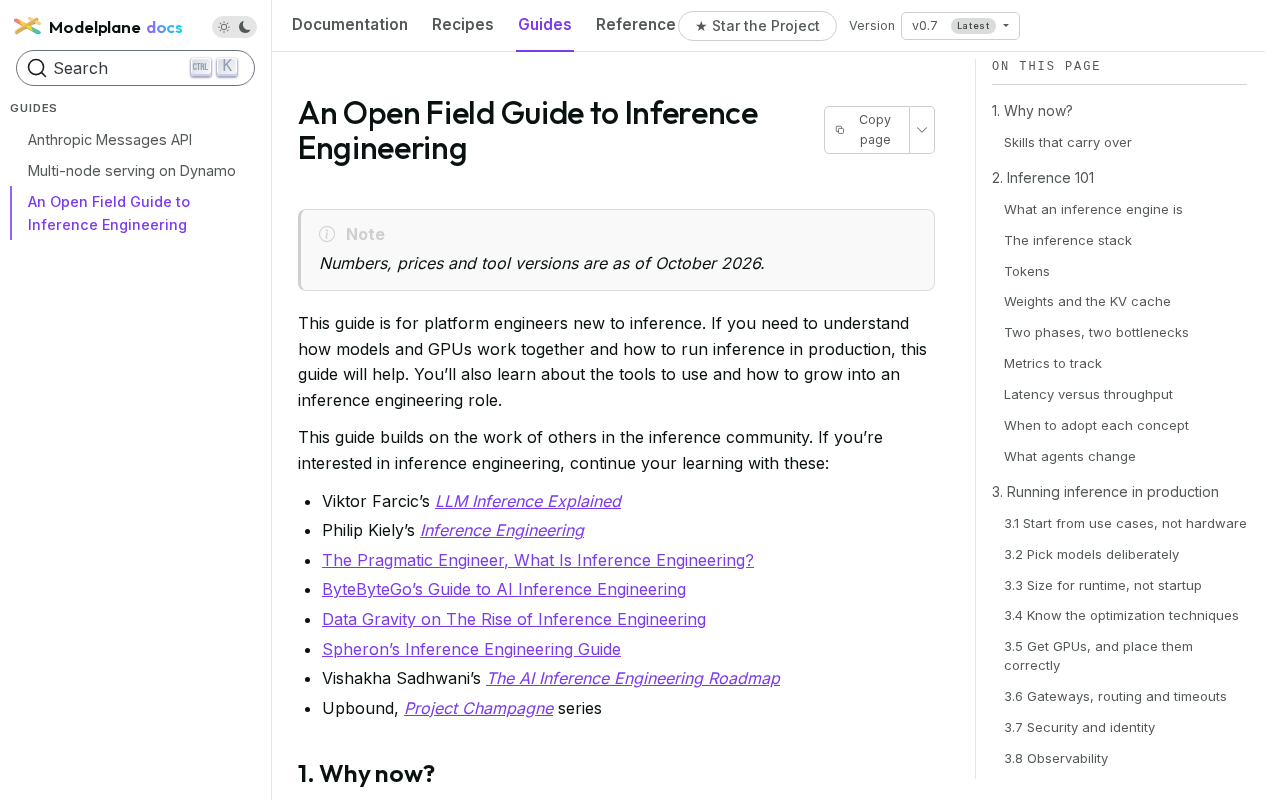
Inference engineering is becoming a key bottleneck for putting AI applications into production. A recent open guide titled "An Open Field Guide to Inference Engineering" appeared on Hacker News and sparked discussion in the community. Although the post did not gain much traction (3 points, 1 comment), its topic speaks directly to the real pain points engineering teams face in model deployment and optimization. Based on the guide's clues and community feedback, this article outlines the core knowledge framework of inference engineering and provides an actionable resource list.
Why Inference Engineering Deserves Separate Attention
Training large models is certainly eye-catching, but running models efficiently and reliably in production is the reality most teams face every day. Inference engineering involves a series of issues including latency optimization, throughput improvement, memory management, hardware selection, and cost control, and its complexity is no less than that of training.
The value of an open field guide lies in its attempt to systematize experience scattered across blogs, papers, and engineering practice. Although the Hacker News discussion was brief, it hints at the community's hunger for this kind of structured knowledge—especially as model sizes grow larger and deployment scenarios become more fragmented.
According to the original post title and community feedback, the guide emphasizes an "open" nature, meaning it likely aggregates open-source tools, public benchmarks, and reproducible configuration plans rather than one company's proprietary solution. This positioning is especially friendly to small and medium-sized teams.
Core Dimensions of Inference Engineering
Based on the guide's framework and community discussion, inference engineering can be broken down into the following key layers:
1. The Trade-off Between Latency and Throughput
The two core metrics of inference systems—single-request latency and overall system throughput—often constrain each other. Batching can improve throughput but may increase tail latency; conversely, overly low latency targets may limit hardware utilization. The guide likely discusses strategies such as dynamic batching and continuous batching, as well as how to set reasonable SLAs based on business scenarios.
A common rule of thumb in the community is: for interactive applications (such as chatbots), prioritize tail latency; for offline batch processing (such as content moderation), prioritize throughput. This scenario-based thinking is what distinguishes inference engineering from purely academic optimization.
Continuous batching is a scheduling strategy relative to traditional static batching. Static batching requires waiting for a batch of requests to all arrive before sending them into the model together, and resources are released only after the entire batch completes, causing short requests to be held back by long ones. Continuous batching dynamically removes completed sequences and inserts newly arrived requests at each decode step, keeping the GPU highly utilized. vLLM's PagedAttention and Orca's iteration-level scheduling are representative implementations of this strategy. In engineering practice, attention must be paid to its coordination with scheduler fairness, GPU memory fragmentation, and request timeout mechanisms; otherwise, long-tail amplification may occur under high concurrency.
2. Memory Management and Quantization
GPU memory is one of the scarcest resources in inference deployment. KV Cache management, quantization of model weights (from FP16 to INT8 or even lower precision), and tensor parallelism strategies all directly affect the number of concurrent requests a single card can handle. Open guides typically list methods for evaluating the impact of quantization on accuracy, as well as measured data on different hardware (NVIDIA GPUs, AMD GPUs, specialized accelerators).
It is important to note that quantization is not a panacea. Extreme quantization can lead to a significant drop in output quality, especially in long-context or complex reasoning tasks. If the guide includes accuracy-efficiency trade-off curves, it would be very helpful for engineering decisions.
KV Cache is an intermediate tensor cached during autoregressive inference to avoid recomputing the key-value pairs of historical tokens. Its size grows linearly with batch size, sequence length, number of layers, and attention head dimension, and it is often the main component of GPU memory usage. PagedAttention borrows the idea of operating system paging, dividing the KV Cache into fixed-size blocks and allocating them on demand, significantly reducing fragmentation and waste; vLLM is based on this to achieve high concurrency. In engineering practice, it is also necessary to consider prefix caching to reuse the KV of system prompts, as well as the impact of eviction policies on long-context scenarios; these directly determine the concurrency limit a single card can handle.
3. Hardware Selection and Serving Frameworks
The choice of inference serving framework (such as vLLM, TensorRT-LLM, TGI, etc.) is closely related to hardware selection. Open-source frameworks have different emphases in feature coverage and performance, while cloud vendors' managed inference services provide different levels of abstraction. The value of an open guide lies in comparing these solutions side by side and pointing out their respective applicable boundaries.
Judging from the atmosphere of the Hacker News discussion, the community prefers self-hostable open-source solutions, but does not reject cloud services in specific scenarios. The key is to have transparent benchmarks and reproducible configurations.
vLLM, TensorRT-LLM, and TGI are currently mainstream open-source inference serving frameworks with different positioning: vLLM stands out for PagedAttention and ease of use, with an active ecosystem and broad model support; TensorRT-LLM relies on NVIDIA's compilation optimization and kernel fusion to achieve lower latency on specific GPUs, but requires offline compilation and is strongly tied to hardware; TGI is maintained by Hugging Face, with high integration and a low deployment barrier. When selecting, one should comprehensively consider model structure, target hardware, whether multi-GPU tensor parallelism is needed, and the team's maintenance capability, and use real workloads for benchmarking rather than only looking at vendor data.
How to Use This Open Guide
For teams that want to go deeper into inference engineering, the following steps are recommended:
- Establish an evaluation baseline first: On the target hardware, test the latency and throughput of existing frameworks with representative workloads to form baseline data.
- Use the guide to troubleshoot bottlenecks: Check one by one according to the dimensions in the guide (batching strategy, quantization, parallelism) to locate the main bottlenecks.
- Validate through small iterative steps: Adjust only one variable at a time and record changes in accuracy and performance, avoiding changing multiple configurations at once and making attribution impossible.
- Participate in community co-building: The vitality of an open guide lies in continuous updates. If you encounter missing or outdated parts of the documentation, you can provide feedback to the community or submit supplements.
Although the original post on Hacker News did not receive much interaction, this kind of openly collaborative documentation is exactly the public good the engineering community needs. Its value will grow with contributions from users.
Limitations and Future of Open Guides
Any open guide faces challenges of timeliness and coverage. The field of inference engineering iterates rapidly, with new hardware, frameworks, and algorithms emerging constantly, and documentation can easily become outdated. In addition, different teams have vastly different constraints (budget, team size, compliance requirements), and a general guide can hardly cover all edge cases.
Therefore, a more reasonable expectation is to treat such guides as a "map" rather than a "route"—it tells you what terrain and tools exist, but the specific path still needs to be explored based on your own situation. If someone in the community discussion shares real lessons learned from pitfalls, its value is often no less than the guide itself.
For practitioners focused on inference engineering, it is recommended to continuously follow discussions of related posts on Hacker News and pay attention to release notes and benchmark updates of open-source frameworks. The combination of open guides and community practice is the best strategy for coping with rapid change.
One-line Summary
Outlines the core knowledge framework of inference engineering and the practical value of open guides.
Paragraph Summary
Using "An Open Field Guide to Inference Engineering" on Hacker News as a线索, the article points out that inference engineering is becoming a key bottleneck for putting AI applications into production, with complexity no less than training. It breaks inference engineering into three core dimensions: the trade-off between latency and throughput, memory management and quantization, and hardware selection and serving frameworks, emphasizing dynamic batching, KV Cache management, quantization accuracy evaluation, and side-by-side comparison of frameworks such as vLLM and TensorRT-LLM. At the practical level, it recommends that teams first establish an evaluation baseline, use the guide to troubleshoot bottlenecks, validate through small iterative steps, and participate in community co-building. The article also notes that open guides have limitations in timeliness and coverage and should be treated as a map rather than a fixed route, requiring continuous updates through combination with community practice.
Related articles

Microsoft Open-Sources Token Economizer: Saving 18%-31% on AI Coding Agent Costs
Microsoft's free open-source plugin Token Economizer cuts AI coding agent costs through micro skills, tool pruning, and failure loop intervention. Tests show 18.4% to about 31% average savings with Claude Code, Codex, and more.
Running GLM-5.3 on Two DGX Stations: A vLLM Tensor Parallelism Hands-On
NVIDIA engineers show how to run the 753B-parameter GLM-5.3 locally on two DGX Stations using vLLM tensor parallelism, covering RDMA setup, launch args, NCCL checks, and performance baselines.
97KB Single-File HTML Underwater World: A WebGPU Experiment in AI Programming
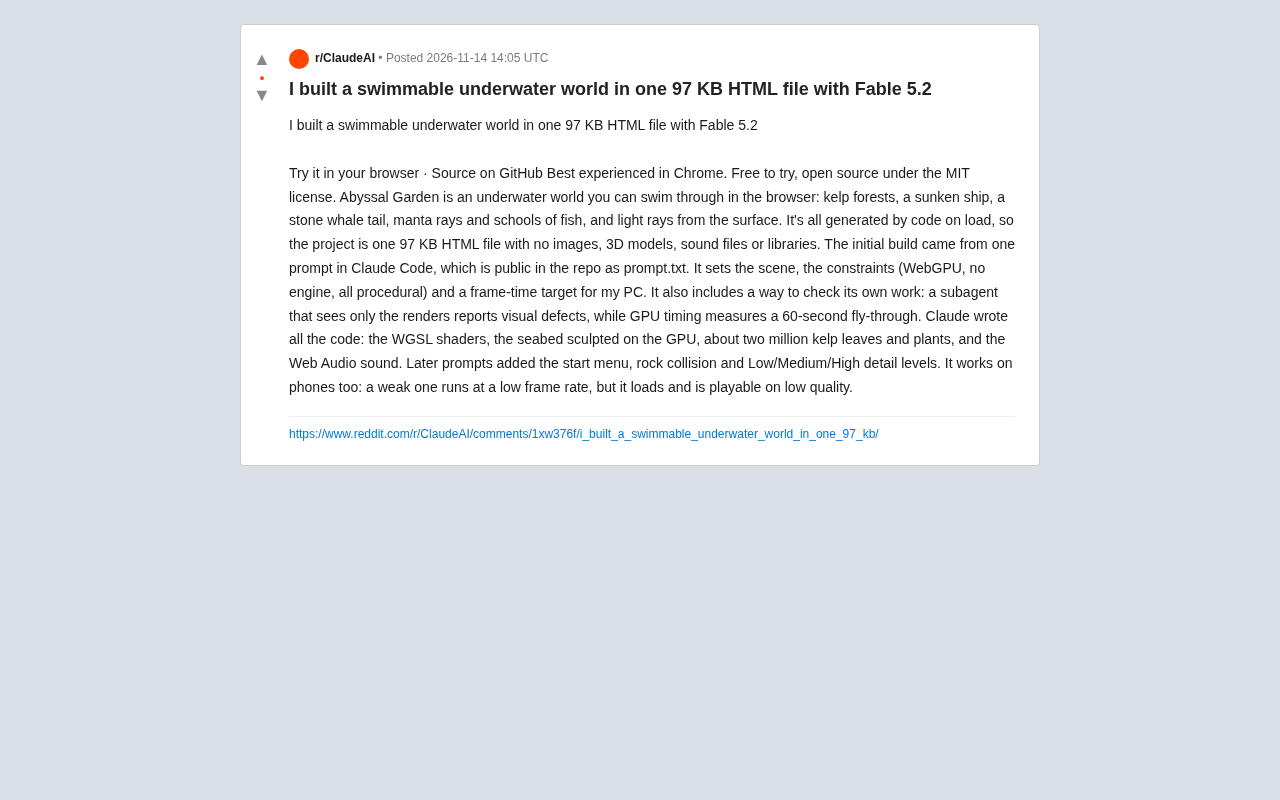
A developer used a single prompt in Claude Code to generate a 97 KB single-file HTML underwater world, fully procedurally generated with WebGPU—kelp forests, a shipwreck, and fish, no images or model libraries, MIT-licensed, playable on mobile.