Inflight: Adding a Feedback Layer to Prototypes So AI Coding Agents Can Take Requirements Directly

Inflight lets you pin comments on running prototypes and passes feedback to coding agents via MCP for execution.
Inflight targets the gap between "describing a problem" and "locating the code" in prototype reviews, letting reviewers pin comments to real DOM elements on a running app or record videos explaining interaction errors, so feedback naturally carries runtime context like route and page state. Its real leverage is handing structured feedback to coding agents like Cursor, Claude Code, and Codex via MCP, reducing manual translation loss. It suits multi-party interaction reviews and teams already using coding agents, but offers limited value to those without agents. Details of how feedback maps to code locations remain undisclosed, and changes still need human oversight.
The pain point in prototype review lies in the "last mile" of feedback: you can comment on design mockups, but not on a running prototype; you can record a screen video, but what's said doesn't match what gets changed. Inflight, ranked #9 on Product Hunt, aims to fill exactly this gap—letting reviewers annotate directly on the running app, then handing that feedback through MCP to coding agents like Cursor, Claude Code, and Codex for execution.
Which Gap It Bridges
The traditional prototype feedback loop roughly goes: send a preview link → reviewers describe issues verbally in a group chat or by email → designers/developers locate the elements themselves → make changes and send another round. The problem lies between "describing" and "locating": the reviewer sees "this button does nothing when clicked," but figuring out which line of code that corresponds to relies entirely on communication.
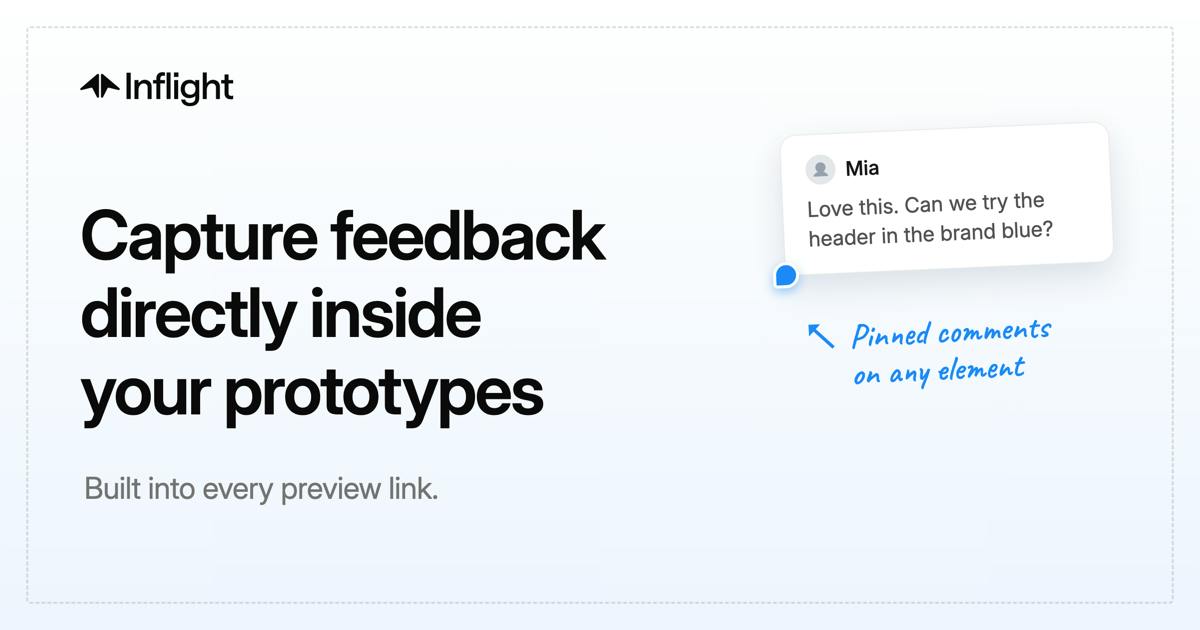
Inflight's approach is to pin comments onto real DOM elements. Reviewers open a preview link or HTML prototype, select specific elements in the running app to attach comments, or record a video explaining where the interaction goes wrong. Comments are bound to elements and page state rather than floating in a chat log.
This step isn't new—Figma has long done the same on static design mockups. Inflight's difference is that the object is a "running app," so comments naturally carry runtime context: which route, what state, what happened after the click.
"Real DOM elements" refers to the object tree the browser generates by parsing the HTML document. Every visible element on the page (buttons, input fields, images, etc.) corresponds to a node in the tree, carrying attributes like id, class, and hierarchy. Pinning comments to DOM elements rather than screenshot pixels means the feedback naturally carries programmatically parseable location information—which node, on which route, in what state. This is exactly the structured foundation for "knowing what's wrong" when later handing off to coding agents, and it's the essential difference from screenshot-annotation tools: screenshot annotations locate to coordinates, DOM annotations locate to nodes.
MCP Is Its Real Leverage
If all it did was "allow comments on prototypes," Inflight would just be a more niche annotation tool. Connecting feedback into coding agents is what makes it "the missing layer" in its product positioning.
According to the official description, Inflight organizes review feedback into actionable next tasks, and coding agents pull this content via MCP (Model Context Protocol). In other words, feedback no longer stops at a to-do list—it enters the agent's working context directly, and tools like Cursor, Claude Code, and Codex take over the edits.
The value of this chain is reducing manual translation. The reviewer's exact words, the element they point to, and the page state at the time are handed to the agent as structured input, with less loss than "copying the comment into a prompt and explaining it again." For teams already using coding agents, this is a low-cost way to plug the review stage into their existing workflow.
It should be noted that the officials haven't disclosed how feedback maps to specific code locations or how much human confirmation is needed on the agent side. MCP solves transport and context supply; from "knowing what's wrong" to "correctly fixing it," humans still need to be in the loop.
MCP (Model Context Protocol) is an open protocol proposed and open-sourced by Anthropic in late 2024, designed to establish a standardized way of connecting LLM applications with external tools and data sources. Think of it as an "AI version of USB-C": coding agents (MCP clients) request context or execute actions from external services (MCP servers) through a unified protocol, without writing separate integration code for each data source. In Inflight's case, review feedback such as comments, element locations, and page state is encapsulated as resources or tools on an MCP server, which agents like Cursor and Claude Code can pull on demand within their own working context, without manually copying content into prompts. This standardization layer is the technical precondition that makes "feedback going directly into the agent workflow" possible.
Use Cases and Boundaries
Inflight's positioning means its applicability is fairly specific. Suitable scenarios include: interaction prototype reviews requiring multi-party confirmation, asynchronous walkthroughs of the same preview link by remote teams, and teams that already incorporate coding agents into their daily development process. Its 113 votes and 11 comments show it hits a real need for some people, but it's not yet a mass-market tool.
What it's less suited for is equally clear. Pure static design mockup reviews have mature tools; if a team hasn't adopted coding agents yet, the value of the MCP chain drops sharply and the product degenerates into a prototype annotation tool. Additionally, automatically feeding review feedback to agents to modify code raises questions of who reviews and how to control the scope of changes—extra process conventions are needed.
Signals Worth Watching
Inflight represents a product direction that's taking shape: as AI coding agents grow more capable, the bottleneck shifts upstream from "writing code" to "clearly stating what to write." Whoever can translate human intent into agent-consumable input with less loss will occupy a new position. The feedback layer is one entry point; review, testing, and monitoring feedback could all connect into agents along protocols like MCP.
For developers, the practical value of such tools depends on two things: the quality of feedback structuring and the reliability of agent execution. Inflight has delivered a solution for the former; the latter remains to be seen in real-world use.
Related articles

Will GitHub Die? Open Source Maintainer Burnout and the Collaboration Crisis in the AI Era
Lex Fridman podcast discussion on open source maintainer burnout and GitHub's predicament: massive pull requests overwhelm core maintainers, and AI worsens code bloat. Using math journal peer review and Poincaré conjecture verification as analogies, the article analyzes why verification in knowledge production must be deliberately slow, and how open source communities can avoid the failure mode of maintainers exiting.

Stop Building Cookie-Cutter AI Websites: 3 Tools That Transform Your Coding Agent
Three tools that boost AI coding agents: FFmpeg skill for local video editing in Claude Code and Cursor, Hallmark's 50 design themes to fix cookie-cutter AI sites, and Jailbreaks' 25+ model prompts.

How America's Gerontocracy Squeezes the Younger Generation
Americans over 55 hold nearly three-quarters of national wealth, alongside an 80-year-old president and elderly congressional leaders. The Atlantic's Idrees Kahloon explains how gerontocracy drives up housing costs, squeezes opportunities for the young, and explores zoning reform and child poverty reduction as practical fixes.