Instagram Launches AI Video Editor Offering Personalized Feedback for Creators

Instagram debuts a conversational AI video editor that offers personalized feedback to help creators improve their content.
Instagram has officially launched a video editing tool built around a conversational AI assistant, with personalized feedback as its key differentiator over generic alternatives. Creators can describe their needs in natural language and receive targeted editing suggestions, marking a shift from traditional tools to intelligent creative collaborators. While this promises to lower the barrier for smaller creators, the true quality of its personalized guidance remains to be tested in practice — and that will ultimately determine its real value.
Instagram's AI Editor Arrives
Instagram has officially rolled out a new AI-powered video editing tool for creators, centered around a conversational AI assistant. Unlike most tools on the market that offer only generic suggestions, this assistant is designed to deliver personalized feedback, helping creators optimize their video content with greater precision.
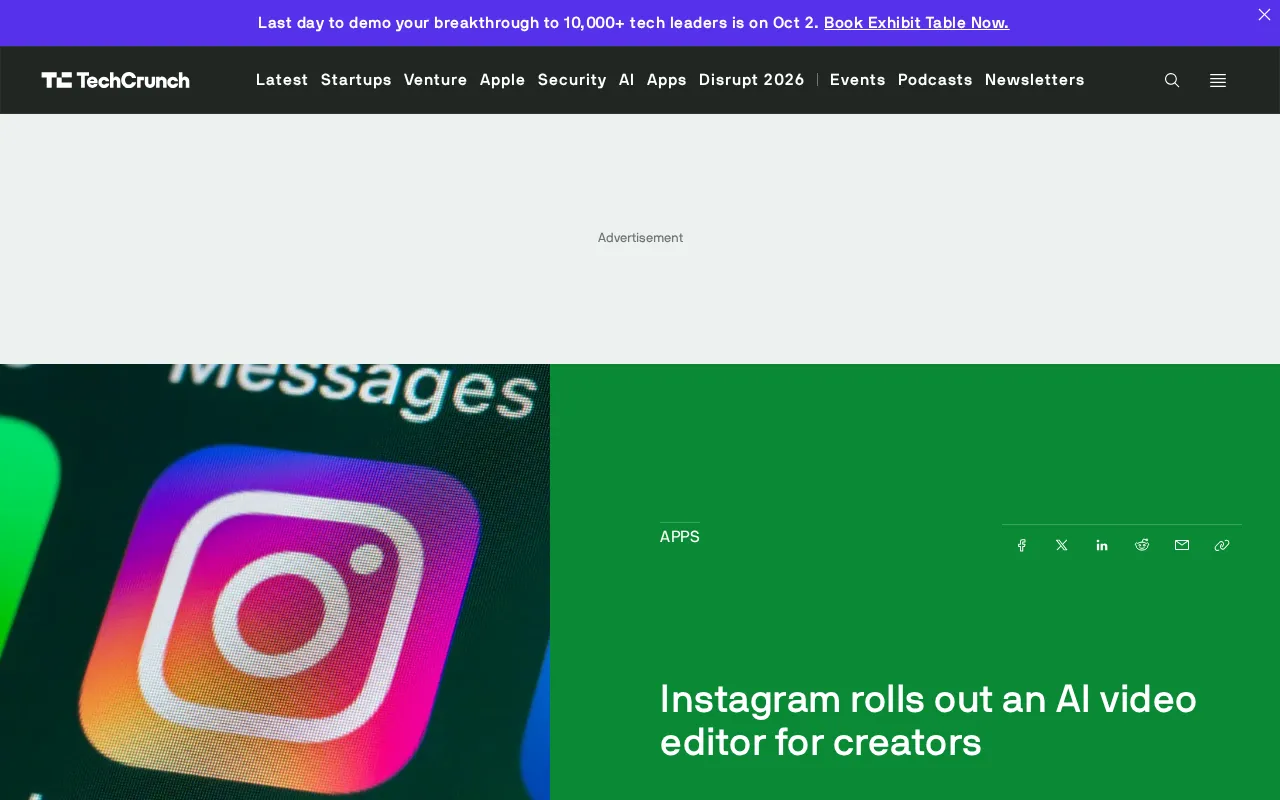
This move continues the trend of social platforms deeply embedding AI capabilities into the creative workflow. For Instagram — where short-form video and Reels are core growth drivers — lowering the barrier to creation and improving content quality directly impacts the platform's content supply and user retention.
Conversational Assistant: From "Generic Tips" to "Personalized Feedback"
The most notable differentiator of this tool is how users interact with it. Traditional video editing software typically offers fixed templates, filters, and parameter controls that creators must navigate on their own. A conversational AI assistant, by contrast, lets users describe what they need in natural language and receive targeted suggestions in return.
"Personalized" here means the assistant doesn't just recycle one-size-fits-all editing tips — it can potentially take into account a creator's specific content, style, and even audience preferences to deliver more relevant, actionable advice. This shift from "tool" to "collaborator" is one of the most compelling directions generative AI is heading in the creative space.
The underlying logic of a conversational AI assistant relies on the contextual understanding capabilities of large language models (LLMs). Natural language input from users is parsed by the model into specific editing intent, which is then mapped to parameters like timeline pacing, rhythm, music, or visual style. Compared to traditional rule-based recommendation systems, LLM-powered assistants can handle vague, open-ended requests — such as "make this video feel more energetic" — and attempt to translate them into actionable editing suggestions. Of course, the performance of such systems is highly dependent on training data quality. The model needs to have been exposed to a large volume of high-quality short-form video examples to provide genuinely useful feedback, rather than simply restating generic creative principles.
What This Means for Creators
For small and mid-sized creators, professional video editing skills and content strategy have always been significant barriers to entry. An AI assistant has the potential to help less experienced users quickly produce more competitive content.
That said, the real-world effectiveness of personalized feedback remains to be seen. Whether AI can truly understand a creator's intent and offer valuable — rather than vague — suggestions will determine whether this tool is a genuine asset or just a marketing gimmick. The platform's emphasis on "personalization" in its promotion is itself telling: it signals that this is precisely the pain point where most competing products fall short.
The AI Race Among Social Platforms
Instagram's move also reflects the ongoing escalation of AI creator tool investments across major social platforms. As content production efficiency becomes a key competitive variable, the platform that can best empower creators with AI will be better positioned to win the battle for content ecosystem dominance.
It's worth noting that this article is based on limited publicly available information. Specific details about the tool's feature scope, regional availability, and pricing have yet to be fully disclosed by the company. Creators should stay tuned and evaluate its value through hands-on use.
One of the core forces driving this AI creator tool race is the shift in algorithmic distribution logic. Short-form formats like Reels have their traffic largely determined by platform algorithms, and the metrics those algorithms weight — completion rate, engagement rate, share rate — are directly tied to editing rhythm, thumbnail appeal, and content structure. By embedding AI editing tools natively into the creation pipeline, platforms are also subtly nudging creators toward producing content that aligns more closely with algorithmic preferences, thereby raising the overall quality metrics of the content pool. TikTok's Symphony AI suite, YouTube's auto-dubbing and captioning tools, and Meta's continued investment in generative AI across its products all point to the same underlying logic: platforms reduce the cost of producing quality content, directly reinforcing their own competitive moat in the content arms race.
Related articles

Will GitHub Die? Open Source Maintainer Burnout and the Collaboration Crisis in the AI Era
Lex Fridman podcast discussion on open source maintainer burnout and GitHub's predicament: massive pull requests overwhelm core maintainers, and AI worsens code bloat. Using math journal peer review and Poincaré conjecture verification as analogies, the article analyzes why verification in knowledge production must be deliberately slow, and how open source communities can avoid the failure mode of maintainers exiting.

Stop Building Cookie-Cutter AI Websites: 3 Tools That Transform Your Coding Agent
Three tools that boost AI coding agents: FFmpeg skill for local video editing in Claude Code and Cursor, Hallmark's 50 design themes to fix cookie-cutter AI sites, and Jailbreaks' 25+ model prompts.

How America's Gerontocracy Squeezes the Younger Generation
Americans over 55 hold nearly three-quarters of national wealth, alongside an 80-year-old president and elderly congressional leaders. The Atlantic's Idrees Kahloon explains how gerontocracy drives up housing costs, squeezes opportunities for the young, and explores zoning reform and child poverty reduction as practical fixes.