Kairos: A PDDL Semantics-Aware Planning Engine Orchestration Framework

Kairos dynamically orchestrates five specialized planning engines based on task semantics, balancing broad coverage, low latency, and verifiability.
Kairos addresses the problem of diverse PDDL fragments and insufficient coverage by a single planner in robot runtime planning by proposing semantics-aware heterogeneous engine orchestration. The system generates a semantic profile for each task, selects and schedules applicable engines from five specialized ones, unifies time and memory budgets, and returns all candidate plans only after independent validator checks; unsolvability conclusions are reported only when search exhaustion constitutes a proof. On 1,756 tasks across nine suites, Kairos leads in the number of tasks solved under full resource limits as well as strict 100ms and 1s limits; it handles all seventeen probed features, while other planners handle at most eight; in classical planning, the difference from LAMA is within noise. Ablation experiments confirm compressed temporal search and novelty fallback as the main contributions, and the planner and benchmarks are open source.
In runtime scenarios where robots need to replan while acting, planners must quickly understand user-written PDDL—including durative actions, numeric resources, temporal windows, and continuous change—and return only validated plans. A single specialized planner often excels on a certain class of PDDL fragments but differs significantly in coverage, latency, and the meaning of failure. A study called Kairos proposes a new approach: select heterogeneous engines based on the semantics of each task, achieving coverage across a broad range from STRIPS to PDDL+ while remaining competitive with specialized planners and clarifying the guarantees behind each answer.
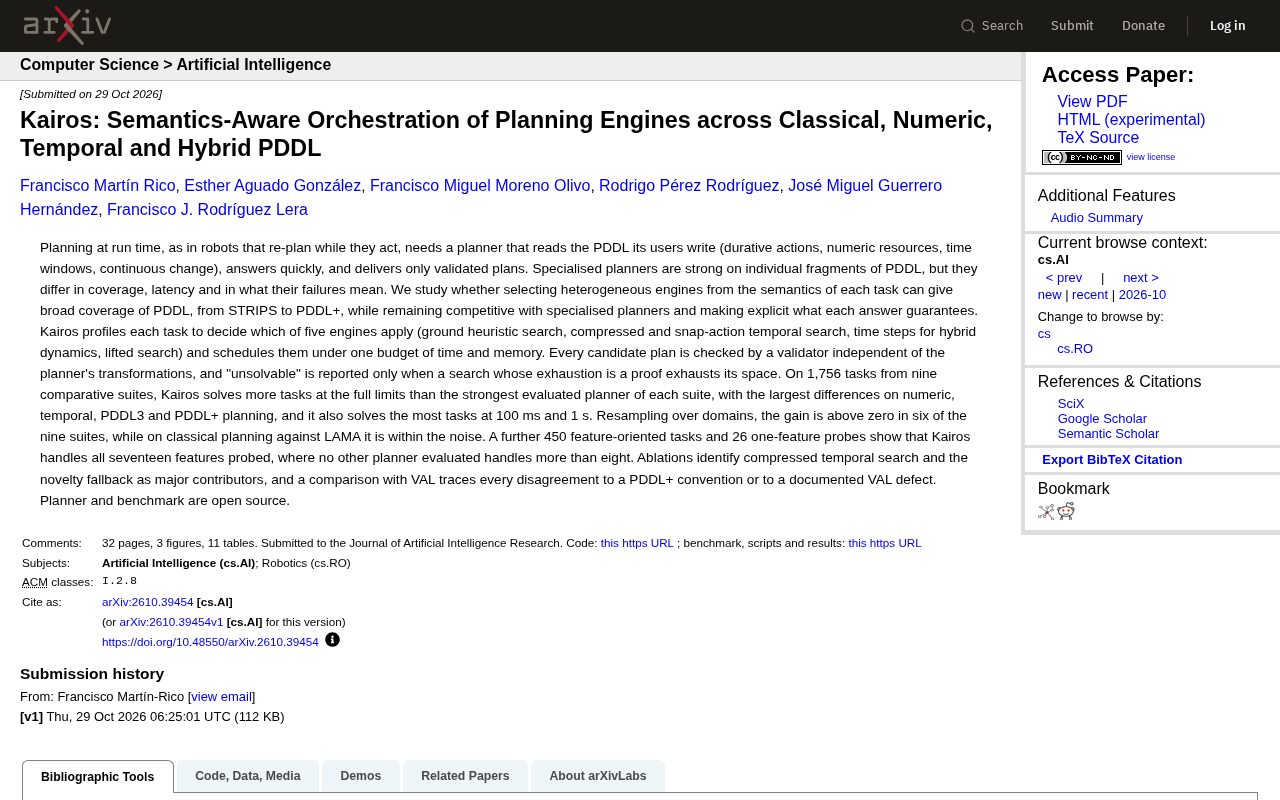
Problem Background: The Fragmentation Dilemma of Specialized Planners
PDDL (Planning Domain Definition Language) has evolved into multiple subsets, from classic STRIPS to PDDL+ supporting numeric, temporal, and hybrid dynamics. Each extension introduces new semantic challenges, and specialized planners typically optimize only for a subset of them. For example, some engines excel at heuristic search, some specialize in temporal constraints, and others are suited to continuous change. When a user writes a task containing multiple features, a single planner may fail outright due to unsupported syntax or produce results that cannot be validated. More troublesome is that the meaning of failure is not unified: some failures mean "no solution," while others are merely "timeout" or "out of memory," making it hard for users to distinguish.
The core observation of Kairos is: rather than seeking a universal planner, dynamically select and schedule multiple specialized engines at runtime based on the semantic features of the task. This leverages the strengths of each engine while ensuring the reliability of outputs through an independent validator.
PDDL (Planning Domain Definition Language) is a standardized modeling language promoted by the International Planning Competition (IPC). Its core idea is to split a planning problem into two files: a domain and a problem. The domain describes predicates, actions, and their preconditions and effects; the problem describes specific objects, the initial state, and the goal. STRIPS is the earliest subset, supporting only conjunctive preconditions, add/delete effects, and deterministic actions; subsequent extensions gradually added numeric fluents (such as resource consumption and production), durative actions and temporal windows, and continuous change quantities (processes and effects), forming versions such as PDDL2.1, PDDL3, and PDDL+. Different subsets are not simply additive semantically: coupling time and numerics introduces decidability and scheduling complexity, while continuous change requires reasoning over differential equations or intervals. For this reason, specialized planners typically deeply optimize for a particular fragment, and cross-fragment tasks often require manual tool switching—this is the root of the fragmentation dilemma.
Semantics-Aware Engine Orchestration Mechanism
Kairos generates a "profile" for each task and uses it to determine which of five engines are applicable: grounded heuristic search, temporal search with compression and instantaneous actions, temporal stepping for hybrid dynamics, lifted search, and others. These engines are scheduled under a unified time and memory budget. The key is that all candidate plans are checked by a validator independent of the planner's translation, and only plans that pass validation are returned. A "no solution" conclusion is reported only when some search process exhausts space and its exhaustiveness constitutes a proof—this avoids misclassifying timeouts as unsolvability.
This design transforms "planner failure" into "an interpretable answer": users can clearly know whether the result is a validated plan, a proven unsolvable case, or resource exhaustion.
"Grounding" is a key preprocessing step in PDDL solving: action schemas with variables and parameters are expanded into propositional actions without variables based on all object combinations in the problem. After grounding, the problem becomes a graph search over a finite state space, facilitating the use of heuristics (such as h^add, h^FF) and subplan extraction. However, grounding can cause combinatorial explosion; when the number of parameters is large, the number of propositions grows rapidly. Lifted search instead reasons directly over action schemas with variables, avoiding explicit enumeration of object combinations, and is more advantageous in domains with many objects and few action schemas. The temporal stepping engine for hybrid dynamics targets continuous processes in PDDL+, approximating continuous evolution with discrete time steps and needing to handle event triggering and numerical integration errors. Kairos unifies these solving methods at different granularities under a semantic profile, precisely to make task-level choices between grounded and ungrounded, discrete and continuous.
Benchmarking: Balancing Broad Coverage and Low Latency
According to the paper, on 1,756 tasks from nine comparison suites, Kairos solves more tasks under full resource limits than the strongest evaluated planner in each suite, with differences most pronounced in numeric, temporal, PDDL3, and PDDL+ planning. At the same time, under strict time limits of 100 milliseconds and 1 second, Kairos also solves the most tasks. After resampling domains, six of the nine suites show gains greater than zero; compared with LAMA on classical planning, the difference is within noise—meaning Kairos does not sacrifice classical planning performance.
An additional 450 feature-oriented tasks and 26 single-feature probes show that Kairos can handle all seventeen probed features, while none of the other evaluated planners can handle more than eight. Ablation experiments show that compressed temporal search and novelty fallback are the main contributing factors. Comparisons with the VAL validator trace every disagreement to PDDL+ conventions or known VAL defects.
VAL is a long-used plan validation tool in the PDDL community that checks whether a plan satisfies action preconditions, effects, and temporal and numeric constraints. However, VAL's support for PDDL+ continuous process semantics is incomplete, and it differs from planner implementations on certain boundary conventions (such as priority when events occur simultaneously, and handling of numeric precision). Therefore, when Kairos's independent validator and VAL give different conclusions, it is necessary to determine case by case whether Kairos follows stricter PDDL+ conventions or whether VAL's known defects are responsible. This also shows that the validator itself is not an absolute source of truth; its semantic implementation likewise requires community standardization. In reproduction experiments, using different validators may yield different "validated" sets—a detail easily overlooked when evaluating planning systems.
Open Ecosystem and Reproducibility
Kairos's planner and benchmarks are open source, providing a foundation for further community validation and extension. For robot applications requiring runtime planning, this semantics-aware orchestration approach offers a path that balances coverage, response speed, and result credibility.
Limitations and Outlook
Currently Kairos's engine set is fixed at five; whether more engines can be automatically discovered or composed in the future is worth exploring. In addition, although validator independence improves credibility, it may also become a performance bottleneck. The disagreements with VAL mentioned in the paper also suggest that PDDL+ semantic conventions themselves still need further community unification.
Overall, Kairos demonstrates the potential of "on-demand orchestration" in planning: not replacing specialized planners, but letting them each play their role, commanded by semantics.
"Novelty fallback" is a class of search recovery strategy based on state novelty: when the main search stalls due to misleading heuristics or local minima, it shifts to prioritizing states containing combinations of facts rarely seen before, in order to escape search dead ends. Such methods do not rely on strong heuristics and are especially useful on tasks whose feature distributions differ greatly from classical benchmarks, making them one of the main contributing factors in ablation experiments. Compressed temporal search, on the other hand, reduces search branching by merging instantaneous actions that occur simultaneously or nearly simultaneously and compressing redundant steps on the timeline, yielding clear benefits for tasks coupling time and numerics. The two improve coverage from two sides—search direction and state-space size—explaining part of why Kairos maintains low latency on heterogeneous tasks.
One-line Summary
Kairos dynamically orchestrates five specialized planning engines based on task semantics, balancing broad coverage, low latency, and verifiability.
Paragraph Summary
Kairos addresses the problem of diverse PDDL fragments and insufficient coverage by a single planner in robot runtime planning by proposing semantics-aware heterogeneous engine orchestration. The system generates a semantic profile for each task, selects and schedules applicable engines from five specialized ones, unifies time and memory budgets, and returns all candidate plans only after independent validator checks; unsolvability conclusions are reported only when search exhaustion constitutes a proof. On 1,756 tasks across nine suites, Kairos leads in the number of tasks solved under full resource limits as well as strict 100ms and 1s limits; it handles all seventeen probed features, while other planners handle at most eight; in classical planning, the difference from LAMA is within noise. Ablation experiments confirm compressed temporal search and novelty fallback as the main contributions, and the planner and benchmarks are open source.
Related articles

Surface RTX Spark Dev Box Runs 120B Model Fully Offline: An Intelligent Terminal Hands-On
Microsoft Surface RTX Spark Dev Box demo: running a 120B local model offline via open-source Intelligent Terminal, building a bootable Hyper-V VM with one sentence, showcasing Project Zemuth local AI.

After Affirmative Action Ends: Sharp Drop in Black Enrollment and the Rise of HBCUs
After the Supreme Court ended race-conscious admissions, Black freshman enrollment at the top 50 most selective universities fell 27%, with Harvard dropping from 18% to 11.5% and Yale from 9.5% to 8%, as more Black students turn to HBCUs.

Claude Rolls Out Watermarking Across the Board: Paid Users Can't Opt Out, But Only a Select Few Can Detect It
Anthropic extends Claude's invisible text watermark to Mythos 5, Opus 4.7 and more, globally and with no paid opt-out. Even proofreading and translation get marked, yet detection is limited to regulators and enterprises.