Kiwi: The AI Assistant That Texts You First and Gets Things Done Ahead of Time

Kiwi is a proactive AI assistant that texts users first and executes tasks on their behalf.
Kiwi is a proactive AI assistant on Product Hunt. Unlike passive tools like ChatGPT, it tracks users' trips, plans, bills, and contacts, texting suggestions via iMessage or WhatsApp at the right moment—such as booking a ride when a flight is delayed. With user consent, it executes tasks across apps and websites. Built by Aneesh Modi, it's a free pilot with 83 upvotes. Its execution method, permission boundaries, and interruption control remain key open questions.
Most AI assistants are still waiting for you to ask a question. Kiwi has chosen a different path: it texts you proactively. Launched on Product Hunt under the tagline "A proactive AI assistant that texts you before you ask," this product tries to turn the assistant from a "Q&A tool" into a "life concierge."
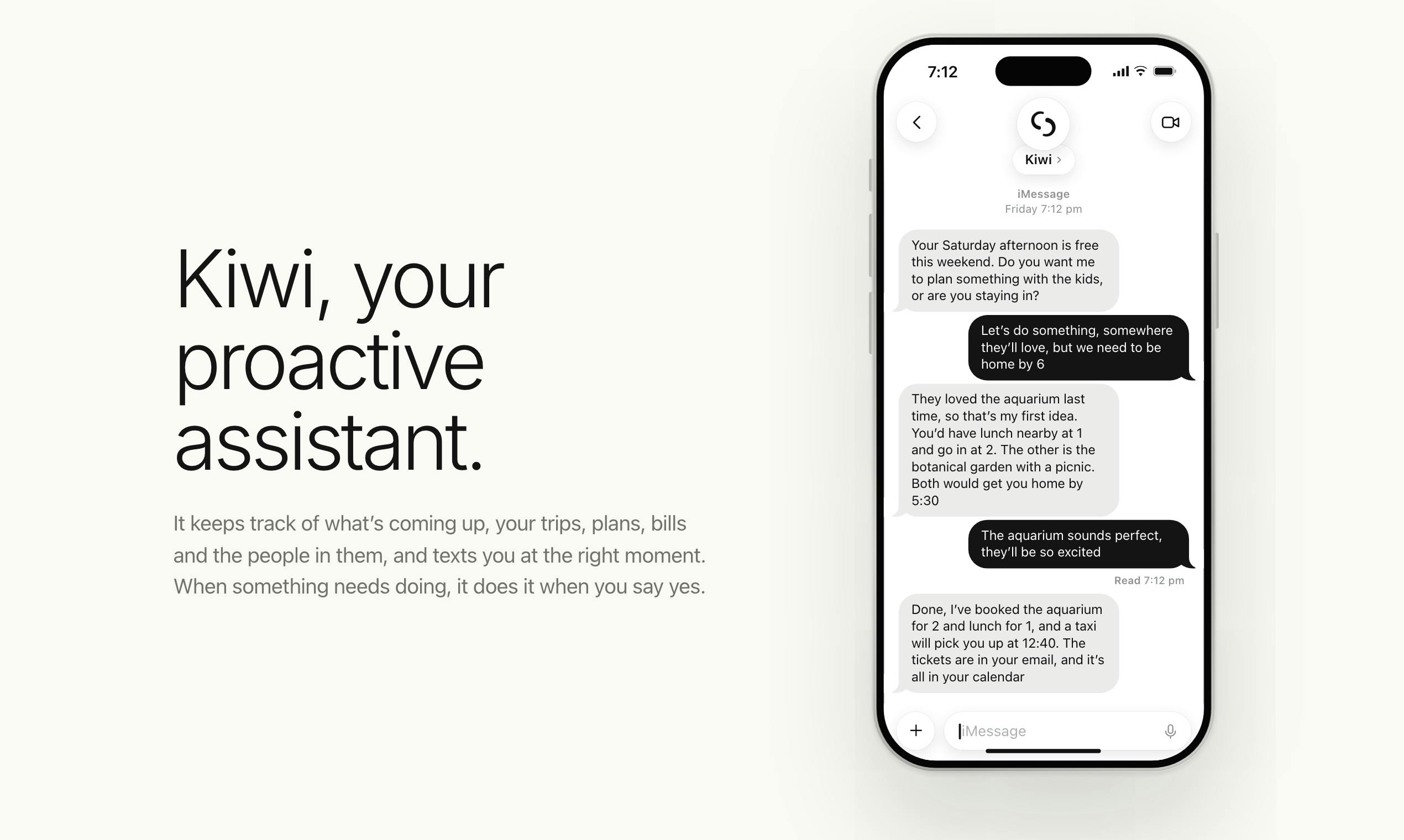
From "You Ask, It Answers" to "It Speaks First"
Kiwi's positioning is quite clear: it continuously tracks your upcoming trips, plans, bills, and the people involved in these matters, then reaches out to you via text at the right moment. The official description gives a few scenarios—when Saturday opens up, it asks whether you'd like to plan an activity with your kid; when a flight is delayed, it asks whether you'd like to book a ride in advance; when a package needs to be signed for but you're at work, it suggests rescheduling delivery to Saturday.
The common thread across these scenarios: the user didn't initiate the conversation—the need was identified and raised by Kiwi. This is fundamentally different from the interaction paradigm of conversational assistants like ChatGPT and Claude—the latter respond passively, while the former tries to take on part of the cognitive burden of "remembering" and "reminding."
Interestingly, Kiwi chose iMessage and WhatsApp as its distribution channel rather than a standalone app. This is a pragmatic decision: text messaging is the interface with the highest open rate and lowest interruption cost on a phone—users don't need to learn a new tool or install anything extra.
Conversational AI assistants (like ChatGPT and Claude) operate on a "request-response" model: the user inputs a prompt, the model generates a reply, and the user controls the pace and direction of the conversation. These systems are essentially passive-reactive—they have no continuously running "background awareness" and cannot initiate interactions. Proactive agents, on the other hand, need to continuously monitor external signals (calendar, email, location, sensor data) when the user provides no input, determine when it's worth interrupting the user, and autonomously decide the timing and content of reaching out. This shift involves two key technical challenges: first, the decision function of "when to speak," which must weigh information value against interruption cost; second, long-term memory and state tracking, so the assistant can remember context across sessions. Kiwi's choice of text messaging as its proactive outreach channel leverages the asynchronous, low-interruption, high-open-rate nature of texting, bypassing the barrier of standalone apps that require users to actively open them.
"You Say Yes, It Gets It Done"
Kiwi's other half of capability is on the action side. The product description states that when something needs handling, as long as the user agrees, Kiwi can complete it on their behalf in any app or website. This means it's not just a reminder—it's an agent with execution capability.
This capability is no small feat to implement. Cross-app, cross-website operations mean Kiwi needs to handle login states, interface differences, and edge cases, and the phrase "any app or website" also leaves questions: is it implemented through API integrations, accessibility services, or some kind of automation script? The original material doesn't provide technical details. For highly sensitive operations like payments and travel bookings, permission boundaries and failure rollback mechanisms are what users care about most, and public information is still very limited.
Implementing cross-app automation on mobile typically follows three technical paths. The first is official API integration: completing bookings, changes, and other operations through programmatic interfaces opened by target services—stable but limited in coverage, and requiring business development one by one. The second is Accessibility Service: Android allows apps to read screen content and simulate clicks, enabling operation of apps without APIs, but it's permission-sensitive, easily restricted by manufacturers, and breaks whenever the interface is redesigned. The third is cloud-based automation scripts or browser automation (like Playwright, Selenium), simulating user operations on the server side, which requires handling login states (cookies, CAPTCHAs, multi-factor authentication) and anti-automation detection. For highly sensitive operations involving payments, transactional safeguards must also be designed: secondary confirmation before operations, failure rollback, idempotent retries, and clearly defined authorization scope. If Kiwi's claim of "any app or website" is to hold true, it likely uses a mix of the above approaches—and its reliability, compliance, and security boundaries remain an open question.
Signals Behind the Product
Kiwi comes from developer Aneesh Modi and received 83 upvotes and 3 comments when it launched on Product Hunt, ranking 10th. This is a mid-to-upper level of exposure on Product Hunt, suggesting that the concept of a "proactive AI assistant" resonates to some degree but is still some distance from being a breakout hit.
In terms of category, Kiwi is classified under Productivity, Travel, and Artificial Intelligence, which reflects its ambition—not to be a single-point tool but to切入 multiple life scenarios like scheduling, travel, and bills. The product is currently in pilot phase and free to use.
Proactive AI assistants are a direction startups have been frequently exploring over the past while. Compared to general-purpose chatbots, these products rely more on continuous access to users' personal data and therefore hit the privacy and trust boundary sooner. Whether Kiwi can make users comfortable handing over their schedules and bills will determine whether it can move from pilot to official product.
Product Hunt's ranking mechanism sorts in real time based on the number of new upvotes that day; 83 upvotes ranking 10th means moderate exposure on a day with relatively light competition. This vote count typically corresponds to the stage of "early adopters paying attention, but not yet breaking out." For the proactive AI assistant category, Product Hunt feedback carries some signal value: the concept sparks curiosity, but the vote count also reflects seasoned users' wait-and-see attitude toward practical issues like privacy and reliability. Historically, proactive assistants (such as Google Now and Microsoft Cortana's proactive reminder features) have been attempted multiple times but failed to become mainstream due to poor interruption control or insufficient data access. Kiwi, with text messaging as its interface and a free pilot as its strategy, is effectively testing whether the hypothesis of "proactive intervention" holds up using the lowest-friction approach.
A Few Questions Worth Watching
First, how is the frequency of proactive interruptions controlled? An assistant that "talks too much" will quickly be muted, and Kiwi needs to prove it has the ability to judge "when not to speak." Second, reliability of the execution layer. Operations like booking and changing reservations have extremely low tolerance for error—a single mistake could erase trust accumulated over time. Third, data sources. To track trips and bills, Kiwi must connect to email, calendars, or text messages, and the depth of these integrations directly determines its capability ceiling as well as its risk exposure.
Kiwi represents a product approach that is taking shape: AI is no longer just answering questions but beginning to proactively intervene in everyday decisions. Whether this direction holds depends on how precisely the product finds the line between "useful" and "not annoying."
One-line Summary
Kiwi is a proactive AI assistant that texts users first and executes tasks on their behalf.
Paragraph Summary
Kiwi is a proactive AI assistant launched on Product Hunt. Unlike passive-response tools like ChatGPT, it continuously tracks users' trips, plans, bills, and related contacts, proactively texting suggestions via iMessage or WhatsApp at the right moment—for example, asking whether to book a ride when a flight is delayed, or suggesting a delivery reschedule when a package can't be signed for. Once the user agrees, Kiwi can complete operations across apps or websites on their behalf, combining reminding and execution capabilities. Built by developer Aneesh Modi, the product is currently a free pilot and ranked 10th on Product Hunt with 83 upvotes. The article notes that its cross-app execution method, permission boundaries, and failure rollback mechanisms remain unclear, and that controlling proactive interruption frequency and earning user trust are key to the success of such products.
Related articles

Microsoft Fabric Database Agent in Action: From Reactive Firefighting to Intelligent Detective
A deep dive into the Microsoft Fabric Database Agent: how to enable it, supported monitoring scenarios, a blocking-issue demo, and the roadmap from reactive to autonomous operations.

Zendesk Uses ChatGPT Enterprise to Build a Sales Agent with 1,000 Daily Active Users
Zendesk opened ChatGPT Enterprise to all employees, who built about 600 apps themselves, including a sales expansion agent with about 1,000 daily active users. This article analyzes how it turns internal data into sales opportunities and its "don't wait" implementation strategy.

Google Releases Gemini 4 Carbon: Its Strongest Model Yet, Debuting with a Cybersecurity Focus
Google releases Gemini 4 Carbon, calling it its strongest model, with a cybersecurity focus. It tops the third-party composite ranking at 59 points but leads by only one or two. This article analyzes its security test results, staged rollout, token pricing, and the divergence between self-reported and third-party tests on hallucinations.