Local AI Bookkeeping Tool LedgerPrep Lite: Automated Receipt Organization

LedgerPrep Lite uses local AI to extract receipt information and export CSV, reducing manual organization before bookkeeping.
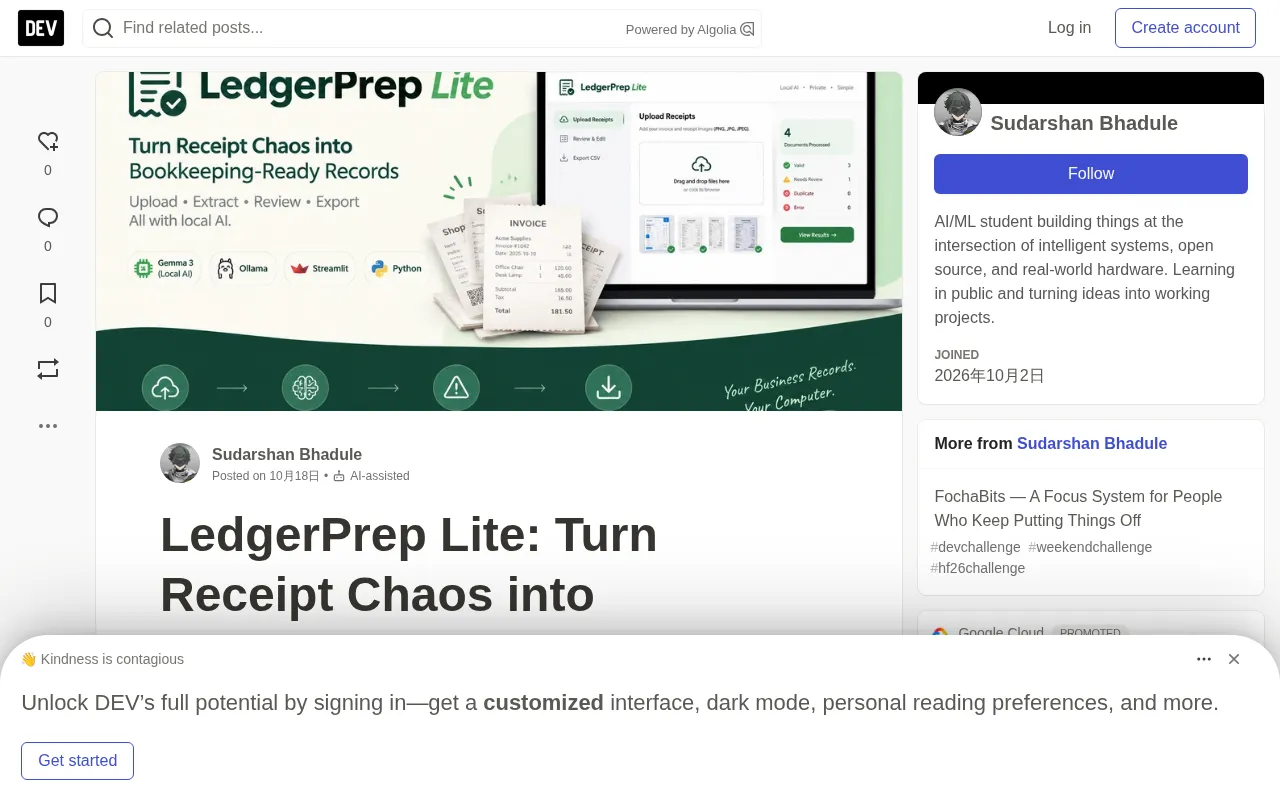
LedgerPrep Lite is a local AI bookkeeping preparation tool for small business owners and independent bookkeepers. Users upload invoice or receipt images, and the app automatically extracts vendor name, invoice number, date, and total amount, flagging possible duplicates, missing information, and totals to verify. After review and correction, users export a CSV that integrates into existing accounting workflows. It uses Streamlit, Ollama with Gemma 3 4B for local inference, Python for validation, and Pandas for CSV export. Local inference protects privacy and avoids vendor lock-in.
Small business owners often leave receipts scattered across WeChat, email, and their photo galleries, and organizing them into records their accountant can use at the end of the month is time-consuming and laborious. LedgerPrep Lite is a locally AI-driven bookkeeping preparation tool. By uploading invoice and receipt images, it automatically extracts key information and flags issues, ultimately exporting a CSV. Its goal is to reduce the manual labor before bookkeeping, not to replace accountants.
The Pain Point: Scattered Receipts and Inefficient Organization
Small businesses and independent bookkeepers face a common challenge: receipts come from scattered sources in inconsistent formats. At the end of each month, information must be manually collected, entered, and completed before it can be handed to an accountant. This process is repetitive and error-prone. LedgerPrep Lite targets exactly this "pre-bookkeeping" stage, with the goal of transforming chaotic receipts into structured records.
Features: Local AI Extraction and Smart Flagging
After users upload invoice or receipt images, the app extracts fields such as vendor name, invoice number, date, and total amount. Beyond extraction, it also flags possible duplicate invoices, missing information, and totals that need verification. Users can review and correct the results before export to ensure data accuracy. The final output is a well-organized CSV that integrates seamlessly into existing accounting workflows.
CSV (Comma-Separated Values) is a plain-text tabular format in which each row represents a record and fields are separated by commas. It is supported by virtually all accounting software (such as QuickBooks and Xero) and spreadsheet tools, making it a universal format for data exchange. LedgerPrep Lite chooses to export CSV rather than integrating directly with a specific accounting platform in order to keep the tool neutral and general-purpose—users can import the generated CSV into their existing bookkeeping workflow without switching accounting systems. This also aligns with the project's positioning of "reducing manual labor before bookkeeping, not replacing accountants."
Technical Implementation: A Lightweight Stack with Local Inference
The project uses a simple Python tech stack focused on a single complete workflow:
- Streamlit: builds the upload, review, and download interface.
- Ollama + Gemma 3 4B: runs an open-weight language model locally to extract structured information from images.
- Python: validates data and flags missing fields, duplicates, and arithmetic inconsistencies.
- Pandas: organizes records and exports CSV.
Model output is not automatically treated as correct. Financial information can be ambiguous, so users must be able to view the original documents, correct errors, and review flagged records.
Ollama is an open-source framework for running local large models. It supports one-click pulling, quantization and compression, and inference for a variety of open-weight models, and provides an OpenAI-compatible API interface. It enables developers without deep learning engineering experience to run language models on ordinary laptops, without GPU clusters or cloud services. In LedgerPrep Lite, Ollama plays the role of deploying the Gemma 3 4B model locally; users only need to install Ollama and pull the model to start extracting receipt information, which lowers the barrier to local AI applications.
Gemma is a series of open-weight language models released by Google, built on technology from the same lineage as Gemini. Gemma 3 4B refers to the small version of the third generation of the series with approximately 4 billion parameters, suitable for running on consumer-grade hardware. Although a 4B-scale model falls short of larger models on complex reasoning, for structured information extraction tasks such as receipt field extraction, combined with prompt engineering and local compute, it can already provide usable accuracy while balancing speed and privacy.
The Value of Open Innovation: Privacy and Cost Control
Financial documents contain sensitive information. Sending every receipt to an external AI service is not always advisable. LedgerPrep Lite processes documents through local inference, requiring no hosted AI API. Open-weight models also let users freely experiment with different models and adjust the extraction pipeline without being locked in by a single vendor's API pricing. Open-source AI here is not just a technical choice but a path to more private and more economical AI-assisted bookkeeping.
The project was submitted in Week 2 of the Hacktoberfest Open Source AI Challenge and is participating in the "Best Use of Gemma" award category.
Limitations and Outlook
The current version focuses on a single workflow and does not build a complete accounting platform. The accuracy of local models on complex documents still has room for improvement, and the user review step is crucial. Future work could explore more model adaptations and automated validation rules.
LedgerPrep Lite demonstrates the practicality of local AI in vertical scenarios: solving a specific pain point, respecting data privacy, and keeping the tech stack lightweight. For small business owners plagued by receipt organization, this is an open-source solution worth watching.
One-line Summary
LedgerPrep Lite uses local AI to extract receipt information and export CSV, reducing manual organization before bookkeeping.
Paragraph Summary
LedgerPrep Lite is a local AI bookkeeping preparation tool for small business owners and independent bookkeepers. Addressing the pain point that receipts are scattered across WeChat, email, and photo galleries, making end-of-month manual organization time-consuming and error-prone, users upload invoice or receipt images and the app automatically extracts fields such as vendor name, invoice number, date, and total amount, while flagging possible duplicate invoices, missing information, and totals that need verification. Users can review and correct the results before exporting CSV that integrates seamlessly into existing accounting workflows. The tech stack uses Streamlit for the interface, Ollama to run the Gemma 3 4B model for local inference, Python to validate data, and Pandas to export CSV. Local inference protects financial privacy, and open-weight models avoid vendor lock-in, demonstrating the practical value of open-source AI in vertical scenarios.
Related articles

Anthropic Files S-1: $16.3B Revenue, $80.7B Net Loss in Half a Year — Who Controls the Company?
Anthropic files S-1 for a Nasdaq IPO: H1 2026 revenue of $16.3B, an $80.7B net loss from valuation remeasurement rather than cash burn, founders' Class F shares holding 50.1% voting power, and no price or date yet.

Anthropic Files S-1: The Truth Behind $16.3B Revenue and $80.7B Loss
Anthropic's S-1 reveals $16.3B revenue and $80.7B net loss in H1 2026, with $72.4B from accounting effects. The filing also discloses $265.6B compute commitments, cloud deal details, and a 50.1% founder voting control structure, while IPO pricing remains blank.

Anthropic Financials Leaked: Revenue Far Exceeds Compute Costs, Claude Inference Gross Margin Hits 68%
Leaked Anthropic financials show revenue roughly twice total compute costs, Claude inference gross margin at 68%, while frontier training burns $2.8B per quarter. This article breaks down the two accounts and analyzes shifts in AI company valuation logic.