Loop Engineering Primer: Agent Loop and Intelligent Agent Loop Design in Practice

Loop Engineering centers on engineering an agent's think-act loop to make it controllable and convergent.
The article introduces "Loop Engineering," noting that AI applications are shifting from single-turn Q&A to agents that continuously observe, decide, and act—with the Agent Loop as the pivot. It distinguishes agents from LLMs by autonomous tool calling and continued reasoning, explains the early while-loop implementation (observe, think, execute, check termination), and cites LangChain's early use of this pattern. It also highlights context memory as a second key difference and derives engineering risks around termination conditions, tool boundaries, context growth, and prompt coordination.
Why You Need to Understand Loop Engineering Now
"Loop Engineering" is a relatively fresh term. It sounds abstract, but broken down it isn't complicated: the core is engineering design around the loop mechanism of an agent. It's worth discussing separately because the focus of AI applications has been shifting over the past few years—from "getting a large model to answer a question" to "getting an agent to continuously observe, decide, and act until the task is complete." The pivot of this shift is the Agent Loop.
According to a Bilibili creator's sharing, when understanding this concept you shouldn't start from existing development experience, because many individual pieces look simple on their own, yet the abstraction that emerges when combined is easily underestimated. Building the overall picture first and then returning to the definition works better than nitpicking terminology.
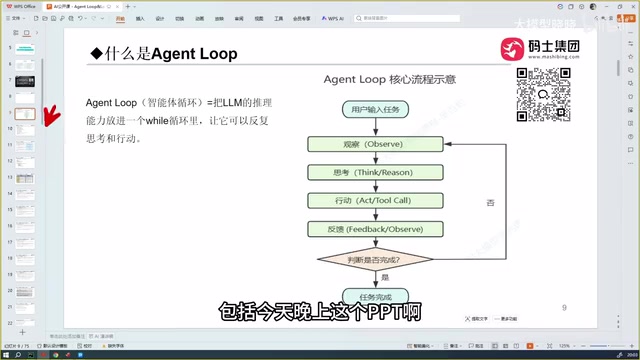
What Is an Agent Loop: The Divide Between Agents and Large Models
The most intuitive difference between an agent and a large model lies in the autonomy of tool invocation. Large models can also call tools, but usually a human must manually execute the call and feed the result back; an agent can initiate tool calls itself and, after getting results, continue reasoning: whether to keep calling tools to gather more information, or to give the user a final answer directly.
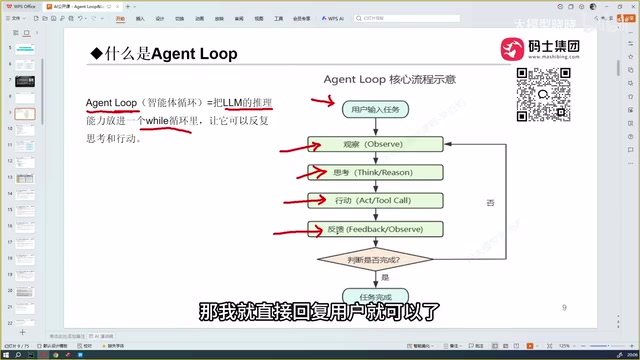
This back-and-forth process of "think—act—think again" is the Agent Loop. It gives agents the ability to complete tasks coherently, rather than ending after a single question and answer. The original text summarizes it in one sentence: the loop is its cycle of thinking and acting, thinking and acting.
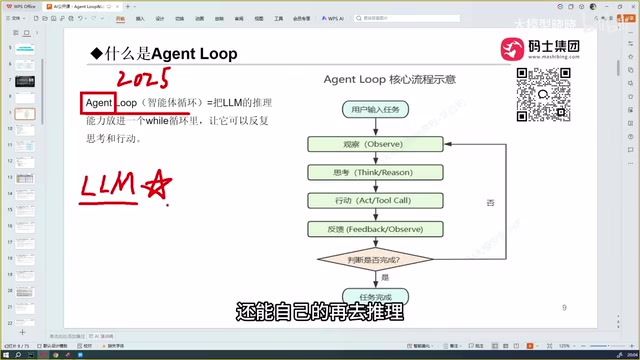
A Single while Loop Explains the Agent Loop
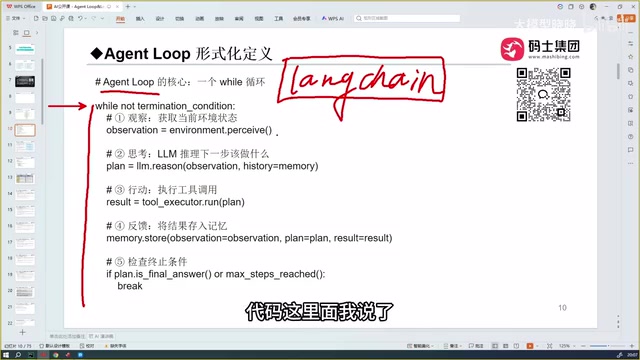
Early Agent Loop implementations were very plain: repeatedly calling the large model inside a while loop. After user input enters the loop, the large model observes the current state and decides whether to answer directly or call a tool; if it calls a tool, the result is passed back and the next round of reasoning continues; if it decides to answer, the output goes to the user.
The loop also contains a termination condition check—if it judges that the user has gotten the desired result, the loop ends and the conversation is complete. The original text emphasizes that LangChain, a relatively mature and mainstream agent development framework in the industry, implemented the Agent Loop in exactly this while-loop fashion in its early days. The formalized code is roughly: read user input and current environment state → think about the next action → execute (call a tool or reply directly) → check the termination condition → if not terminated, return to the thinking step.
The ReAct paradigm is important background for understanding the Agent Loop. ReAct (Reasoning + Acting) was proposed by Shunyu Yao et al. in 2022, and its core idea is to have the large model alternate between "reasoning" and "acting": first output a Thought, then decide to execute an Action, receive an Observation, and continue to the next round of thinking. This is precisely the academic origin of the "think—act—think again" loop in the text, and the paradigm on which LangChain's early agent implementation was based. Understanding ReAct helps connect the plain while loop with the more complex planning and reflection-based agents that followed.
Memory Is the Second Key Difference Beyond the Loop
Besides tool invocation, another difference between agents and large models is contextual memory. Memory can also be managed on the large-model side, but it often requires manual human execution; an agent naturally carries context through the loop, bringing historical tool results and reasoning traces into the next round. This is why Loop Engineering needs a separately designed memory strategy: the longer the loop, the more easily the context balloons, and how to trim, summarize, and retain key state directly determines whether the loop can converge stably.
The context window refers to the upper limit of tokens a large model can receive in a single inference, and it is a hard constraint on memory management within the loop. The results of each round of tool calls and the model's reasoning traces are appended to the context, and the more rounds there are, the more space is consumed. Once it approaches the window limit, early key information may be truncated, reasoning quality declines accordingly, and the loop may even fail to converge. Common countermeasures include sliding-window trimming, summarizing and compressing history, and storing long-term state in external storage and retrieving it on demand—all of these are concrete designs of memory strategy in Loop Engineering.
Design Elements and Risk Points of Loop Engineering
In the course, the creator planned content covering the Agent Loop, Prompt, five major building blocks, Loop design elements, and risk points. Although the original material only expands on the Agent Loop part, several engineering concerns can be derived from the loop structure itself:
- Termination condition design: Judging "whether the task is complete" is the exit of the loop. Conditions that are too loose lead to premature wrap-up, while conditions that are too strict may fall into an infinite loop of repeated tool calls.
- Tool invocation boundaries: An agent autonomously calling tools means constraining what it can call and how frequently, to avoid无效 loops that consume resources.
- Context and memory management: Information accumulated over multiple loop rounds needs to be traded off, otherwise reasoning quality will decline with each round.
- Coordination between Prompt and the loop: Each round of thinking relies on prompt guidance, so prompt design actually determines the decision quality of the loop.
For readers new to this, it's recommended to first get the while loop running with formalized code, understand the main line of "observe—think—execute—check termination," and then layer on tools, memory, and prompt optimization. The value of Loop Engineering isn't in inventing new loops, but in making this loop controllable, convergent, and maintainable.
Function Calling / Tool Calling is the technical foundation for agents to autonomously invoke tools. The model itself doesn't actually execute code; instead, according to pre-declared tool descriptions (name, parameter structure, usage description), it outputs a structured call request, which an external runtime parses and actually executes, then passes the result back to the model as a new message. Therefore, the so-called "tool invocation boundary" is essentially a constraint on the set of declarable tools, parameter validation, and call frequency. The clearer the tool description, the lower the probability that the model picks the wrong tool or passes the wrong parameters, which directly affects the stability of the loop.
One-line Summary
Loop Engineering is engineering design around an agent's think-act loop, with the core goal of making the loop controllable and convergent.
Paragraph Summary
The article starts from the concept of "Loop Engineering" and points out that AI applications are shifting from single-turn Q&A to a loop mode in which agents continuously observe, decide, and act, with the Agent Loop as the pivot of this shift. The author first distinguishes agents from large models: the former can autonomously initiate tool calls and continue reasoning after getting results, while the latter often requires manual execution of calls. Then a while loop illustrates the early implementation—observe, think, execute, check the termination condition, and return to thinking if not terminated; LangChain adopted this pattern in its early days. The article also notes that contextual memory is the second key difference beyond the loop, and derives engineering risk points such as termination conditions, tool invocation boundaries, context ballooning, and prompt coordination, suggesting beginners first get the formalized loop running and then gradually layer on optimizations.
Related articles

LLM Application Development Interview Crash Course: High-Frequency Topics on LLMs, RAG, and Agents
A systematic guide to high-frequency LLM application development interview topics: LLM fundamentals, Prompt and Context Engineering, the RAG pipeline, Agent loop prevention and memory design, tool calling, and AI coding engineering follow-ups, with preparation strategies and answer approaches.

Animal Conservationist Maya Higa's Advice to Her 9-Year-Old Self
Animal conservationist Maya Higa shares advice to her 9-year-old self, core values, and a philosophy of observing nature in a National Geographic interview, discussing Jane Goodall and Bill Nye's influence—offering transferable inspiration for tech content creators.

EACL 2027 Decisions Imminent: The Wait and Anxiety Trending on Reddit
EACL 2027 decisions are imminent, and a Reddit decision thread has drawn collective attention from authors. This article analyzes the waiting anxiety during conference decision periods, the review decision mechanism, and how authors should plan resubmission and revision after decisions are released.