LZ4: The Open-Source Benchmark for Blazing-Fast Compression
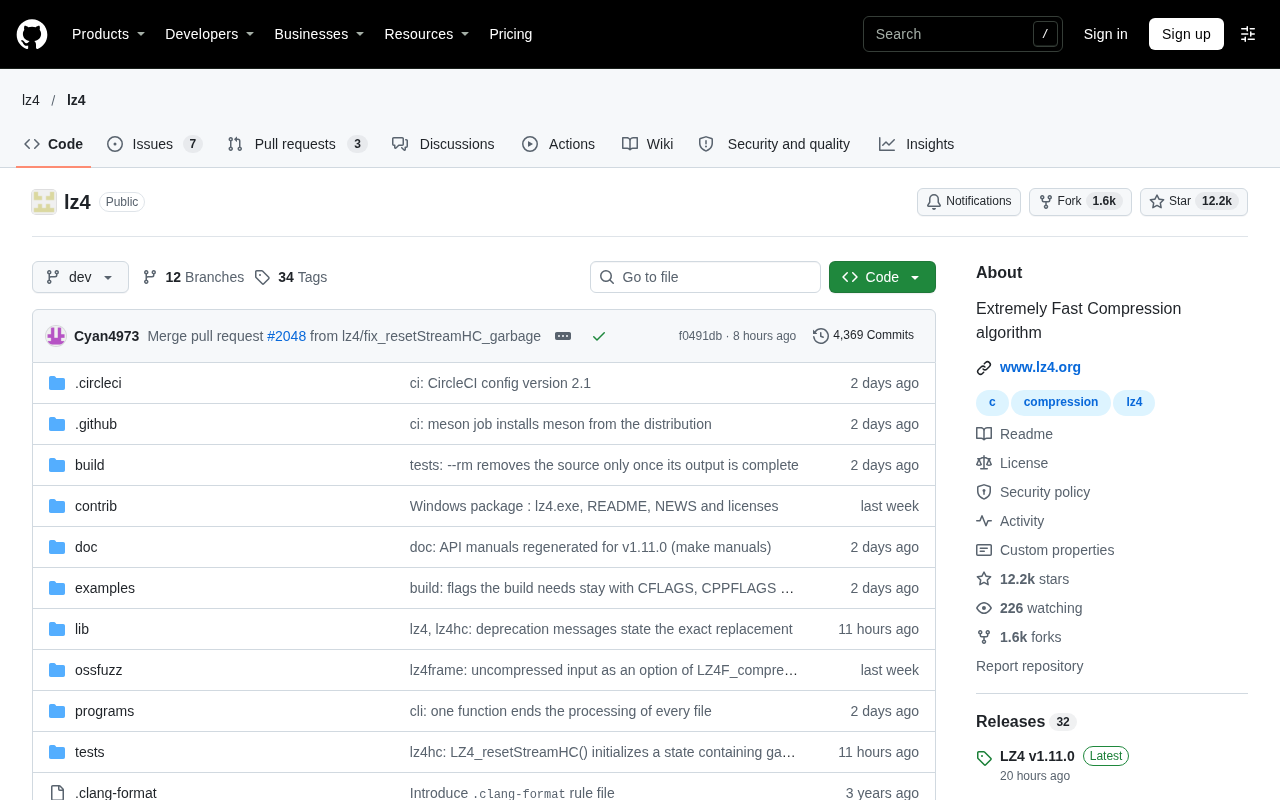
LZ4 is renowned for extreme speed, trading compression ratio for several GB/s throughput, and is widely integrated into infrastructure.
LZ4 is an open-source C compression library maintained by Yann Collet, with over 12,000 GitHub stars, known for blazing-fast compression and decompression reaching several GB/s. It uses the BSD 2-Clause license, has minimal dependencies and high portability, running from embedded devices to large servers. Its design philosophy is speed-first: using byte-based match finding and a simple hash table, sacrificing some compression ratio for extremely low CPU overhead, and offering an LZ4 HC mode to improve compression ratio when needed. With this trade-off, LZ4 is widely integrated into the Linux kernel (zram), ZFS, Btrfs, RocksDB, Hadoop, Spark, and container image layers, becoming the preferred compression solution for high-frequency data access in infrastructure and an excellent model for learning compression algorithms and C engineering practices.
In the era of data explosion, compression algorithms must strike a balance between speed and efficiency. LZ4 stands out for its "blazing-fast" characteristics, becoming a highly regarded compression library in the open-source community. This C-language project maintained by Yann Collet has garnered over 12,000 stars on GitHub, with 16 new stars added in a single day recently, showing sustained popularity.
Why LZ4 Became the Speed King
The core advantage of LZ4 lies in its compression and decompression speed. Its decompression speed can reach several GB/s, and its compression speed far exceeds most general-purpose algorithms on the market. This performance makes it highly attractive for latency-sensitive scenarios, such as real-time data transmission, game asset loading, and in-memory caching.
The project uses the BSD 2-Clause license, allowing commercially friendly integration. The codebase is written in C, maintaining minimal dependencies and high portability, running from embedded devices to large servers.
The LZ77-style compression principle behind LZ4: LZ4 is a dictionary-based lossless compression algorithm whose idea originates from LZ77—finding byte sequences in already-processed data that match the current position, and replacing repeated content with a "distance + length" pair. LZ4 simplifies this process to the extreme: it only keeps a hash table index of the most recent bytes, performs only one probe for match finding, does not backtrack, and does not build complex data structures. It is this "good enough" matching strategy that reduces the cost of each byte processed to a constant level, thereby achieving decompression throughput of several GB/s. Understanding this reveals that LZ4's speed does not come from magic, but from a systematic trimming of the general compression process.
Design Trade-offs Behind the Performance
LZ4 does not pursue the highest compression ratio but prioritizes speed. It uses byte-based match finding and a simple hash table, sacrificing some compression ratio for extremely low CPU overhead. This design philosophy makes it the first choice in systems requiring fast response.
Compared with algorithms such as zlib and snappy, LZ4 typically leads by an order of magnitude in decompression speed. For already-compressed data (such as logs and JSON), LZ4 can significantly reduce transmission and storage costs while barely affecting the processing pipeline.

The project also provides an LZ4 HC (high compression) mode, which can be selectively enabled when a higher compression ratio is needed, though speed decreases. This flexibility allows developers to adjust according to the scenario.
The trade-off between compression ratio and throughput: General-purpose compression algorithms usually trade off among three metrics—compression ratio, compression speed, and decompression speed. zlib favors compression ratio, requiring Huffman decoding and a sliding window during decompression, which limits speed; Snappy and LZ4 both belong to the "speed-first" camp, but LZ4 has a more streamlined decompression path. LZ4's compression ratio is generally between 2:1 and 3:1, noticeably lower than zlib's 3:1 or higher, but its decompression speed can be several times higher. The practical significance of this trade-off is: when compressed data is read repeatedly (such as caches, logs, and image layers), decompression cost is often more critical than storage cost, and choosing LZ4 yields higher overall benefits. LZ4 HC improves the compression ratio by increasing the depth of match search, at the cost of increased compression time, making it suitable for cold data scenarios of "compress once, read many times".
A Broad Application Ecosystem
LZ4 has been integrated into many well-known projects, including the Linux kernel (for zram and compressed caches), file systems (such as transparent compression in ZFS and Btrfs), databases (such as RocksDB), and big data processing frameworks (such as Hadoop and Spark). Its influence has penetrated multiple layers of infrastructure.
In the container space, LZ4 is used for image layer compression, accelerating container startup. In game development, it is used for asset packaging to reduce loading times. In addition, many programming languages provide LZ4 bindings for developers to call.
Background on zram and transparent compression mechanisms: The article mentions that the Linux kernel uses LZ4 to support zram, which is worth elaborating on. zram is a block device in memory; written data is compressed in real time and stored in RAM, then decompressed on read, effectively trading CPU for memory capacity. Because memory reads and writes are extremely frequent, the decompression latency of the compression algorithm directly determines system responsiveness, so zram has long defaulted to LZ4 (some distributions have also evaluated zstd). Similarly, transparent compression in ZFS and Btrfs requires real-time encoding and decoding on every file read and write, making it sensitive to CPU overhead; RocksDB's block compression affects database read/write amplification. The common point of these scenarios is that "compressed data is accessed at high frequency", which falls exactly in the sweet spot of LZ4's speed advantage—this is the fundamental reason it has been widely adopted at the infrastructure layer.
Insights from a Developer's Perspective
LZ4's success shows that in the field of foundational software, focusing on solving one pain point and doing it to perfection can also earn broad recognition. Its code structure is clear, its tests are complete, and its documentation is detailed, making it an excellent model for learning compression algorithms and C engineering practices.
For AI and technology practitioners, understanding LZ4's design helps make better storage and transmission decisions in data pipelines. When processing large-scale datasets, choosing the right compression algorithm can significantly improve overall efficiency.
As data volumes continue to grow, the importance of efficient algorithms like LZ4 will become even more prominent. Its open-source model also encourages more innovation, such as variants optimized for specific hardware. In the future, we may see more domain-specific solutions based on LZ4.
One-line Summary
LZ4 is known for its extreme speed, sacrificing compression ratio for throughput of several GB/s, and is widely integrated into infrastructure.
Related articles

Baidu's ERNIE 5.5 Flash Base Goes Open Source, Images 2.6 Dual Versions Hit the API
Baidu releases ERNIE 5.5 Flash Base sparse MoE model with 280B total parameters and million-token context; OpenAI Images 2.6 Flare and Sunburst hit the API; Ascend adapts Kimi K31 Pro on day one; Google Cloud briefly shows GPT-6 and other model names.

Baidu ERNIE 5.5 Flash Base Open-Sourced: 280B Parameters with Only 14B Active, Million-Token Context
Baidu ERNIE 5.5 Flash Base is now open-sourced: 280B total parameters with only 14B active, million-token context, MLA and HCA hybrid attention. We analyze its specs, Base model positioning, comparison with DeepSeek V4.1 Flash, and hands-on experience with Baidu's free AI workbench.

How BookTok Became the Antidote to Reading in the Digital Age
The Vergecast talks with BookTok creator Morgan Book about the BookTok community ecosystem, why romance novels are thriving, whether audiobooks count as reading, and the trade-offs behind Kindle's premium feel and price hikes.