Meta Defies Brazilian Court Order: Bolsonaro Favoritism Controversy Escalates

Meta is accused of ignoring a Brazilian court order to end favoritism toward Bolsonaro's camp, sparking debate over platform governance and judicial sovereignty.
The article centers on a Pan American Dispatch report that "Meta ignored a Brazilian court order to end favoritism toward Bolsonaro's camp," which gained 224 points and 146 comments on Hacker News. It notes that Brazilian judicial authorities have frequently intervened in platform content governance in recent years, previously issuing similar orders to platforms such as X, and that this case is significant because it involves a judgment about systematic favoritism toward a specific political figure. Tech community reactions are polarized: one side emphasizes that enforceability of judicial rulings is the baseline of the rule of law, while the other worries that judicial intervention in recommendation algorithms could set a dangerous precedent. The article argues that the incident highlights the importance of transparency and auditability once platform content ranking systems become infrastructure for political contestation; it also reminds readers that Meta's official position, the specific provisions of the court order, and the technical basis for determining "favoritism" have not been fully disclosed and require subsequent cross-verification.
Background: The Court Order and Meta's Silence
According to a report by Pan American Dispatch, Meta has been accused of ignoring a Brazilian court order requiring it to stop favoring former President Jair Bolsonaro's camp. The report gained 224 points and 146 comments on Hacker News, indicating that this intersection of platform governance and political intervention is sparking intense discussion in the tech community.
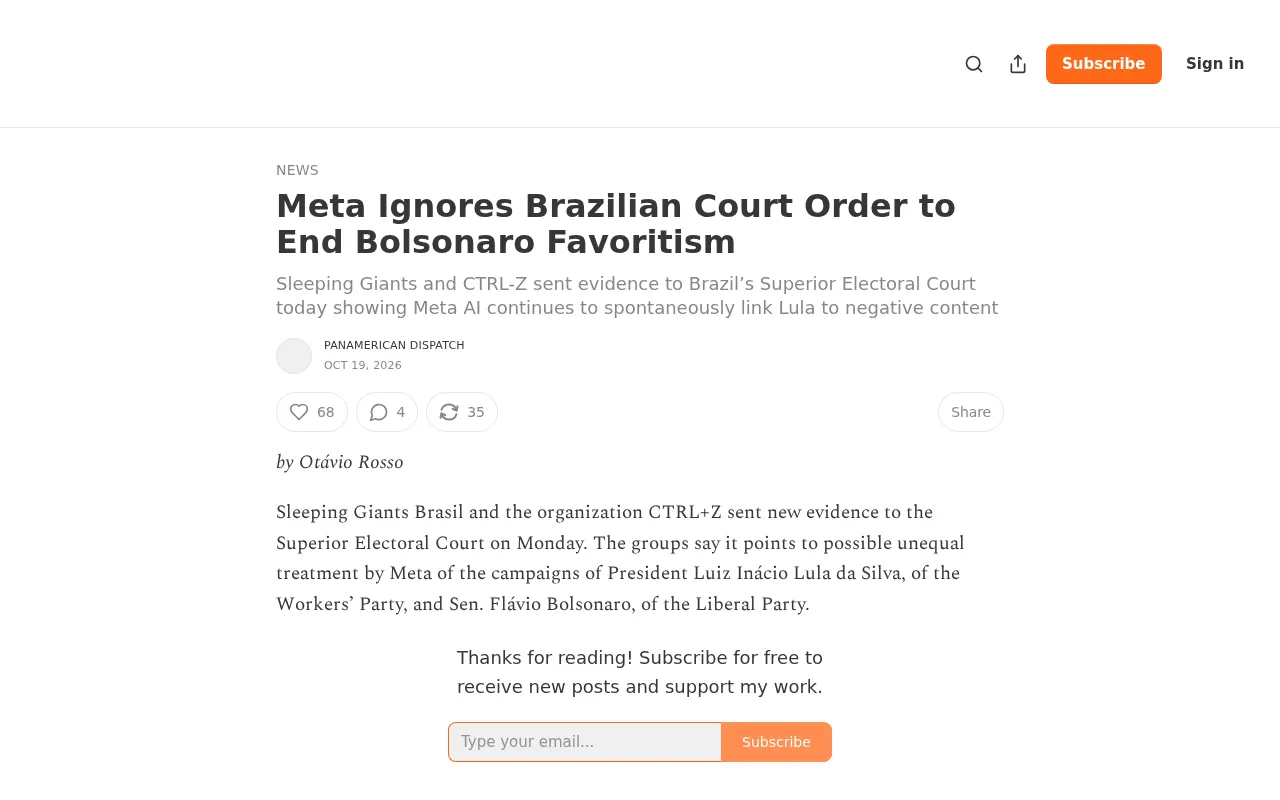
The report's headline directly states "Meta Ignores Brazilian Court Order to End Bolsonaro Favoritism," with the core allegation being that Meta did not take substantive corrective measures after the court issued a clear ruling. This incident once again brings the tension between content moderation, judicial sovereignty, and platform power to the forefront.
Why This Order Is Significant
Brazilian courts' intervention in platform content policies is not an isolated case. In recent years, Brazilian judicial authorities have been active in governing election information and combating disinformation, and have previously issued similar orders to platforms such as X (formerly Twitter). What makes Meta's alleged "defiance" particularly notable is that it directly involves a judgment about whether there is systematic favoritism toward a specific political figure.
If the court order is accurate and Meta has indeed not complied, this means platforms may face higher compliance risks in cross-border jurisdictions. For global platforms that rely on content recommendation and moderation systems, how to balance local laws against globally unified policies remains an unsolved challenge.
Brazil's judicial activism in election information governance has a clear institutional background. Brazil's Superior Electoral Court (TSE) is a judicial body specifically handling election disputes, with broad investigative and adjudicative powers that allow it to directly order platforms to remove content, restrict accounts, or adjust recommendation strategies during election cycles. Around the 2022 general election, the TSE issued multiple content takedown and account suspension orders to platforms including YouTube, Telegram, and X, and led special investigations into "disinformation networks." This model of "judicial bodies directly intervening in platform content policy" stands in sharp contrast to the EU's Digital Services Act approach, which relies primarily on regulatory compliance review, and the US approach centered on the Section 230 liability shield framework. It also makes Brazil one of the most prominent case studies for observing the tension between platforms and judicial sovereignty.
Reactions and Divisions in the Tech Community
Among the 146 comments on Hacker News, the discussion showed clear polarization. Some commenters argued that platforms should not use algorithmic neutrality as an excuse to evade judicial rulings, and that the enforceability of court orders is the baseline of the rule of law; others worried that direct judicial intervention in recommendation algorithms could set a dangerous precedent, making it easier for political forces to influence information distribution.
This division itself reflects a deeper problem: when platform content ranking systems become critical infrastructure for political contestation, transparency and auditability become more important than ever. In currently available information, Meta has not yet provided a detailed response to the report, making it difficult for outsiders to determine the specific reasons for its non-compliance.
The concept of "algorithmic neutrality," which recurred throughout the discussion, deserves clarification. Recommendation systems do not inherently produce value-neutral rankings—they implicitly determine which content gets amplified through objective functions (such as dwell time and engagement rate) and training data. What is called "favoritism" typically manifests technically as: accounts from a particular political camp receiving disproportionate recommendation exposure, moderation systems applying more lenient thresholds to their violating content, or systematic bias in search and trending lists. Determining whether favoritism exists often requires auditing recommendation logs and moderation decision records, and such internal data is rarely made public by platforms—which is the fundamental reason why judicial orders are difficult to verify for enforcement effectiveness.
Potential Impact on Platform Governance
Regardless of the final outcome, this incident provides an observational sample for global platform governance. If Meta continues not to comply with the court order, Brazil may take further legal or economic measures; if Meta eventually adjusts its strategy, it could trigger a chain reaction of emulation in other jurisdictions.
For the tech industry, what deserves attention is the explainability of content moderation decisions. When platforms are required to end "favoritism," there is a lack of unified technical standards for how to define favoritism and how to verify corrective effects. This gap is precisely the soil in which the controversy continues to ferment.
Auditability is a core concept in platform governance research, referring to the ability of external third parties (regulators, researchers, court-appointed experts) to independently verify the behavior of platform algorithmic systems. Common technical approaches include algorithmic audit interfaces, retention of recommendation logs, explainable records of moderation decisions, and "researcher access" regimes—Article 40 of the EU's Digital Services Act requires very large platforms to open data to qualified researchers. When courts require platforms to "end favoritism," if there is a lack of auditable technical interfaces and verification standards, the enforcement of the order is difficult to quantitatively assess, and it easily falls into a deadlock where "the platform claims to have corrected the issue, but the court cannot verify it."
Key Questions Still to Be Clarified
It is worth noting that the currently available information mainly comes from a single-source report and community discussion. Meta's official position, the specific provisions of the court order, and the technical basis for determining the alleged "favoritism" are all not fully elaborated in the source material. Readers following this matter should pay attention to subsequent cross-verification from court documents and Meta's official statements.
Related articles
AWS AgentCore Gateway: Connecting AI A…
AWS AgentCore Gateway: Connecting AI Agents to Enterprise Backends with MCP
How AWS AgentCore Gateway acts as a primary MCP server to aggregate REST APIs, Lambda, and existing MCP services? Analyzing its AST real-time mapping, zero cold start, semantic search for tool overload, session isolation, and key injection security design, plus the architectural approach to decoupling enterprise AI agents from backends.

One Link Gives Figma AI a New Skill: Hands-On with MCP Connectors
Paste one MCP server link and the AI Agent in Figma gains new tool capabilities. We break down the setup flow, 20+ one-click apps, read/write permissions and execution policies, and the public HTTPS requirement.

Cognition SWE-2 in Practice: One Prompt to Handle the Whole Product Launch Process
Analyzing a YouTube creator's prompt for using Cognition SWE-2 to launch a product: a landing page, seven-email sequence, and non-buyer follow-up tool, plus how the 'test and report' constraint changes AI delivery quality.