Meta Reportedly Plotted 'Whisper Strategy' to Turn Academia Against Haidt

Court documents show Meta discussed a "whisper strategy" to use academia to undermine critic Haidt's credibility.
Newly filed court documents reveal that in March 2023 Meta internally discussed a "whisper strategy" targeting social psychologist Jonathan Haidt—not to debate him publicly but to "turn scholars against Haidt" and weaken his credibility as a thought leader. The discussion occurred as Meta faced intense pressure over teen mental health and child safety lawsuits. The piece notes the phrase hints at quietly infiltrating academia to shape consensus behind the scenes, a costly reputational gamble for a platform claiming to respect science.
Meta Reportedly Plotted 'Whisper Strategy' to Turn Academia Against Haidt
Court documents have revealed that Meta, while under pressure over teen mental health and facing child safety lawsuits, discussed a "whisper strategy" targeting its core critic, social psychologist Jonathan Haidt. The goal of this internal plan was not public debate, but rather to "turn scholars against Haidt."
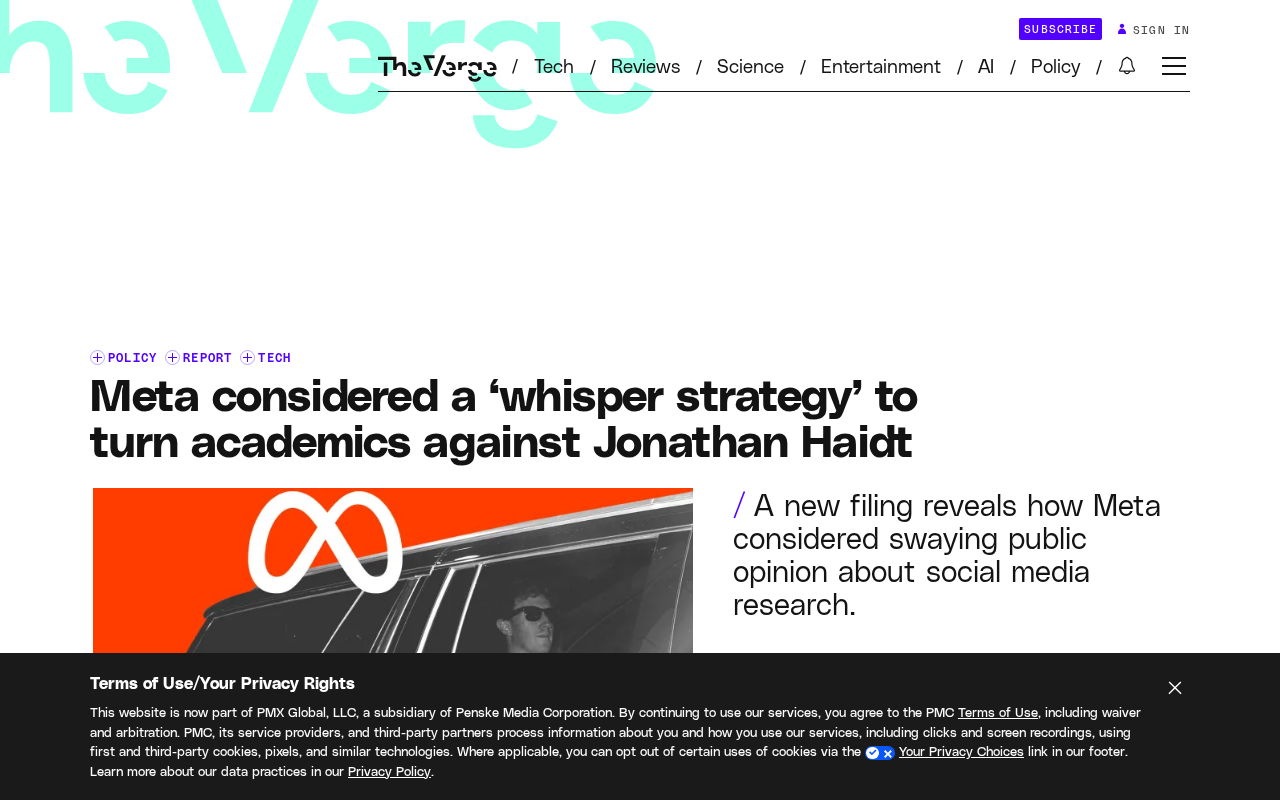
A "Whisper" Campaign Against a Critic
The so-called "whisper strategy" centers on quiet infiltration rather than direct confrontation. According to newly filed court documents, Meta discussed this approach in March 2023, intending to weaken Haidt's credibility as a "thought leader" by influencing views within academic circles.
This revelation comes as Meta faces enormous public pressure over teen mental health issues and a series of child safety lawsuits. The documents show that when the company considered how to respond to criticism, it aimed at one of its most influential critics.
Why Haidt
Jonathan Haidt has long focused on the impact of social media on adolescent psychology, and his views carry considerable weight in both academia and the public discourse. Targeting such a "thought leader" shows that Meta's anxiety about criticism at the time had extended from the PR level to the level of academic mobilization.
The very phrase "whisper strategy" is telling—it hints at an approach that avoids open confrontation while attempting to shift academic consensus behind the scenes. For a platform that claims to respect scientific research, once such a strategy is confirmed, the reputational cost could far outweigh any short-term PR gain.
Jonathan Haidt is a social psychologist at NYU's Stern School of Business who began his career studying moral psychology and is the author of academic works such as The Righteous Mind. In recent years he has shifted his research focus to adolescent mental health, publishing The Anxious Generation in 2024, which argues that the spread of smartphones and social media in the early 2010s was a major driver of rising rates of teen depression and anxiety, and proposes policies such as delaying the age of smartphone use and banning phones in schools. After the book became a bestseller, its arguments spread widely among parents, schools, and legislators, making him one of the most influential voices in this public debate. The term "thought leader" refers precisely to someone who can simultaneously influence academic discussion, media coverage, and the policy agenda—and that is exactly why he was seen as a critic requiring special attention.
What the Court Documents Reveal About Internal Deliberations
The newly filed court documents are the key source of evidence in this matter. They indicate that the relevant discussions took place internally within the company and were not the private remarks of individual employees. This offers a new window for the public to examine how platforms respond under regulatory pressure.
Following the disclosure, discussion around platform transparency and academic independence is expected to intensify further. For readers concerned with tech ethics and youth protection, the value of this episode lies in how it reveals the non-public tactics companies may resort to under public pressure.
Such court documents typically come from the discovery process in U.S. civil litigation: one party can require the other to produce internal emails, chat logs, presentations, and other materials, some of which enter the public record when filed with the court. In recent years, the lawsuits tech companies face over youth addiction and mental health have mostly been consolidated into multidistrict litigation (MDL), with broad discovery scope and long timelines, making them an important channel for outsiders to glimpse companies' internal decision-making. It is worth noting that disclosed internal discussion documents can only prove that a plan was proposed or discussed—not that it was carried out; but for assessing how companies respond to scientific criticism, such materials remain uniquely valuable.
Editor's Observation
The core of this episode is not whether the "whisper strategy" was ultimately implemented, but the very fact that it was discussed. When a platform faces research-based criticism, choosing to influence scholars rather than respond to the research is a line of thinking worth continued attention. Future disclosures of court documents may provide further details.
One-line Summary
Court documents show Meta discussed a "whisper strategy" to use academia to undermine the credibility of its critic Haidt.
Paragraph Summary
Newly filed court documents reveal that in March 2023 Meta internally discussed a "whisper strategy" targeting social psychologist Jonathan Haidt, whose goal was not public debate but to "turn scholars against Haidt," thereby undermining his credibility as a thought leader. The discussion took place as Meta faced intense public pressure over teen mental health and child safety lawsuits. Haidt has long studied the impact of social media on adolescent psychology and carries weight in both academia and public discourse. The article notes that the phrase "whisper strategy" hints at an approach of quietly infiltrating academic circles and shaping consensus behind the scenes—a costly reputational gamble for a platform that claims to respect science. The core of the episode is not whether the strategy was carried out, but the fact that it was discussed, raising concerns about platform transparency and academic independence.
Related articles
AWS AgentCore Gateway: Connecting AI A…
AWS AgentCore Gateway: Connecting AI Agents to Enterprise Backends with MCP
How AWS AgentCore Gateway acts as a primary MCP server to aggregate REST APIs, Lambda, and existing MCP services? Analyzing its AST real-time mapping, zero cold start, semantic search for tool overload, session isolation, and key injection security design, plus the architectural approach to decoupling enterprise AI agents from backends.

One Link Gives Figma AI a New Skill: Hands-On with MCP Connectors
Paste one MCP server link and the AI Agent in Figma gains new tool capabilities. We break down the setup flow, 20+ one-click apps, read/write permissions and execution policies, and the public HTTPS requirement.

Cognition SWE-2 in Practice: One Prompt to Handle the Whole Product Launch Process
Analyzing a YouTube creator's prompt for using Cognition SWE-2 to launch a product: a landing page, seven-email sequence, and non-buyer follow-up tool, plus how the 'test and report' constraint changes AI delivery quality.