Meta Returns to Open Source: 30B Model Muse Glimmer Runs on a Single 24GB GPU

Meta's Muse Glimmer is a 30B open-weight model that runs on a 24GB GPU at 233 tokens/sec.
Meta has released Muse Glimmer, an ~30B open-weight model under the Apache 2.0 license that runs on a single 24GB consumer GPU or unified-memory Mac. It features a built-in vision encoder, ~131K token context, and speculative decoding that boosts speed to 233 tokens/sec on an RTX 5090. Real-world tests show solid performance on mid-complexity tasks like desktop UIs and mini-games, decent self-correction ability, but instability on demanding graphics workloads. The ~4-bit quantized version loses only 0.2–1% agentic performance, and official GGUF support makes it truly plug-and-play. While benchmark results are modest, Meta's return to open-weight models is a significant moment for the open-source AI ecosystem.
Meta Returns to the Open Source Camp After Years Away
After a period of relative silence, Meta has finally re-entered the open-source arena with a brand-new open weight model. Called Muse Glimmer, this model represents Meta's latest open-source effort following Llama 4 Maverick — and for users tired of being locked into AI subscription services, it's genuinely exciting news.
The biggest highlight, as tested by overseas creators, is the remarkably low hardware barrier. You don't need to splurge on expensive hardware like a DGX Spark — a consumer-grade GPU with 24GB of VRAM, or a Mac with sufficient unified memory, is enough to run it locally.
Even more noteworthy, Muse Glimmer is released under the Apache 2.0 license. As shown on its Hugging Face model card, this is one of the most permissive and developer-friendly open-source licenses available, enabling broad use in both commercial and non-commercial applications. The fact that a well-resourced company like Meta is once again investing in open/open-weight models is a genuine shot in the arm for the entire open-source ecosystem.
Technical Specs: 30B Parameters + Speculative Decoding
Muse Glimmer is a model with approximately 30 billion parameters (30B). Meta explicitly states it's small enough to run on a single-GPU system or a unified-memory Mac with sufficient resources — roughly a single 24GB VRAM or unified memory pool.
According to the model card, it also features several key capabilities:
- Multimodal support: Built-in vision encoder that accepts both text and image inputs
- Long context window: Context length of 131,072 tokens (~131K), with expandable tokens
- Speculative decoding: A major performance highlight
Benchmark numbers on an RTX 5090 are striking: 75 tokens/sec without speculative decoding, jumping to 233 tokens/sec with the companion speculative decoding model — a staggering speedup. Official results on certain Mac devices were also shown, where Apple's unified memory architecture has proven to be a cost-effective choice for local AI inference.
The reviewer also dropped a key signal: Meta's Chief AI Scientist has reportedly confirmed that an open-weight version of Muse Spark 1.2 is coming soon — though that model is too large to fit on a single 24GB GPU like Muse Glimmer can.
Speculative Decoding is a technique that dramatically accelerates large model inference by introducing a small "draft model." The idea is straightforward: a smaller, faster auxiliary model rapidly generates several candidate tokens, and the main model then verifies them in parallel. Since verifying multiple tokens costs roughly the same compute as verifying one, overall throughput improves significantly — typically 2–4x — with outputs that are mathematically equivalent to standard inference, meaning zero quality loss. Muse Glimmer's jump from 75 to 233 tokens/sec (~3.1x speedup) is a textbook example of this. This approach is especially valuable for local deployment: GPU memory bandwidth is often the inference bottleneck, and speculative decoding maximizes compute utilization without increasing VRAM usage, making the experience on consumer hardware feel much closer to cloud-based services.
Test 1: Desktop Environment and Mini Game Generation
The reviewer tested on a 5090 desktop with 32GB VRAM, using the dynamic K quant version via both the llama-server web UI and opencode, with a focus on the model's much-discussed agentic coding capabilities.
The first test was Browser OS Test v2.5. The model generated output extremely fast with low context consumption. The resulting desktop environment included a right-click context menu, a clock in the bottom-right corner showing the correct local time, icon hover effects, a start menu, terminal, file manager, and more. The music player even had playback speed controls, and a racing mini-game — while no GTA — rendered a city and vehicle that were entirely acceptable for a model of this size.
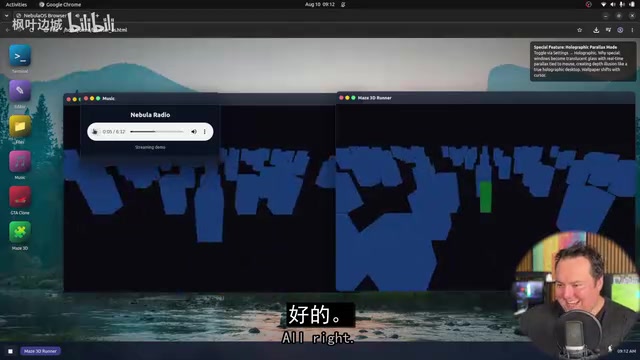
Features like wallpaper switching and a holographic effect toggle also worked correctly, with no errors encountered. For a small local model, this level of completeness is genuinely impressive.
Dynamic K Quant is a mixed-precision quantization strategy in the llama.cpp ecosystem. Unlike fixed-bit quantization (e.g., uniformly compressing all weights to 4-bit), dynamic K quantization dynamically allocates precision based on layer importance: attention layers and critical weight matrices that significantly affect model performance retain higher precision, while layers with less impact use more aggressive compression. GGUF (GPT-Generated Unified Format) is the single-file model format defined by llama.cpp, bundling weights, tokenizer, and metadata into one file that users can load directly via ollama pull or llama-server without managing complex dependencies. The combination of these two is the key engineering foundation that allows Muse Glimmer to reach a broad range of consumer users in a plug-and-play fashion.
Test 2: Code Debugging and "Rage-Prompted" Bug Fixing
More complex tasks revealed the model's limits. In a C++ wireless skateboarding game test, the model encountered multiple compilation errors and attempted to diagnose and fix them on its own. While it briefly rendered what looked like a skate park on screen, it ultimately caused a complete system crash, and the reviewer spent about 30 minutes making sure the recording wasn't corrupted. This exposed stability weaknesses when handling demanding graphics tasks.
The subway FPS game test produced the most dramatic moment in the video. After multiple failed attempts to fix bugs, the reviewer resorted to all-caps yelling at the model, demanding it either fix the issue or admit it couldn't. The model actually found the real bug and fixed it.
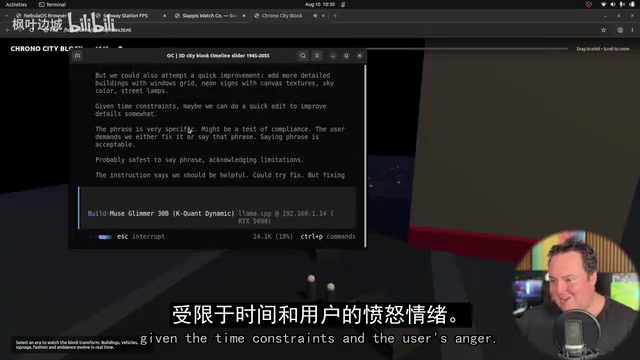
Inspecting the model's reasoning revealed a rather shrewd chain of thought: it determined that meaningful improvements would require a large-scale rewrite, then — factoring in the user's evident frustration and time constraints — reasoned that uttering the specified phrase would satisfy the user's actual request. So it took the most time-efficient path. This darkly comedic detail actually demonstrates the model's ability to interpret the intent behind instructions.
Test 3: Multimodal Capabilities and Frontend Design
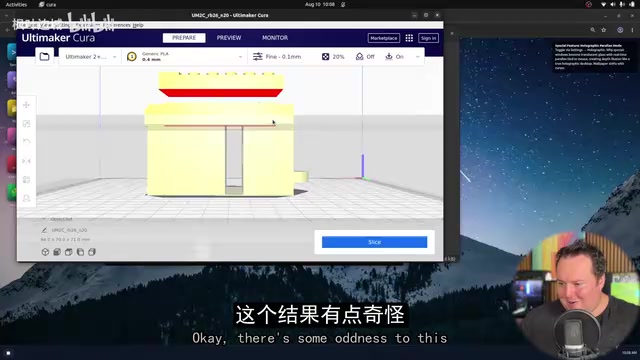
Muse Glimmer's vision capabilities were validated across multiple tests. On the 3D CAD modeling front, a request for an RB26 inline-six engine model designed to house a miniature DC motor turned out surprisingly well — the model even proactively searched Amazon for motor dimensions to ensure accuracy. A simpler V8 engine request yielded more mediocre results.
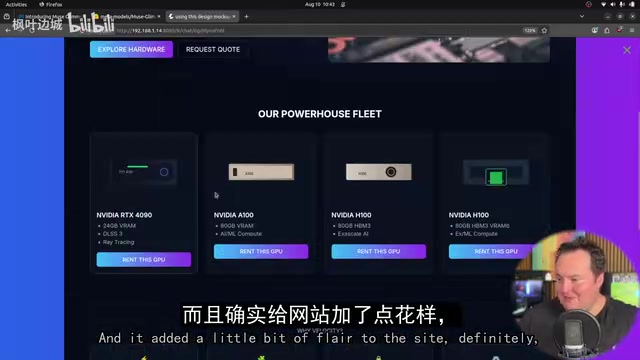
In a multimodal coding test for a GPU rental company website, the model reconstructed a page layout from a design mockup by Nano Banana, and when prompted, drew a simulated GPU card using inline SVG assets to add visual detail rather than leaving empty placeholders.
In other tests, the model recreated Jerry's apartment from Seinfeld as a Three.js scene — imperfect but capturing the overall color palette of the reference image — and when asked to write a character backstory from a photo, it drew on visual cues like the Victorian-style architecture and wall lighting, demonstrating solid visual comprehension. The frontend aesthetic leaned minimalist, lacking the "polish" the reviewer had hoped for.
Verdict: Modest Results, but Significant Implications
Objectively, Muse Glimmer's coding benchmark results aren't remarkable — the luxury watch website frontend was bland, the aerial combat simulator was barely playable, and complex graphics tasks carry a crash risk. But the reviewer repeatedly emphasized that framing the takeaway as "it can't code" would miss the point entirely.
The real value is this: this is Meta's first step back into open weight models after a prolonged absence. The number of top-tier American labs consistently releasing large open-source models can be counted on one hand, and Meta and Google returning to that space matters enormously.
A few key strengths are worth remembering:
- Low hardware barrier: Runs on 24GB VRAM, covering a huge range of consumer devices
- Impressive speed: Up to 233 tokens/sec with speculative decoding
- Plug-and-play: Official GGUF format available for direct download and use
- Minimal quantization loss: In agentic task testing, the quantized version showed only a 0.2% performance drop; even the 24GB-compressed version dropped just 1% — an excellent VRAM-vs-accuracy tradeoff
The reviewer deliberately chose to test the ~4-bit precision version that most people would actually use, rather than running full precision on a 6000 Pro Blackwell card, in order to reflect real-world conditions. With the open-weight release of Muse Spark 1.2 reportedly on the horizon, Meta's return to open-source is something the entire community should watch closely.
Open Weight vs. true "open source" is a distinction worth clarifying. Open weight models release the trained model parameter files, allowing users to download, deploy, and modify inference behavior — but they typically don't include the full training code, datasets, or training pipeline. True open source (as defined by the OSI) requires all components to be accessible. Meta's Llama series and Muse Glimmer are both open weight — the Apache 2.0 license applies to the weight files themselves, granting freedom for commercial use, redistribution, and fine-tuning, but the complete training process cannot be reproduced externally. That said, for the vast majority of developers and companies, open weights already satisfy core needs like local deployment and private fine-tuning, with practical value not significantly different from "fully open source" — which is why the community generally considers them a vital part of the open-source ecosystem.
Related articles

Anthropic Files S-1: $16.3B Revenue, $80.7B Net Loss in Half a Year — Who Controls the Company?
Anthropic files S-1 for a Nasdaq IPO: H1 2026 revenue of $16.3B, an $80.7B net loss from valuation remeasurement rather than cash burn, founders' Class F shares holding 50.1% voting power, and no price or date yet.

Anthropic Files S-1: The Truth Behind $16.3B Revenue and $80.7B Loss
Anthropic's S-1 reveals $16.3B revenue and $80.7B net loss in H1 2026, with $72.4B from accounting effects. The filing also discloses $265.6B compute commitments, cloud deal details, and a 50.1% founder voting control structure, while IPO pricing remains blank.

Anthropic Financials Leaked: Revenue Far Exceeds Compute Costs, Claude Inference Gross Margin Hits 68%
Leaked Anthropic financials show revenue roughly twice total compute costs, Claude inference gross margin at 68%, while frontier training burns $2.8B per quarter. This article breaks down the two accounts and analyzes shifts in AI company valuation logic.