Microsoft Launches Xbox Nano Controller: Smaller, Cheaper at $49.99

Microsoft launches the Xbox Nano, its smallest official controller yet, at $49.99, targeting portability and small-handed users.
Microsoft has officially launched the Xbox Nano controller at $49.99, its smallest official controller to date. It targets younger players, users with smaller hands, and mobile gamers who need a portable controller. The article examines the market logic behind small controllers: mainstream controllers have long been designed around adult male hand sizes, causing fatigue for children and some female players, while the rise of mobile and cloud gaming has created demand for portable physical controls. Microsoft's advantage is ecosystem integration, with the Nano connecting to Xbox consoles, Windows PCs, and mobile devices. However, its small size brings ergonomic limitations, making it better suited as a supplementary device for specific scenarios rather than a replacement for the standard controller.
Microsoft today officially unveiled the Xbox Nano controller, a smaller and more affordable portable game controller. The product is designed to fit in a pocket, with the company positioning it for "younger players, users with smaller hands, and anyone who wants to carry a controller with them on the go."
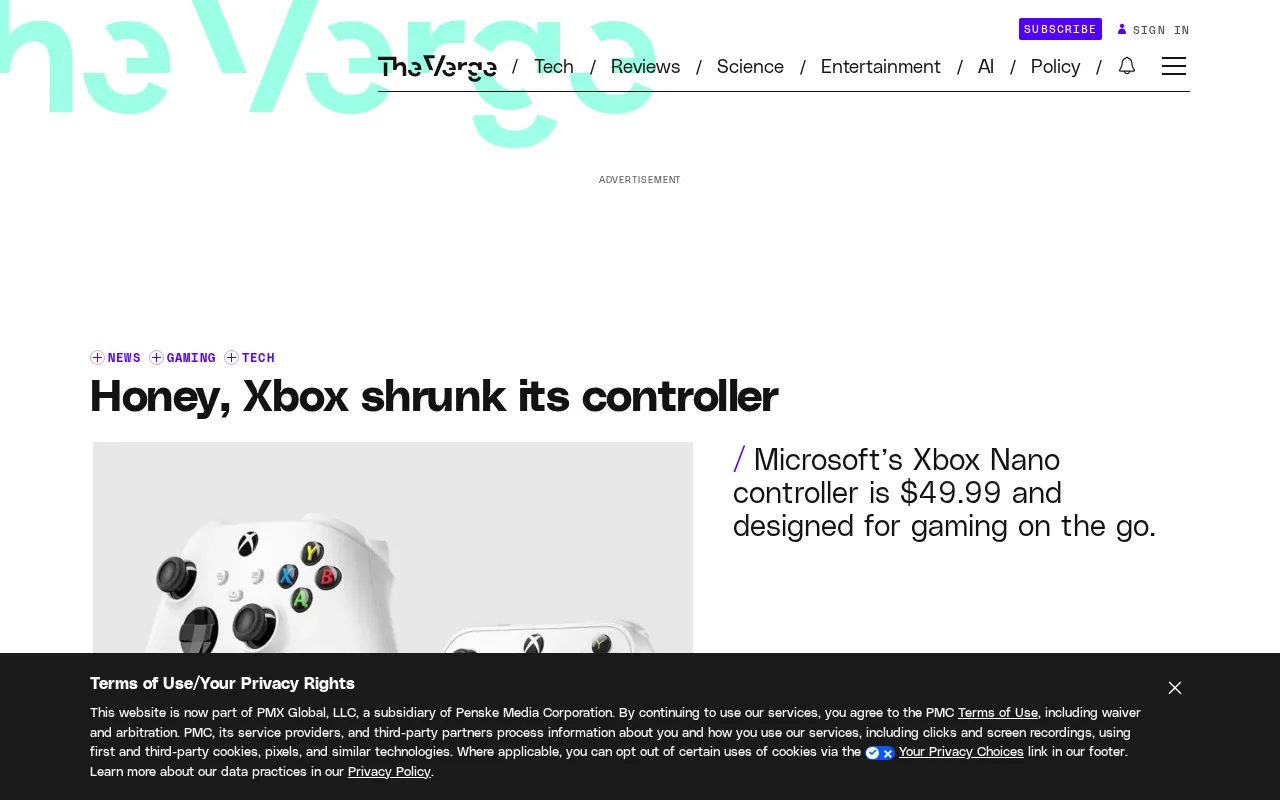
A Controller Truly Built for Portability
The Xbox Nano is priced at $49.99 and is Microsoft's smallest official controller to date. Compared to the standard Xbox Wireless Controller, the Nano is noticeably smaller, with a shorter overall length and a redesigned grip area.
Based on the official description, this controller isn't simply a scaled-down version of the standard model. Its target audience is very clear: children, players with smaller hands, and mobile gamers who want physical button controls even when they're on the go. The $49.99 price point also makes it one of the most affordable controllers in the Xbox ecosystem.
The Xbox Wireless Controller is Microsoft's standard controller introduced in 2016 (often referred to as the Xbox One S controller and its subsequent versions). It uses dual-mode Bluetooth and Xbox Wireless connectivity, features textured grips, and measures approximately 15 cm in width. It serves as the default controller for Xbox consoles and is one of the most compatible third-party controllers on Windows PC. Compared to it, the Nano isn't just smaller in size — the grip shape, button layout, and battery compartment design have all been reworked, giving the two a clear distinction in feel and use cases.
The Market Logic Behind a Smaller Controller
Controller sizing has long been overlooked by major manufacturers. Standard controller grips are typically designed around adult male hand sizes, which can cause fatigue for children and some female players during extended use. The arrival of the Xbox Nano shows that Microsoft is starting to take this group of users seriously.
At the same time, the rise of mobile gaming and cloud gaming is driving changes in controller form factors. As more players game on phones, tablets, and even handheld devices, a Bluetooth controller that fits in a pocket has genuine real-world use cases.
Game Pass cloud gaming (officially Xbox Game Pass Ultimate cloud gaming) is the streaming feature within Microsoft's subscription service that lets users play Xbox console games directly on phones, tablets, browsers, or select smart TVs without local downloads. Since the video is transmitted over the network, players actually have a stronger need for physical buttons than in mobile gaming, because touchscreen virtual buttons have high latency and poor feel. These scenarios are naturally suited to portable Bluetooth controllers: slip the device in your pocket, connect to your phone, and get a near-console experience — this is one of the direct reasons behind growing demand for smaller controllers.
Differentiation from Competitors
There are already plenty of third-party portable controllers on the market, but it's rare for a first-party manufacturer to personally enter the small-form-factor controller space. Microsoft's advantage lies in ecosystem integration — the Xbox Nano connects seamlessly to Xbox consoles, Windows PCs, and mobile devices, and its portability becomes even more pronounced when paired with Game Pass cloud gaming.
Full compatibility lists and battery life figures haven't been announced yet, but given Xbox controllers' consistently solid connectivity experience, the Nano's software-side performance should not disappoint.
Issues Worth Watching
The core challenge facing small controllers is ergonomics. When size is reduced, button spacing, analog stick travel, and grip stability are all affected. For adult players with larger hands, the Nano may not be suitable for extended play sessions. This product feels more like a supplementary device for specific scenarios rather than a replacement for the standard controller.
Additionally, while $49.99 isn't expensive, it's not far off from promotional prices for the standard Xbox controller. Whether consumers are willing to pay for "smaller" will depend on how it actually feels in hand.
One-line Summary
Microsoft launches the Xbox Nano, its smallest official controller yet, priced at $49.99, targeting portability and small-handed users.
Paragraph Summary
Microsoft has officially launched the Xbox Nano controller at $49.99, its smallest official controller to date. The product targets younger players, users with smaller hands, and mobile gamers who need a portable controller. The article analyzes the market logic behind small controllers: mainstream controllers have long been designed around adult male hand sizes, causing fatigue for children and some female players; the rise of mobile and cloud gaming has also created demand for portable physical controls. Microsoft's advantage lies in ecosystem integration, with the Nano connecting to Xbox consoles, Windows PCs, and mobile devices. However, the ergonomic limitations of its small size make it better suited as a supplementary device for specific scenarios rather than a replacement for the standard controller.
Related articles
AWS AgentCore Gateway: Connecting AI A…
AWS AgentCore Gateway: Connecting AI Agents to Enterprise Backends with MCP
How AWS AgentCore Gateway acts as a primary MCP server to aggregate REST APIs, Lambda, and existing MCP services? Analyzing its AST real-time mapping, zero cold start, semantic search for tool overload, session isolation, and key injection security design, plus the architectural approach to decoupling enterprise AI agents from backends.

One Link Gives Figma AI a New Skill: Hands-On with MCP Connectors
Paste one MCP server link and the AI Agent in Figma gains new tool capabilities. We break down the setup flow, 20+ one-click apps, read/write permissions and execution policies, and the public HTTPS requirement.

Cognition SWE-2 in Practice: One Prompt to Handle the Whole Product Launch Process
Analyzing a YouTube creator's prompt for using Cognition SWE-2 to launch a product: a landing page, seven-email sequence, and non-buyer follow-up tool, plus how the 'test and report' constraint changes AI delivery quality.