Milliseconds.ai: One API for Real-Time AI Decision-Making Across Text and Images

Milliseconds.ai offers a low-cost, millisecond-speed API model built for classification and structured decision-making.
Milliseconds.ai takes a different approach from mainstream generative AI: its core product `decision-machine-1` delivers millisecond-speed decisions via a unified API, returning labels, classifications, and structured fields rather than natural language. Pricing is aggressive at $0.04 per million input tokens with free output and 125M free monthly tokens. Use cases include email routing, invoice extraction, and return policy decisions — high-frequency tasks where general-purpose LLMs are overkill. The product reflects a growing AI application trend: lightweight specialized models filling the gap left by over-engineered general models, though accuracy and stability still await real-world validation.
From Generation to Decision: A Different Track for AI Inference
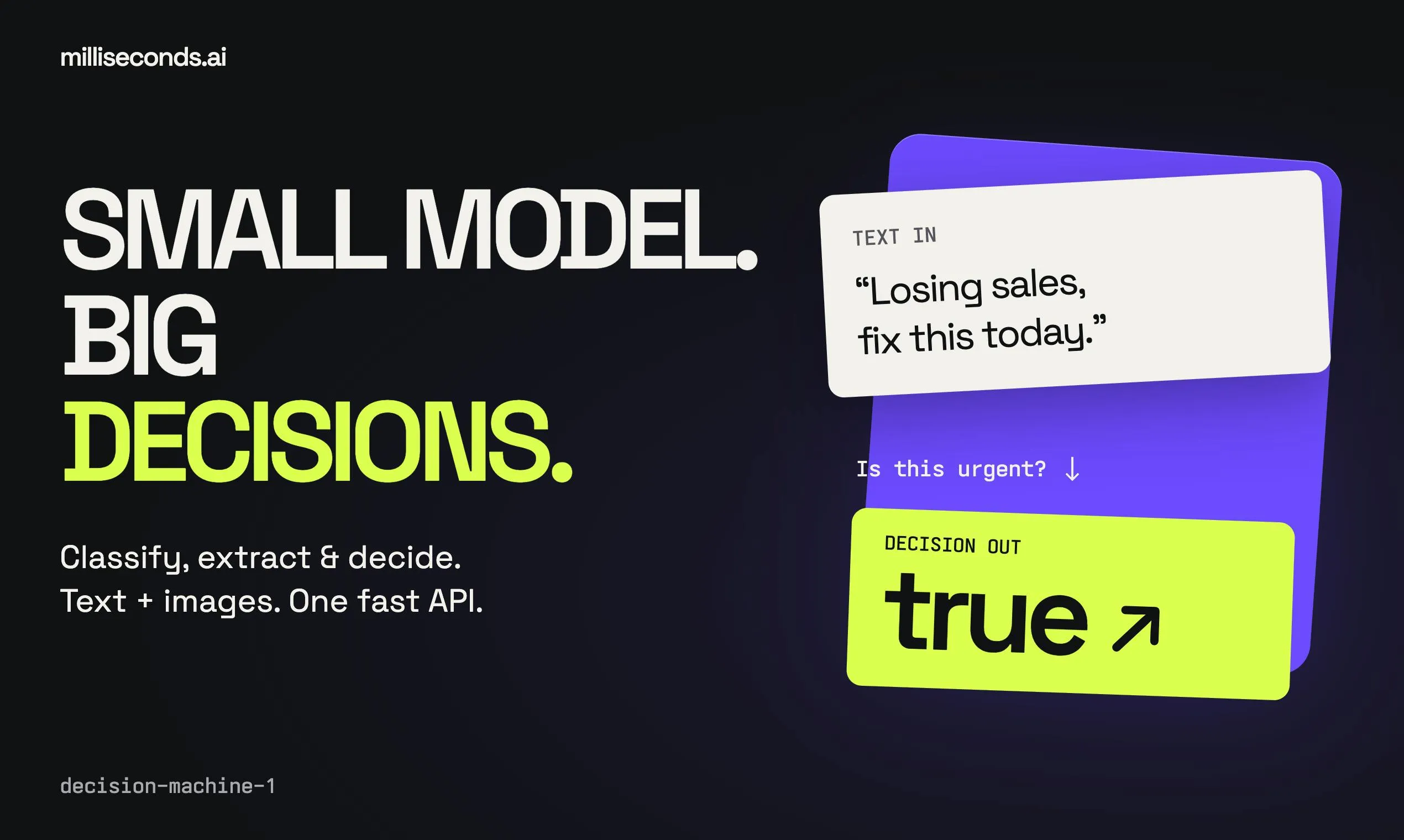
While the industry's attention remains fixed on large models' conversational and content generation capabilities, Milliseconds.ai has taken a fundamentally different path — one focused on fast decision-making. Its core product is a small model called decision-machine-1, which accepts text and image inputs through a unified API and outputs labels, classifications, structured fields, and decision results.
This positioning reflects a clear product philosophy. For a large number of real-world business scenarios, what enterprises actually need isn't a fluent natural language response — it's a clear, actionable judgment: Which department should this email be routed to? What are the key fields on this invoice? Does this return request qualify for a refund? These tasks are fundamentally about classification and structured extraction. Using large generative models to handle them is overkill — slow and expensive.
The Performance and Cost Advantages of Small Models
Milliseconds.ai signals its core value proposition right in its name — millisecond-level response times. Low latency is critical for business workflows that require real-time processing, such as automated email routing, real-time invoice data extraction, and automatic application of return policies. Response speed directly impacts user experience and business throughput.
The pricing strategy is equally aggressive. The officially published rate is just $0.04 per million input tokens, with output tokens completely free. Compared to mainstream generative large models that can cost several dollars per million tokens, this price is almost negligible. For applications that require large-scale, high-frequency AI decision-making, the difference in cost structure can determine whether a product can actually scale.
Even more notable is the free tier: test API keys come with 125 million free input tokens per month. This is a generous allowance for developers validating ideas and building prototypes, significantly lowering the barrier to entry.
Typical Use Cases Covered by One API
The official documentation highlights several application areas that clearly illustrate the product's positioning:
- Email routing: Automatically directing emails to the appropriate handling workflow based on content
- Invoice data extraction: Pulling structured financial fields from images or text
- Return policy decisions: Automatically determining whether a refund condition is met based on predefined rules
- Image recognition: The team half-jokingly mentions "build your hot dog detection empire," hinting that image classification is a core capability
What these scenarios share is that they're all high-frequency, rule-based tasks requiring fast, deterministic outputs — not open-ended generation.
Understanding the technical architecture behind this price difference helps assess its sustainability. Traditional large language models (such as GPT-4-class models) typically have hundreds of billions of parameters and require multiple high-end GPUs working in parallel for inference, making per-request compute costs significant. Small models focused on classification and structured extraction can be compressed to hundreds of millions of parameters or fewer, and combined with techniques like Knowledge Distillation and Quantization, can achieve high-concurrency inference on a single standard GPU. Decision-type tasks have another characteristic: extremely short outputs — a label, a JSON object — meaning the generation phase requires far less compute than conversational models. This explains why output tokens can be free: their marginal cost is nearly zero. This combination of "task specialization + streamlined architecture" is the fundamental reason small models can outperform general-purpose large models on latency and cost.
Built for Developers
Milliseconds.ai is categorized on Product Hunt under API, Developer Tools, and Artificial Intelligence. After launch, it received 89 upvotes and ranked 14th for the day. This result reflects developer community interest in the "specialized small model + unified API" format.
For developers, the appeal lies in the fact that complex model deployment and inference optimization are abstracted away into a single API call. You don't need to train your own classification model, handle multimodal ingestion of images and text, or repeatedly tune inference performance — text and image go in, structured decisions come out, all through one interface.
An Industry Signal Worth Considering
The emergence of Milliseconds.ai represents, in some sense, a segmentation trend in the AI application layer: not every task requires a general-purpose large model. Beyond the generative AI wave, lightweight models purpose-built for high-frequency structured tasks like decision-making, classification, and extraction are carving out their own market space.
They deliver lower latency and lower cost to cover scenarios that general-purpose large models "over-serve." For teams building real business systems, the value of these tools may be more practical than it first appears — in production environments, stability, affordability, and speed often matter more than being "smarter."
That said, as a product that just debuted on Product Hunt, its model accuracy, performance on complex tasks, and stability at scale still need more real-world usage data to validate. The generous free tier at least gives developers a low-risk opportunity to experiment.
This trend has corresponding theoretical backing in academia. Research shows that for well-defined discriminative tasks, small models with targeted fine-tuning can often match or even outperform general-purpose models with ten times the parameters, while delivering significant advantages in inference speed and cost. The limitations of such models are equally clear: once task boundaries become ambiguous, cross-domain reasoning is required, or edge cases outside the training distribution appear, their generalization ability drops quickly. Choosing a specialized small model therefore presupposes that the business scenario is sufficiently stable and the label space is relatively closed. For scenarios with frequently changing decision logic or large volumes of long-tail exceptions, the flexibility of general-purpose large models remains hard to replace. This suggests that in practice, the two types of models are more likely to be complementary than zero-sum competitors.
Related articles
AWS AgentCore Gateway: Connecting AI A…
AWS AgentCore Gateway: Connecting AI Agents to Enterprise Backends with MCP
How AWS AgentCore Gateway acts as a primary MCP server to aggregate REST APIs, Lambda, and existing MCP services? Analyzing its AST real-time mapping, zero cold start, semantic search for tool overload, session isolation, and key injection security design, plus the architectural approach to decoupling enterprise AI agents from backends.

One Link Gives Figma AI a New Skill: Hands-On with MCP Connectors
Paste one MCP server link and the AI Agent in Figma gains new tool capabilities. We break down the setup flow, 20+ one-click apps, read/write permissions and execution policies, and the public HTTPS requirement.

Cognition SWE-2 in Practice: One Prompt to Handle the Whole Product Launch Process
Analyzing a YouTube creator's prompt for using Cognition SWE-2 to launch a product: a landing page, seven-email sequence, and non-buyer follow-up tool, plus how the 'test and report' constraint changes AI delivery quality.