Mitra-v2: How Synthetic Pretraining Is Reshaping Tabular Foundation Models
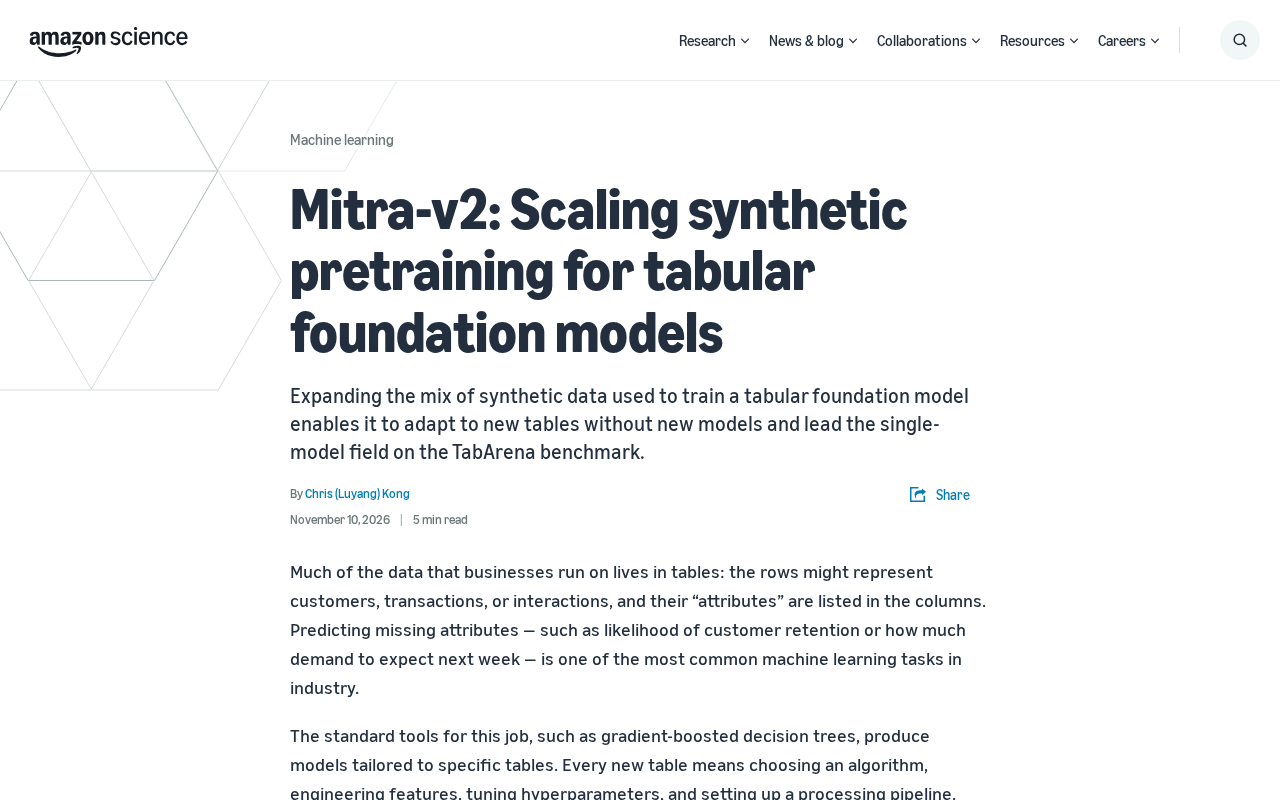
Mitra-v2 pretrains tabular foundation models with an expanded synthetic data mixture, leading TabArena as a single model.
Mitra-v2 addresses the lagging development of tabular foundation models by expanding the synthetic data mixing ratio during pretraining. Since tabular data lacks massive public corpora and varies greatly in column structure, synthetic data can alleviate privacy and scarcity constraints, and richer generation mechanisms, table structures, and task types improve pretraining coverage, enabling a single model to adapt to new tables without retraining. On TabArena, Mitra-v2 leads the single-model track, showing that leading performance can be achieved without multi-model ensembles, reducing inference costs and deployment complexity. The article also notes that synthetic data distribution bias and the gap between benchmarks and real business data remain deployment risks, and argues that competition is shifting from model architecture to data recipe.
Tabular data is the most common data form in the real world, but compared with text and images, the development of foundation models in the tabular domain has clearly lagged behind. The release of Mitra-v2 is precisely a response to this gap: by expanding the mixing ratio of synthetic pretraining, it enables a single model to adapt to new tables without retraining, and leads the single-model track on the TabArena benchmark.
The Predicament of Tabular Foundation Models and Mitra-v2's Breakthrough Approach
Traditional tabular machine learning relies on training or tuning separately for each dataset, resulting in limited model generalization. The foundation model approach is to introduce large-scale pretraining into the tabular domain, but tabular data naturally lacks the massive public corpora that text has, and different tables vary greatly in column structure, semantics, and distribution.
Mitra-v2 chooses synthetic data as its core lever. According to the official description, its key lies in "expanding the mixing ratio of synthetic data used to train tabular foundation models." This is not simply about piling on more data, but rather about exposing the model during pretraining to diverse column types, value distributions, and task forms through richer combinations of synthetic tables, thereby equipping it with zero-shot or few-shot adaptation capability when encountering entirely new tables.
The value of this approach lies in decoupling: in the past, switching to a different table often meant retraining a model, whereas Mitra-v2 attempts to make "one model adapting to multiple tables" a reality, greatly reducing deployment and maintenance costs.
Tabular Foundation Model refers to models that borrow the "large-scale pretraining + downstream adaptation" paradigm from large language models, pretrained on large amounts of heterogeneous tables and directly usable for new table tasks. Unlike text, tables have no unified vocabulary; each table's column names, column counts, and types (numeric, categorical, date, text) may differ, so such models typically need to serialize a row of samples into a token sequence and employ column-aware encoding to handle heterogeneous schemas. Representative works include the TabPFN series (in-context learning based on prior-data fitted networks) and the subsequent TabPFNv2, Mitra, etc. Their goal is to enable the model to "understand" a small number of training samples at inference time and predict accordingly, without gradient updates—in sharp contrast to the traditional AutoML approach of tuning per dataset.
Why Synthetic Pretraining Is a Key Lever in the Tabular Domain
Synthetic data has unique advantages in tabular scenarios. Real tables are often difficult to make public due to privacy and compliance restrictions, whereas synthetic data can generate samples with controllable structure and adjustable distribution without leaking sensitive information. At the same time, the synthesis process allows researchers to deliberately cover patterns that are rare but important in real data, such as sparse columns, high-cardinality categorical columns, and missing-value-dense cases.
Mitra-v2's approach is to make the "recipe" of synthetic data broader: mixing different generation mechanisms, different table structures, and different task types makes the pretraining signal more comprehensive in coverage. According to the official statement, this expansion allows the model to "adapt to new tables without a new model," indicating that synthetic diversity directly translates into downstream generalization capability.
Of course, distribution bias in synthetic data remains a potential risk. No matter how rich the synthetic mixture is, it cannot fully equate to the long-tail patterns of real business tables, and this deserves continued attention when evaluating model deployment.
Prior-Data Fitted Network (PFN) is key background for understanding the value of synthetic pretraining. The core idea of PFN is: sample a large number of synthetic datasets from a manually designed prior distribution, and train a model to learn the Bayesian inference process of "predicting the test set given the training set," so that at inference time it can perform in-context learning on new datasets without parameter updates. Therefore, the generation mechanism of synthetic data (i.e., the "prior") directly determines which functional forms and data patterns the model can cover. This explains why Mitra-v2 focuses on expanding the synthetic mixing ratio—it is essentially expanding the coverage of the prior, making it more likely that the model, when faced with real tables, falls within the distribution families it has already learned.
What Leading the Single-Model Track on the TabArena Benchmark Means
According to official information, Mitra-v2 "leads the single-model track" on the TabArena benchmark. TabArena is an evaluation benchmark for tabular tasks, and its value lies in comparing different methods under a unified standard. The meaning of leading the single-model track deserves unpacking: it means that without relying on customizing a model for each dataset or ensembling multiple models, a single pretrained model can achieve leading performance across a wide range of tasks.
This has a direct impact on engineering practice. Although multi-model solutions can often stack up high performance, they come with higher inference costs, version management, and deployment complexity. Leading the single-model track shows that Mitra-v2 achieves a better balance between performance and simplicity, bringing the "out-of-the-box" use of tabular foundation models closer to reality.
It should be noted that leading on a benchmark does not equal superiority on all real business tables. Differences between benchmark tasks and production data distributions, as well as the choice of evaluation metrics, both affect the extrapolation scope of the conclusions.
TabArena is an open evaluation benchmark for tabular machine learning methods, designed to stay close to real-world scenarios: it covers a large number of datasets from different domains, uses multiple random splits and statistical tests to compare methods, and distinguishes between "single model" and "ensemble/AutoML" tracks to prevent ensemble methods from masking single-model quality with higher computational cost. Such benchmarks typically also report the distribution of rankings across datasets rather than a single average score, thereby reflecting generalization more robustly. Understanding this helps correctly interpret the meaning of "leading the single-model track": it measures the relative performance of a single pretrained model under a unified protocol, without per-dataset customization or model ensembling.
Implications for the Deployment of Tabular AI Applications
The signal Mitra-v2 sends is that competition in tabular foundation models is shifting from "model architecture" to "pretraining data recipe." The scale and diversity of synthetic data have become core variables that create differentiation, similar to the evolution logic in the text domain from data quantity to data quality.
For practitioners, what is worth watching is the change in migration costs: if a single model can adapt to new tables, the model iteration burden on enterprises when adding new data sources will significantly decrease, allowing more effort to be devoted to feature understanding and business closed loops. For researchers, how to design synthetic mixtures and how to evaluate the gap between synthetic and real data will become key questions in the next stage.
Mitra-v2 is still in the research advancement stage, and the details of its synthetic data recipe and its robustness on real business tables still require more independent evaluations to verify. However, the direction of "expanding the synthetic mixture in exchange for generalization" has already provided a clear and followable path for tabular foundation models.
One-line Summary
Mitra-v2 pretrains tabular foundation models with an expanded synthetic data mixture, leading TabArena as a single model.
Paragraph Summary
Aiming at the lagging development of foundation models in the tabular domain, Mitra-v2 proposes a pretraining approach centered on expanding the synthetic data mixing ratio. The article points out that tabular data lacks massive public corpora and varies greatly in column structure; synthetic data can alleviate privacy and scarcity constraints and, through richer generation mechanisms, table structures, and task types, improve pretraining coverage, enabling a single model to adapt to new tables without retraining. On the TabArena benchmark, Mitra-v2 leads the single-model track, showing that leading performance can be achieved without relying on multi-model ensembles, thereby reducing inference costs and deployment complexity. The article also cautions that synthetic data distribution bias and the gap between benchmarks and real business data remain deployment risks, and argues that competition in tabular foundation models is shifting from model architecture to data recipe.
Related articles
Anthropic Model Benchmarking: Fable 5 vs 5.1 vs 5.2 Comparison
Based on Reddit community comparison material, this analyzes benchmark differences among Anthropic models Fable 5, 5.1, and 5.2, and discusses the practical implications of version iterations for developers and model selection advice.

Jensen Huang Steps Down as Nvidia CEO, Asian Governments Scramble to Respond to Chip Supply Shifts
Jensen Huang's departure as Nvidia CEO triggers chain reactions across Asian governments: some confirm chip supply commitments, others monitor local AI project impacts and handle related investigations. This article analyzes supply chain stability, project risks, and compliance uncertainty.
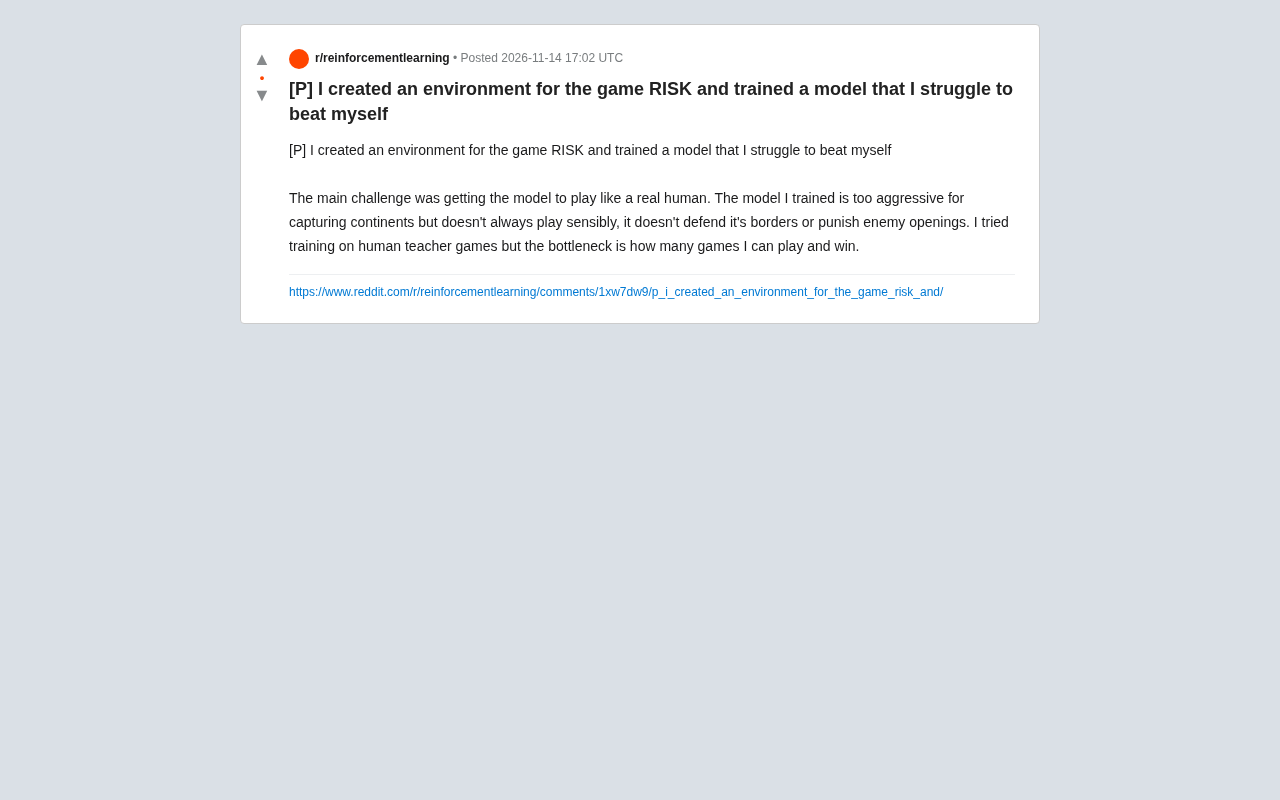
Reddit Player Builds RISK Game Environment and Trains an AI That's Nearly Impossible to Beat
Reddit player builds a RISK training environment and trains an aggressive AI model that's nearly unbeatable. Strong at expansion but weak at defense, the author hits a bottleneck trying human data training, revealing common game AI development challenges.