n8n for Beginners: Core Concepts from Lesson 1 of an AI Automation Course, Fully Explained

TechZain's n8n Lesson 1 shows why mastering AI automation — not fearing AI — is the real career edge.
This article covers the core content of Lesson 1 in TechZain's n8n AI automation course series. It opens by reframing AI anxiety with "AI won't replace you, but people who use AI will," then uses everyday analogies to clarify four foundational concepts: AI, automation, AI automation, and AI agents. The course centers on n8n for its visual workflows, self-hosting capability, data sovereignty, and affordability — advantages over costly Zapier and limited Make. The instructor sees n8n expertise as a scarce, well-paid skill in the coming years, and sets a no-hype, long-term tone: success requires time, dedication, and consistency.
Why AI Won't Replace You — But People Who Use AI Will
Anxiety about AI is everywhere. Whether you're a beginner still figuring out which skills to develop, or someone already navigating the workforce, the same worry tends to linger: will AI take my job?
Indian tech YouTuber TechZain offers a clear answer in the first lesson of his n8n AI automation course series: AI won't replace you, but people who know how to use AI will. The reason is straightforward — work that takes you hours and might still contain errors, AI can complete in minutes with zero mistakes. AI is fundamentally a tool for saving time and simplifying processes. The real competitive edge lies in whether you've mastered the ability to wield it.
This reframes the anxiety from "should I fear AI?" to "how do I put AI to work for me?" — and sets a pragmatic tone for the entire course.
From AI to Automation: Core Concepts You Need to Understand
This first lesson lays the theoretical groundwork before subsequent lessons move into hands-on practice. The instructor uses everyday analogies to explain several key concepts clearly.
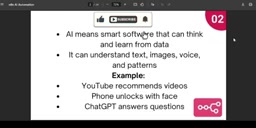
What is AI? Simply put, AI is intelligent software that learns from data and makes decisions on its own. YouTube recommending videos based on your preferences, face unlock on your phone or laptop, ChatGPT answering your questions — all of these are powered by AI. The instructor uses a fitting analogy: AI is like a diligent student — the more it reads, the smarter it gets.
What is Automation? The essence of automation is "letting machines repeatedly do the work for you, instead of doing it manually over and over." Think of a washing machine — you load the clothes, press a button, and the machine handles the rest. No need to intervene.
What happens when AI meets Automation? That's where the real power emerges. A smart email system that can read incoming messages, understand their content, and automatically reply — that's a classic example of AI automation in action.
What is an AI Agent? An AI agent can be thought of as a "digital employee." It understands goals, makes decisions, uses tools, and completes tasks step by step — like an office assistant who checks your emails, schedules meetings, and proactively follows up on action items, all on its own.
What Is n8n, and Why Do Businesses Prefer It?
The star of this course is n8n — an automation platform that connects different tools and services together. The instructor describes it as "the brain of automation," like the wiring behind a control panel that governs how an entire process flows.
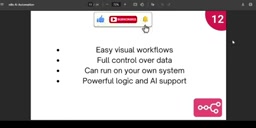
There are several key reasons why n8n is favored by businesses and the industry:
- Visual workflows: Processes are built visually, making them intuitive and easy to understand
- Full control: It can be deployed on your own infrastructure, giving you complete ownership
- Data sovereignty: Your data stays in your hands. With third-party services, data often flows to external parties — self-hosting eliminates that risk
- Cost-effective: The instructor uses a spot-on analogy — rather than paying a premium for a ready-made product on the market, you build it yourself at home
He also compares it to the difference between renting and owning a home: renting comes with all kinds of restrictions, while owning your own place means you can do whatever you want without all those limitations.
n8n (pronounced "n-eight-n," short for "nodemation") is an open-source workflow automation tool with a node-based visual interface. Users define data flows and trigger logic by dragging and dropping "nodes" and connecting them — no need to write full programs. It supports self-hosted deployment, running on your own server, cloud instance, or even a local machine. This is its biggest structural difference from Zapier and Make. n8n comes with hundreds of built-in integration nodes for popular services (Gmail, Slack, Google Sheets, OpenAI, etc.), and also supports connecting to any custom API via its HTTP Request node, making it highly flexible. The open-source community edition is completely free; a paid cloud-hosted version is available for those who don't want to manage their own infrastructure. Because it's open-source and self-hostable, companies can deploy it within their internal network, ensuring sensitive business data never leaves to a third-party cloud — a critical advantage for compliance-heavy industries like finance and healthcare.
n8n vs. Zapier vs. Make: Which Should You Choose?
N8n isn't the only automation tool on the market — Zapier and Make are strong contenders too, but each has its drawbacks.
The instructor's comparison is direct:
- Zapier: Very easy to get started, but expensive
- Make: A decent experience, but limited in functionality
- n8n: Powerful, flexible, and affordable
That's why this course centers on n8n. The instructor adds another reason: once you've mastered n8n, picking up other automation tools is easy — they're not that hard. In other words, learning n8n thoroughly is like getting a universal pass into the entire automation space.
Why n8n Is Called One of the Most In-Demand Skills of the Next Few Years
The instructor argues that AI automation represents a "golden opportunity" in the coming years. The logic is clear: demand for AI agents is surging, automation-related roles are multiplying, and businesses want smarter systems — all of which is driving up demand for n8n expertise. And right now, there aren't many people who know n8n well. A supply-demand imbalance means salaries for this kind of talent can be quite attractive.
The full course aims to take complete beginners to "job ready" AI automation engineers. The curriculum covers:
- APIs and data processing
- AI Agents and RAG systems
- Real-world project practice
- Job-seeking and freelancing skills
- Industry best practices and interview preparation
The instructor emphasizes he won't have learners memorize things by rote, nor just teach them to "click buttons" — he wants to build genuine understanding of the underlying principles. The barrier to entry is also extremely low: all you need is a laptop and the ability to open YouTube. No development, DevOps, cybersecurity, or programming background required.
RAG (Retrieval-Augmented Generation) is one of the key technical areas the course covers and is worth explaining on its own. Traditional large language models have a knowledge cutoff tied to their training data — they can't access a company's internal private documents or the latest information. RAG addresses this by retrieving relevant passages from an external knowledge base before generating a response, then passing those passages as context to the model. This allows AI to answer questions based on real-time or proprietary data. In n8n workflows, a RAG system typically consists of three stages of nodes: "document embedding and vector storage," "semantic retrieval," and "LLM generation." Knowing how to build RAG systems means you can create high-value applications for businesses — like intelligent customer support agents and internal knowledge base Q&A tools built on their own data. This is one of the core competencies that sets AI automation engineers apart from people who simply connect nodes in a workflow.
Who This Course Is NOT For: No Hype Allowed

Notably, the instructor takes time to explain who this course is not for — a topic most courses avoid entirely.
If you're coming in with the mindset of "I'll become an expert in one day, land freelancing projects immediately, and get rich overnight," this course isn't for you. The instructor is blunt: any promise of overnight success is manufactured hype, and he's not going to do that. His approach is refreshingly honest — success takes time, freelance projects won't come in one day, and becoming an AI automation expert doesn't happen overnight.
What you actually need is time investment, dedication, and consistency. Bring those three things and stick with the course, and mastering AI automation is absolutely within reach. This refusal to overpromise — combined with a genuine emphasis on long-term thinking — is exactly what makes the course worth trusting.
Background: AI Agents vs. Ordinary AI Models
The core distinction between an AI agent and a standard AI model lies in autonomy and tool use. A standard AI model (like directly prompting ChatGPT) typically operates as a single-turn interaction: you ask, it responds, and the process ends there. An AI agent, by contrast, introduces a "perceive–decide–act" loop. It can perceive the current state of its environment, autonomously break down a goal into sub-tasks, call external tools (search engines, databases, APIs, code executors, etc.), and dynamically adjust subsequent actions based on the result of each step — until the goal is achieved. This means an agent can handle complex tasks requiring multi-step reasoning and cross-system coordination, rather than simply answering an isolated question. In automation platforms like n8n, an AI agent typically exists as a single node, surrounded by various tool nodes — the entire workflow serving as the agent's extended "hands and feet."
Related articles

Anthropic Files S-1: The Truth Behind $16.3B Revenue and $80.7B Loss
Anthropic's S-1 reveals $16.3B revenue and $80.7B net loss in H1 2026, with $72.4B from accounting effects. The filing also discloses $265.6B compute commitments, cloud deal details, and a 50.1% founder voting control structure, while IPO pricing remains blank.

Anthropic Financials Leaked: Revenue Far Exceeds Compute Costs, Claude Inference Gross Margin Hits 68%
Leaked Anthropic financials show revenue roughly twice total compute costs, Claude inference gross margin at 68%, while frontier training burns $2.8B per quarter. This article breaks down the two accounts and analyzes shifts in AI company valuation logic.

JetBrains Open-Sources ThinkRail: A Visual AI Coding Workbench
JetBrains' open-source ThinkRail embeds an AI coding assistant into a visual dev environment with isolated workspaces, side-by-side chat and code diffs, and requirements docs alongside code.