Neural Implicit Energy Optimization: Smoother LiDAR Mapping
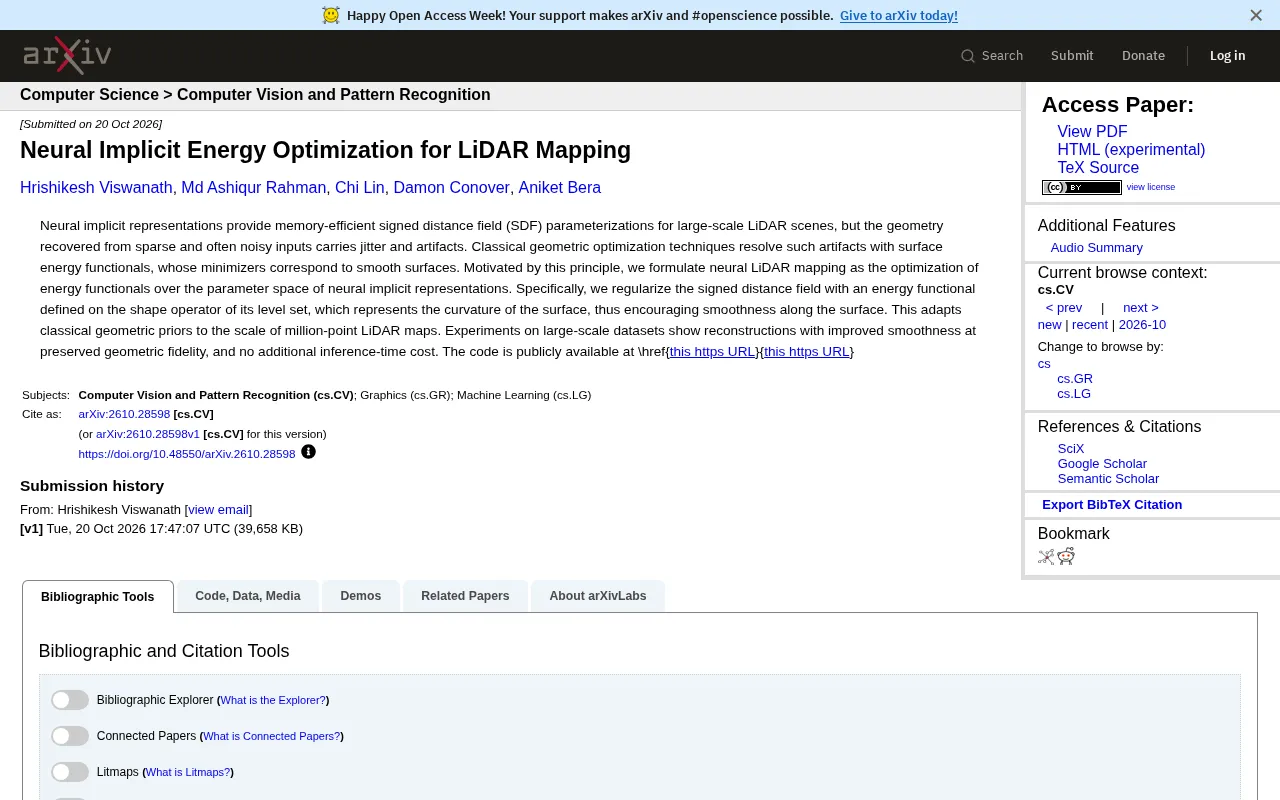
NIEO introduces energy functional regularization to neural implicit LiDAR mapping, smoothing the SDF during training with zero inference overhead.
This article presents NIEO (Neural Implicit Energy Optimization), a neural implicit mapping method for large-scale LiDAR scenes. To address surface jitter and artifacts from sparse, noisy LiDAR input, the authors reformulate neural LiDAR mapping as energy functional optimization in neural implicit parameter space, defining the energy on the shape operator of the SDF level set to encourage smoothness via curvature constraints. Regularization occurs only during training, so inference remains a standard forward pass with no extra cost. Experiments show improved smoothness while preserving geometric fidelity, and the code is open source.
When Neural Implicit Representations Meet LiDAR Noise
Neural implicit representations provide a memory-efficient way to parameterize signed distance fields (SDFs) for large-scale LiDAR scenes, compressing million-point 3D maps into neural networks. However, geometry recovered from sparse and often noisy LiDAR input frequently comes with jitter and surface artifacts. These flaws directly affect the quality of perception and decision-making in downstream tasks such as autonomous driving, robot navigation, and digital twins.
Classical geometry optimization already offers a solution: surface energy functionals repair such artifacts, and their minima correspond to smooth surfaces. Inspired by this principle, researchers propose reformulating neural LiDAR mapping as an optimization problem over energy functionals in the parameter space of neural implicit representations.

A signed distance field (SDF) is a classical form of 3D geometry representation: for any point in space, the SDF gives the signed distance to the nearest surface, with the sign indicating whether the point lies inside or outside; the zero level set corresponds to the object surface. Unlike voxel grids or point clouds, an SDF is a continuous function, naturally supporting implicit surface extraction and differentiable rendering. Neural implicit representations fit the SDF with networks such as multilayer perceptrons, storing only network weights rather than massive discrete samples, and can thus express million-point scenes with minimal memory. In LiDAR mapping, the network learns the SDF from sparse and noisy range measurements, but without geometric constraints the zero level set tends to exhibit high-frequency jitter—exactly the reason surface energy functional regularization is needed.
Core Method: Defining Energy Functionals on Shape Operators
The key innovation is to regularize the SDF with an energy functional defined on the shape operator of the SDF level set. The shape operator essentially characterizes surface curvature, so imposing an energy constraint on it is equivalent to encouraging tangential smoothness of the surface.
This design adapts classical geometric priors (such as minimal curvature and surface smoothness) to the scale of million-point LiDAR maps. Unlike simple smoothing filters, the energy functional is optimized in the parameter space of the neural network, meaning smoothness is encoded into the weights of the implicit representation rather than applied as post-processing on point clouds.
Why No Extra Inference Cost?
Because regularization happens during training, the model still performs only a standard forward pass at inference, introducing no additional inference-time overhead. This is especially important for latency-critical scenarios such as autonomous driving and mobile robotics. The paper explicitly states that reconstructions improve in smoothness while preserving geometric fidelity, with no extra inference cost.
The level set method represents a surface as an isosurface of a scalar function; the zero level set of the SDF is the reconstructed surface. The shape operator (also known as the Weingarten map) is defined on the tangent plane at each surface point and describes the rate of change of the normal vector along tangential directions; its eigenvalues are the principal curvatures. Thus the trace of the shape operator corresponds to mean curvature and its determinant to Gaussian curvature, making it a core differential-geometry tool for characterizing surface bending. In the SDF framework, the shape operator can be computed analytically from the SDF's Hessian and gradient, allowing curvature-related energy terms to be written directly into the loss function. Imposing an energy constraint on the shape operator is equivalent to penalizing excessive curvature variation, encouraging the reconstructed surface to be smooth while preserving genuine geometric edges.
The separation of training and inference is key to understanding the zero extra cost. Neural implicit mapping requires repeated forward passes to compute SDF values and backward passes to update network weights, and the energy functional regularization term participates in gradient computation only during this phase as part of the loss. Once training is complete, the network weights have internalized the smoothness prior; inference requires only a single standard forward pass per query point to obtain the SDF value, with no need to compute curvature, shape operators, or any energy terms. This contrasts sharply with point-cloud post-processing filters, which must perform extra computation on the output at every use. The method's cost is therefore entirely shifted to offline or one-time training, making it especially friendly for latency-sensitive deployments in autonomous driving and mobile robotics.
Experimental Validation and Open-Source Contribution
Experiments on large-scale datasets show that the method significantly improves surface smoothness while preserving geometric detail. Ablation and comparison experiments (specific numbers were not disclosed in the original text) support the effectiveness of the energy regularization.
The code is publicly available on GitHub: https://github.com/HrishikeshVish/nieo, under the repository name NIEO (Neural Implicit Energy Optimization). The open-source implementation lowers the barrier for community reproduction and further development, and provides a foundation for extending energy functional ideas to other implicit mapping tasks.
Industry Perspective: The Value of Bringing Back Geometric Priors
In recent years, neural implicit mapping (such as NeRF, NeuS, and their LiDAR variants) has shown clear advantages in memory efficiency, but the noise problem of sparse LiDAR input has remained a practical pain point. The significance of this work lies in that it does not introduce more complex network architectures; instead, it "translates" the energy functional ideas of classical geometry optimization into neural parameter space, using mathematical priors to compensate for data sparsity.
This fusion route of "classical geometry + neural representation" may be more sustainable than simply stacking network capacity. For engineers working on SLAM, 3D reconstruction, and autonomous driving perception, NIEO offers a low-inference-cost smoothing path that is worth further validation on proprietary data.
Key Takeaways
- Neural implicit SDFs in LiDAR mapping suffer from jitter and artifacts, requiring geometric regularization.
- The method defines an energy functional on the shape operator to encourage smooth surface curvature.
- Regularization is completed during training, with zero extra inference overhead.
- Large-scale experiments show improved smoothness while preserving geometric fidelity.
- The code is open source, facilitating community reproduction and extension.
One-line Summary
NIEO brings energy functional regularization to neural implicit LiDAR mapping, smoothing the SDF during training with zero inference overhead.
Paragraph Summary
This article introduces NIEO (Neural Implicit Energy Optimization), a neural implicit mapping method for large-scale LiDAR scenes. To address surface jitter and artifacts caused by sparse and noisy LiDAR input, the authors reformulate neural LiDAR mapping as an optimization problem over energy functionals in the parameter space of neural implicit representations, defining the energy functional on the shape operator of the signed distance field's level set to encourage smoothness via curvature constraints. Because regularization occurs only during training, inference remains a standard forward pass with no additional computational overhead. Large-scale experiments show significantly improved smoothness while preserving geometric fidelity. The open-source code offers a low-cost smoothing path for SLAM, 3D reconstruction, and autonomous driving perception.
Related articles

A New Paradigm for Text Editing in Compose: TextFieldState Replaces the Old API
Jetpack Compose introduces the TextFieldState API to fix dropped characters and cursor jumps from async input. The old value/onValueChange callbacks will be deprecated in 1.13. This article covers InputTransformation, OutputTransformation, four state hoisting patterns, and new formatted text editing capabilities.

Remote Compose: A New Document-Driven Paradigm for Cross-Platform UI on Android
Remote Compose transmits compact binary documents instead of screen pixels, enabling efficient UI rendering on remote surfaces like Wear OS and widgets. This article covers its document creation API, expression animations, size optimization techniques, and Wear OS progress.

How Crashlytics Eliminates Android Memory and Responsiveness Issues
Through the Chroma Clip case study, this article explains how Firebase Crashlytics uses Application Exit Info, Profiling Manager, GWP ASAN, and ARM MTE to pinpoint ANRs, OOMs, memory limit terminations, and native memory corruption—solving the challenge of stack traces that don't point to the real culprit.