New Breakthrough in Multi-Agent Collaboration: MASCAL Teaches AI to Express Confidence

MASCAL lets multi-agent systems jointly optimize task performance and confidence calibration, explicitly passing answer correctness probabilities.
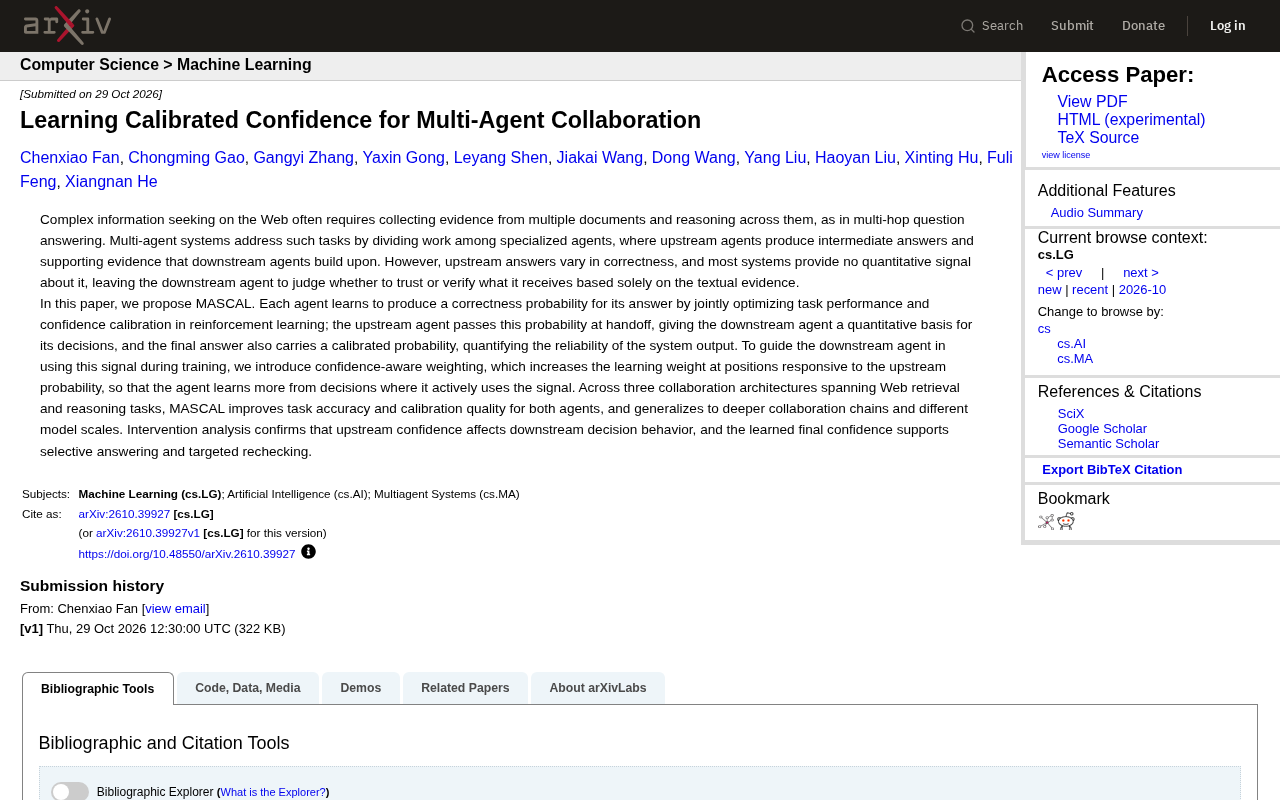
The article introduces MASCAL, a method addressing unreliable upstream answers and the lack of quantitative trust signals for downstream agents in multi-agent information retrieval systems. MASCAL has each agent jointly optimize task performance and confidence calibration in reinforcement learning, outputting a calibrated probability of correctness and passing it downstream at handoff. With confidence-aware weighting, downstream agents learn to use the signal—adopting high-confidence answers quickly and triggering verification or re-retrieval at low confidence. Experiments across three collaboration architectures and web retrieval reasoning tasks improve both accuracy and calibration, generalizing to deeper chains and different model scales. Intervention analysis confirms upstream confidence affects downstream decisions, enabling selective answering and targeted re-checking.
Multi-agent systems often face a key challenge when handling complex web information retrieval tasks: the correctness of answers provided by upstream agents varies, while downstream agents lack quantitative signals to judge whether they should trust these intermediate results. The newly proposed MASCAL method offers an elegant solution by having each agent learn to output a calibrated probability of correctness.
The Trust Dilemma in Multi-Agent Collaboration
In complex information retrieval scenarios, such as multi-hop question answering, the system needs to gather evidence from multiple documents and perform cross-document reasoning. Multi-agent systems tackle such challenges by decomposing tasks among specialized agents: upstream agents produce intermediate answers and supporting evidence, and downstream agents build on that basis.
The problem is that the correctness of upstream answers fluctuates, and most systems do not provide quantitative signals about correctness. Downstream agents can only rely on the textual evidence itself to decide whether to trust or verify the information they receive. This ambiguity can lead to error propagation, ultimately affecting the quality of the entire system's output.
The core idea of MASCAL is to have each agent jointly optimize task performance and confidence calibration during reinforcement learning, thereby learning to generate a probability of correctness for its answers. This probability is passed to downstream agents during handoff, providing them with a quantitative basis for decision-making. The final answer likewise carries a calibrated probability, quantifying the reliability of the system's output.
Multi-hop QA is a typical task in information retrieval and natural language processing that requires the system to perform chained reasoning across multiple documents or passages to arrive at an answer. For example, answering "In which city is the university founded by a certain scientist's advisor located?" requires first finding the scientist, then finding their advisor, then locating the university founded by the advisor, and finally looking up the city where that university is located. The intermediate result at each step depends on the correctness of the previous step, so errors are amplified step by step along the reasoning chain. Multi-agent systems usually split such tasks into subtasks such as retrieval, evidence filtering, reasoning, and verification, with different agents handling them and handing off intermediate answers and supporting evidence to one another. It is precisely this chained dependency structure that makes the reliability of upstream answers a bottleneck for overall system performance and makes "whether to pass quantitative confidence downstream" a key design question.
Confidence-Aware Weighting: Teaching Downstream Agents to Use the Signal
Merely passing a confidence signal is not enough; downstream agents need to learn how to use this signal effectively. To this end, the research team introduced a confidence-aware weighting mechanism: during training, they increase the learning weight on positions that are sensitive to upstream probabilities, enabling agents to learn more from decisions that actively use the signal.
This design makes downstream agents not passive recipients of confidence but active incorporators of it into their decision process. Through the reinforcement learning framework, agents gradually learn to adopt quickly when confidence is high and to trigger verification or re-retrieval when confidence is low.
Calibration measures the degree of agreement between a model's output probabilities and its actual accuracy. A well-calibrated agent, when claiming "I am 80% confident," should be correct in approximately 80% of cases. In contrast, modern neural networks often exhibit overconfidence—predicted probabilities are too high while actual accuracy is too low. Common calibration metrics include Expected Calibration Error (ECE) and the Reliability Diagram, the latter of which buckets predicted probabilities and compares the average accuracy within each bucket. Calibration and accuracy are two different dimensions: a model can be accurate but poorly calibrated, or have mediocre accuracy yet be well calibrated. MASCAL requires the correctness probabilities output by agents to be calibrated precisely so that downstream agents can treat the value as a credible risk estimate rather than merely a ranking score.
Generalization Across Architectures and Tasks
The experiments covered three collaboration architectures and involved web retrieval and reasoning tasks. The results show that MASCAL improves the performance of both types of agents in terms of task accuracy and calibration quality, and can generalize to deeper collaboration chains and different model scales.
This means the method does not depend on a specific architecture or model size and has good generality. For complex systems requiring multi-level agent collaboration, MASCAL provides a scalable confidence-passing mechanism.
Joint optimization objectives in reinforcement learning are typically composed of a weighted combination of task rewards and auxiliary terms. In MASCAL, task performance (e.g., whether the answer is correct) and confidence calibration quality are simultaneously incorporated into the reward signal, so that while agents pursue high accuracy, the correctness probabilities they output gradually approach the true accuracy. In implementation, the calibration term can adopt proper scoring rules such as the Brier score—the optimal strategy for such scoring rules is to truthfully report true probabilities, thereby preventing agents from misreporting confidence at the incentive level. Joint optimization means the two are not trained in stages but shape each other within the same policy optimization process: the task reward provides the learning direction, and the calibration term constrains the semantics of the probability output, giving the confidence signal interpretable quantitative meaning at handoff.
Intervention Analysis: How Confidence Affects Decision Behavior
Through intervention analysis, the research team confirmed that upstream confidence indeed affects downstream decision behavior. The learned final confidence supports selective answering and targeted re-checking: when system confidence is high, answers can be output with greater confidence; when confidence is low, re-examination of specific steps can be triggered instead of blindly outputting or retrying everything.
This selective answering mechanism is significantly valuable in practical applications. It enables the system to proactively expose uncertainty when reliability is insufficient, rather than giving answers that appear certain but are actually wrong. For building trustworthy AI systems, this capability is crucial.
Implications for Multi-Agent System Design
The value of MASCAL lies not only in its technical innovation but also in the design principle it reveals: trust in multi-agent collaboration should not be implicit but should be explicitly modeled and passed along. By embedding confidence calibration into the reinforcement learning objective, the system can maintain task performance while gaining a quantitative awareness of the reliability of its own output.
For developers building multi-agent applications, this means that when designing agent handoff protocols, in addition to passing textual results and evidence, they should also consider passing quantitative confidence signals. Downstream agents need corresponding training mechanisms to learn to use these signals, and confidence-aware weighting provides a feasible implementation path.
As multi-agent systems are increasingly applied in information retrieval, complex reasoning, and other fields, how to establish reliable trust mechanisms among agents will become a key research direction. MASCAL offers a valuable exploration in this direction.
One-line Summary
MASCAL enables multi-agent systems to jointly optimize task performance and confidence calibration in reinforcement learning, explicitly passing the probability of answer correctness.
Paragraph Summary
The article introduces the MASCAL method, which aims to solve the problem in multi-agent information retrieval systems where upstream answer reliability varies and downstream agents lack quantitative trust signals. MASCAL has each agent jointly optimize task performance and confidence calibration during reinforcement learning, so that it outputs a calibrated probability of correctness for its answers and passes it to downstream agents at handoff. Combined with a confidence-aware weighting mechanism, downstream agents are trained to actively use this signal—adopting quickly when confidence is high and triggering verification or re-retrieval when confidence is low. Experiments covering three collaboration architectures and web retrieval reasoning tasks show improvements in both task accuracy and calibration quality, with generalization to deeper collaboration chains and different model scales. Intervention analysis confirms that upstream confidence indeed affects downstream decisions, supporting selective answering and targeted re-checking.
Related articles
AWS AgentCore Gateway: Connecting AI A…
AWS AgentCore Gateway: Connecting AI Agents to Enterprise Backends with MCP
How AWS AgentCore Gateway acts as a primary MCP server to aggregate REST APIs, Lambda, and existing MCP services? Analyzing its AST real-time mapping, zero cold start, semantic search for tool overload, session isolation, and key injection security design, plus the architectural approach to decoupling enterprise AI agents from backends.

One Link Gives Figma AI a New Skill: Hands-On with MCP Connectors
Paste one MCP server link and the AI Agent in Figma gains new tool capabilities. We break down the setup flow, 20+ one-click apps, read/write permissions and execution policies, and the public HTTPS requirement.

Cognition SWE-2 in Practice: One Prompt to Handle the Whole Product Launch Process
Analyzing a YouTube creator's prompt for using Cognition SWE-2 to launch a product: a landing page, seven-email sequence, and non-buyer follow-up tool, plus how the 'test and report' constraint changes AI delivery quality.