No God Required: Can AI Religious Exemptions Redefine Faith Boundaries in the Workplace?

A Kentucky administrator obtained a religious exemption from using AI without believing in God, showing workplace AI resistance is channeled through the religious exemption system.
The article uses University of Kentucky administrator David Durman's religious exemption from using AI as an entry point to explore how workplace AI resistance migrates into institutional frameworks. Title VII and the EEOC's broad interpretation allow "religion" to cover moral or ethical beliefs, so applicants need not believe in God to claim protected core beliefs. Lacking dedicated channels for technological ethical objections, employees turn to the mature religious exemption path that employers must respond to, creating dilemmas for employers and suggesting companies should build internal ethical objection channels in advance.
A university administrator recently secured a religious exemption from using AI at work—and he doesn't need to believe in any deity. This case raises a question worth exploring: as AI permeates daily work, the reasons employees give for refusing to use it are expanding from technological anxiety to a framework of expression resembling "faith."
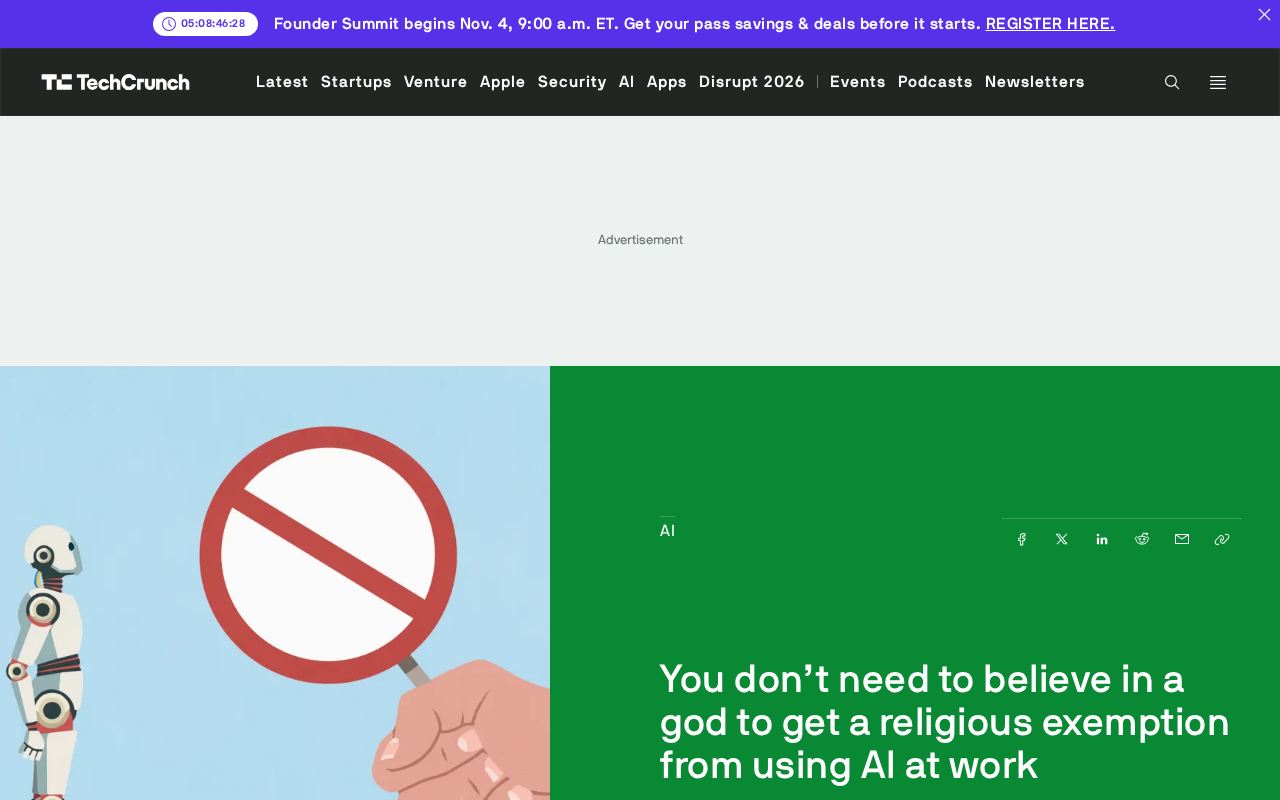
The Incident: A University Administrator's AI Exemption
According to an RSS source, David Durman, an administrator at the University of Kentucky, recently obtained a religious exemption in the workplace—the exemption being from using AI. The report did not disclose details of the application process, but it made one key point clear: the exemption does not require the applicant to believe in any religion or deity.
What makes this notable isn't how rare the exemption itself is, but rather the gap in workplace rules that it reveals—when companies write "AI use" into job requirements, employees' resistance needs an outlet recognized by the system, and "religious exemption" happens to provide a ready-made legal and organizational framework.
How Religious Exemptions Work: No Theism Required
Religious exemptions in the U.S. workplace typically operate under the framework of Title VII of the Civil Rights Act. The EEOC's interpretation under this framework is that the protected concept of "religion" is very broad, encompassing both traditional theistic beliefs and moral or ethical beliefs, as long as those beliefs occupy a place in the employee's heart equal to that of religion. In other words, applicants don't necessarily need to belong to a church—or even believe in God.
The direct consequence of this interpretation is that a person can package deep ethical objections to AI—such as concerns about the fairness of algorithmic decision-making, privacy erosion, or unease about technology replacing human judgment—as "religion-like" core beliefs. The fact that Durman's case was reported precisely demonstrates that this approach is viable in practice.
Why AI Refusal Gets Pushed into a Religious Framework
What employees really want to refuse is the AI tool itself, but workplace systems haven't set aside a clear channel for "technological ethical objections." By contrast, religious exemptions have mature legal precedent, clear application procedures, and compliance obligations that organizations must respond to. When one road is paved smooth and the other is still wasteland, people naturally choose the former. This isn't sophistry—it's a behavior pattern forced into existence by institutional design.
Title VII of the Civil Rights Act of 1964 is the core federal law prohibiting employment discrimination in the United States, applying to employers with 15 or more employees. The law prohibits employment discrimination based on race, color, religion, sex, or national origin. The "religion" clause requires employers to provide reasonable accommodation for employees' religious practices unless doing so would impose an "undue hardship" on the employer. In 2023, the Supreme Court raised the bar for what constitutes "undue hardship" in Groff v. DeJoy, requiring employers to show that accommodations would cause substantial, quantifiable burdens—significantly increasing the difficulty for employers to deny religious exemption requests.
The Equal Employment Opportunity Commission (EEOC) is the federal agency responsible for enforcing Title VII. Its compliance guidance interprets "religion" far more broadly than everyday understanding: it includes not only traditional theistic beliefs but also moral or ethical beliefs held by employees, as long as those beliefs occupy a place in the employee's life equal to that of religion (the so-called "sincerely held" standard). The EEOC explicitly states that employees do not need to belong to a church, have clergy endorsement, or even believe in God to claim protected religious beliefs. This broad definition is precisely the legal foundation for "obtaining a religious exemption without believing in God"—and the institutional prerequisite that makes such cases possible.
"Institutional isomorphism" is a concept in organizational sociology describing how organizations, when facing uncertainty, tend to imitate institutional forms that are considered legitimate, mature, and precedented. When employees want to express resistance to AI, the institutional channels available are actually few: technological anxiety is typically viewed as a personal adaptation issue and doesn't constitute a protected ground for appeal; ethical objections have no corresponding application procedure in most corporate policy documents; while religious exemptions have a mature legal framework, clear evidentiary standards, and compliance obligations employers must respond to.
This "institutional gap" between channels channels behavior toward the path of least resistance. Employees aren't necessarily deliberately "packaging" their positions—they're searching the existing institutional menu for the option closest to their needs. Religious exemption has become the template precisely because it satisfies three conditions simultaneously: legal precedent, procedural pathway, and organizational obligation to respond. Understanding this helps explain why AI objections exhibit a "religification" spillover phenomenon rather than being simple opportunism.
What This Means for Employers
From the employer's perspective, this trend brings two practical problems. First is the uncertainty of application volume—if religious exemption becomes a universal template for refusing AI, companies may face numerous exemption requests based on "personal belief," each requiring compliance assessment. Second is the management dilemma: approving exemptions means two sets of work methods emerging in the same role, raising coordination costs; denying them may invite discrimination claims.
More worth pondering is that such cases expose a communication breakdown between companies and employees on AI issues. If organizations position AI solely as an efficiency tool without acknowledging employees' ethical concerns about certain uses, resistance will spill over into forms of expression outside the system.
"Undue hardship" is the only defense standard an employer can invoke when denying a religious exemption request, and its determination has become stricter since the 2023 Groff case. Employers must demonstrate that accommodations would impose substantial, quantifiable operational burdens—they cannot broadly refuse on grounds of "increased cost" or "affecting colleagues." For AI use exemptions, this means that if an employer wants to deny a request, it must specifically explain what measurable efficiency losses, collaboration obstacles, or compliance risks would result from two sets of workflows existing in the same role.
At the same time, approving exemptions isn't cost-free either. Once a religious exemption is granted, employers typically need to continuously assess its necessity and revisit it when job responsibilities change substantially. More subtly, exemptions may trigger fairness questions among colleagues—why can one person in the same role avoid AI while others must use it? Therefore, when handling such requests, employers are effectively making a triangular trade-off among compliance obligations, management consistency, and team morale—not simply approving or denying.
A Deeper Layer: The Emotional Structure of AI Resistance
The fact that Durman's case attracted media attention itself shows that the public has a strong need for resonance on the issue of "refusing AI." Technological resistance isn't always about skill gaps or habitual inertia—sometimes it's about identity and values: how a person views their own judgment at work, how they define what belongs to "the human domain."
The loose definition of religious exemption has inadvertently provided an officially recognized container for such emotions. This doesn't mean everyone who refuses AI has deep faith, but it does show that when resistance is strong enough, people actively seek institutional language to empower their positions.
For organizations, rather than waiting passively until exemption requests pile up on the desk, a more pragmatic approach is to build ethical objection channels into AI adoption policies in advance—resolving the issue internally rather than letting it take a detour through religious exemption.
Conclusion
The core message of this case is simple but sharp: workplace resistance to AI has migrated from technical discussion to the intersection of belief and institution. The loose definition of exemption clauses allows even "non-believers" to stand within the threshold of religious exemption—this is both an extension of legal interpretation and a signal that employees are redefining personal boundaries in the AI era.
One-line Summary
A University of Kentucky administrator was granted a religious exemption from using AI without believing in God, revealing that workplace AI resistance is finding expression through the religious exemption system.
Paragraph Summary
Using University of Kentucky administrator David Durman's religious exemption from using AI as a starting point, the article explores how workplace AI resistance migrates into institutional frameworks. Title VII and the EEOC's broad interpretation allow "religion" to encompass moral or ethical beliefs, so applicants need not believe in God to claim protected core beliefs. Lacking dedicated channels for technological ethical objections, employees naturally turn to the mature, precedented religious exemption path that employers must respond to. The article notes this creates dilemmas for employers around application volume uncertainty and management coordination, and recommends that companies build internal ethical objection channels into AI policies in advance to prevent resistance from being expressed outside institutional channels.
Related articles
AWS AgentCore Gateway: Connecting AI A…
AWS AgentCore Gateway: Connecting AI Agents to Enterprise Backends with MCP
How AWS AgentCore Gateway acts as a primary MCP server to aggregate REST APIs, Lambda, and existing MCP services? Analyzing its AST real-time mapping, zero cold start, semantic search for tool overload, session isolation, and key injection security design, plus the architectural approach to decoupling enterprise AI agents from backends.

One Link Gives Figma AI a New Skill: Hands-On with MCP Connectors
Paste one MCP server link and the AI Agent in Figma gains new tool capabilities. We break down the setup flow, 20+ one-click apps, read/write permissions and execution policies, and the public HTTPS requirement.

Cognition SWE-2 in Practice: One Prompt to Handle the Whole Product Launch Process
Analyzing a YouTube creator's prompt for using Cognition SWE-2 to launch a product: a landing page, seven-email sequence, and non-buyer follow-up tool, plus how the 'test and report' constraint changes AI delivery quality.