No Training Required: How LongCapHarness Unlocks the Long-Context Reasoning Potential of Large Models

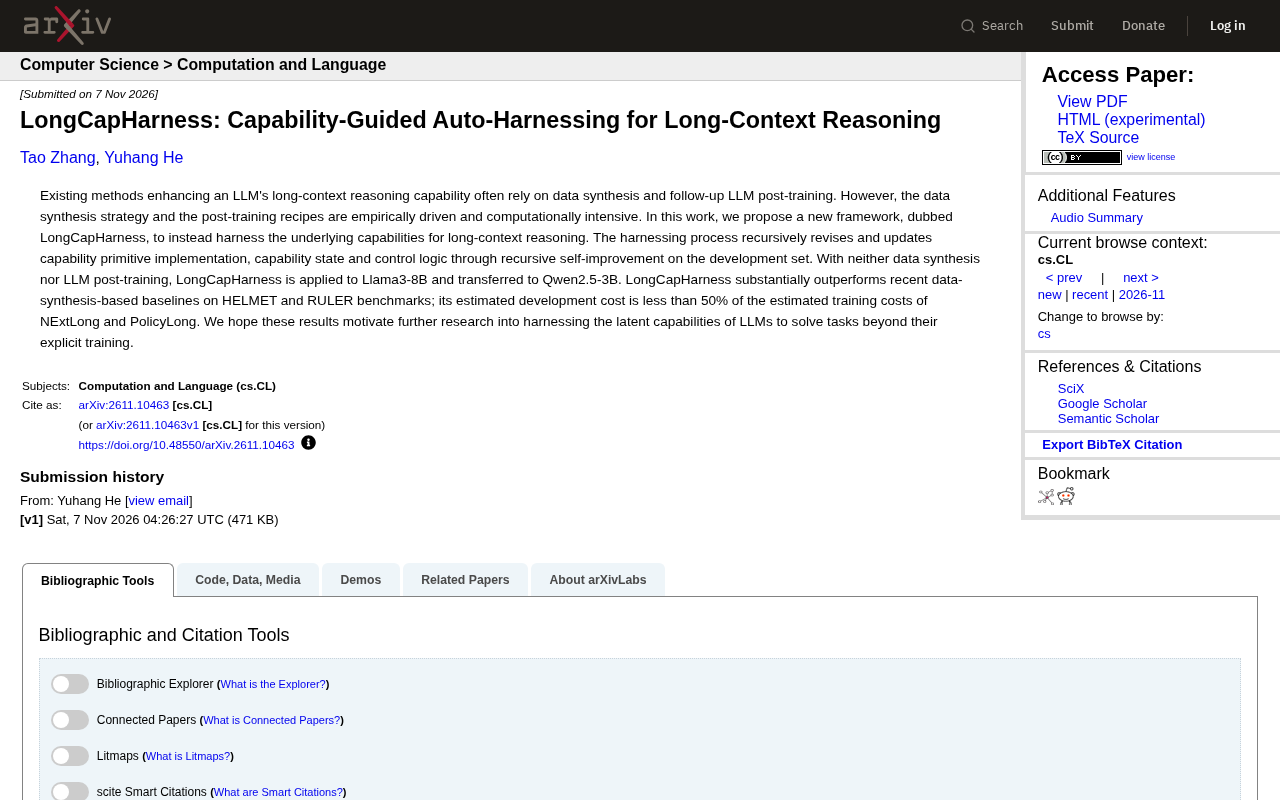
LongCapHarness avoids data synthesis and post-training, using recursive self-improvement to harness long-context capabilities.
LongCapHarness offers a long-context enhancement path distinct from data synthesis plus post-training: without changing model weights, it iteratively refines capability primitives, capability state, and control logic via recursive self-improvement on a development set, thus invoking existing model capabilities more effectively at inference. Applied to Llama3-8B and transferred to Qwen2.5-3B, it significantly beats recent data synthesis baselines on HELMET and RULER, with estimated development costs under half of NExtLong and PolicyLong training costs. Its limitations include dependence on development set quality and capability primitive design, and cross-task generalization remains to be validated, but it suggests a lightweight direction of "unleashing latent capabilities" rather than "instilling new ones."
Long-context reasoning is one of the toughest challenges in deploying large models: data synthesis is costly, and post-training pipelines are complex and experience-driven. The recently proposed LongCapHarness framework offers another path—no data synthesis, no post-training, but rather recursive self-improvement to "harness" the model's existing capabilities. According to the paper, this method was applied to Llama3-8B and transferred to Qwen2.5-3B, significantly outperforming recent data-synthesis-based baselines on the HELMET and RULER benchmarks, with development costs estimated at less than half of the training costs of NExtLong and PolicyLong.
The Current Dilemma of Long-Context Reasoning
The mainstream approach to improving LLM long-context reasoning is data synthesis plus post-training. This route works, but both stages are experience-driven: what data to synthesize and what recipe to train with often require repeated trial and error, and compute costs climb accordingly. The authors of LongCapHarness argue that rather than instilling new capabilities from the outside, it is better to "draw out" the model's latent long-context reasoning abilities from within.
This shift in thinking is noteworthy: it reframes the problem from "how to train the model" to "how to design a mechanism that lets the model better call upon its own capabilities at inference time." This is akin to giving the model an external control layer rather than modifying the model weights.
Data synthesis and post-training: Data synthesis refers to using strong models or rules to automatically generate training samples (such as long-document QA pairs and multi-hop reasoning chains) to compensate for the scarcity of real long-context data; post-training refers to continuing supervised fine-tuning or preference optimization on a pretrained model to write new capabilities into the weights. Together they form the current mainstream pipeline for long-context enhancement, but its recipe relies heavily on manual trial and error, and every switch of the base model requires redoing the whole round, with costs rising linearly with model scale.
The Core Mechanism of LongCapHarness: Recursive Self-Improvement
The core of LongCapHarness is a recursive self-improvement loop that repeatedly revises and updates three things on a development set: the implementation of capability primitives, the capability state, and the control logic.
- Capability primitives: These can be understood as the basic operation units required for long-context reasoning, such as information retrieval, cross-segment association, and state tracking. The framework continuously adjusts the specific implementations of these primitives.
- Capability state: This records the current model's performance state across various capabilities, used to guide subsequent adjustments.
- Control logic: This determines when to invoke which capability and how to combine them to complete reasoning.
This loop involves no data synthesis and no post-training of the LLM. It is more like searching on a development set for an optimal "harnessing strategy" that lets the model use its own capabilities in a more sensible way during inference. Since the entire process relies only on feedback from the development set, the computational cost is significantly lower than a full data synthesis plus training pipeline.
Recursive Self-Improvement: This refers to a system using feedback from its own outputs on a development set to iteratively modify its own components (here, capability primitives, capability state, and control logic), rather than updating model parameters through gradients. The key difference from traditional post-training is that improvement occurs in an external control layer at inference time, with model weights kept frozen, so each iteration requires only forward inference and involves no backpropagation or optimizer states, reducing computational cost by an order of magnitude.
Experimental Results: Cross-Model Transfer and Cost Advantages
The paper presents two key sets of results.
First, LongCapHarness was applied to Llama3-8B and successfully transferred to Qwen2.5-3B. Cross-model transfer means this harnessing strategy has a degree of generality and is not a patch customized for a single model.
Second, on the two long-context benchmarks HELMET and RULER, LongCapHarness substantially surpasses recent data-synthesis-based baseline methods. At the same time, its estimated development cost is less than half of the estimated training costs of NExtLong and PolicyLong. The cost advantage comes from eliminating the two major expenses of data synthesis and model post-training.
It should be noted that the cost figures in the paper are estimates, and the specific comparison basis should be referred to the original text. But the direction is clear: without training the model, overall costs can be significantly reduced.
HELMET and RULER: Both are benchmarks for evaluating long-context capabilities. RULER systematically scans effective context length by synthesizing "needle" tasks of various lengths (retrieval, multi-hop tracing, and aggregation); HELMET focuses on downstream task performance on real long documents, such as question answering, summarization, and classification. The two are complementary—RULER tests "whether distant information can be found and used," while HELMET tests "whether it is used well in real tasks," so reporting both is more convincing than a single benchmark.
Comparison with the Data Synthesis Route
The logic of the data synthesis route is: if the model's capabilities are insufficient, create more long-context data to train it. The logic of LongCapHarness is: the model may already possess latent capabilities, and what is missing is a mechanism to invoke them.
The two routes are not entirely mutually exclusive. Data synthesis is suited to filling in capabilities the model completely lacks, while a harnessing framework is suited to unleashing capabilities the model already has but does not effectively use. The authors also mention that they hope these results will encourage more research into mining the latent capabilities of LLMs to solve tasks beyond their explicit training scope.
From an engineering perspective, the appeal of LongCapHarness lies in deployment cost. If data synthesis and post-training do not need to be redone for each model, the adaptation cycle and compute threshold for long-context capabilities will both decrease.
NExtLong and PolicyLong: Both belong to the data synthesis plus post-training route. NExtLong synthesizes ultra-long-context training data by decomposing long documents and constructing negative samples; PolicyLong focuses on using strategic data recipes to guide long-context post-training. What they have in common is that both require generating large-scale training corpora for a specific model and performing fine-tuning—exactly the reference point LongCapHarness uses when comparing costs.
Limitations and Open Questions
Currently available public information is limited, and several issues deserve follow-up attention.
- Development set dependence: Recursive self-improvement is performed on a development set, and the quality and distribution of that development set directly affect the harnessing results. The paper does not detail how the development set is constructed or its scale.
- Task generalization boundary: The experiments focus on two benchmarks, HELMET and RULER, and whether the method is equally effective on a broader range of long-context tasks requires further validation.
- Design of capability primitives: The framework relies on predefined capability primitives, and whether this part also requires substantial manual expertise determines the method's practical usability.
Implications for Long-Context Research
The value of LongCapHarness is not only in benchmark scores. It points to a neglected path: beyond pursuing larger context windows and more training data, how to use the model's existing capabilities more intelligently is equally worth investing in.
For resource-constrained teams, this framework—which does not rely on large-scale data synthesis and post-training—may offer a lighter-weight approach to enhancing long-context capabilities. Of course, there is still a gap between the paper and engineering deployment, and the stability and reproducibility of recursive self-improvement require more independent validation.
One-line Summary
LongCapHarness synthesizes no data and does no post-training, relying on recursive self-improvement to harness the model's long-context capabilities.
Paragraph Summary
LongCapHarness proposes a long-context enhancement path distinct from data synthesis plus post-training: without modifying model weights, it uses a recursive self-improvement loop on a development set to repeatedly revise capability primitives, capability state, and control logic, thereby more effectively invoking the model's existing capabilities at inference time. The method was applied to Llama3-8B and transferred to Qwen2.5-3B, significantly outperforming recent data synthesis baselines on the HELMET and RULER benchmarks, with estimated development costs at less than half of the training costs of NExtLong and PolicyLong. Its limitations lie in its dependence on development set quality and capability primitive design, and cross-task generalization still needs validation, but it points to a lightweight direction of "unleashing latent capabilities" rather than "instilling new capabilities."
Related articles
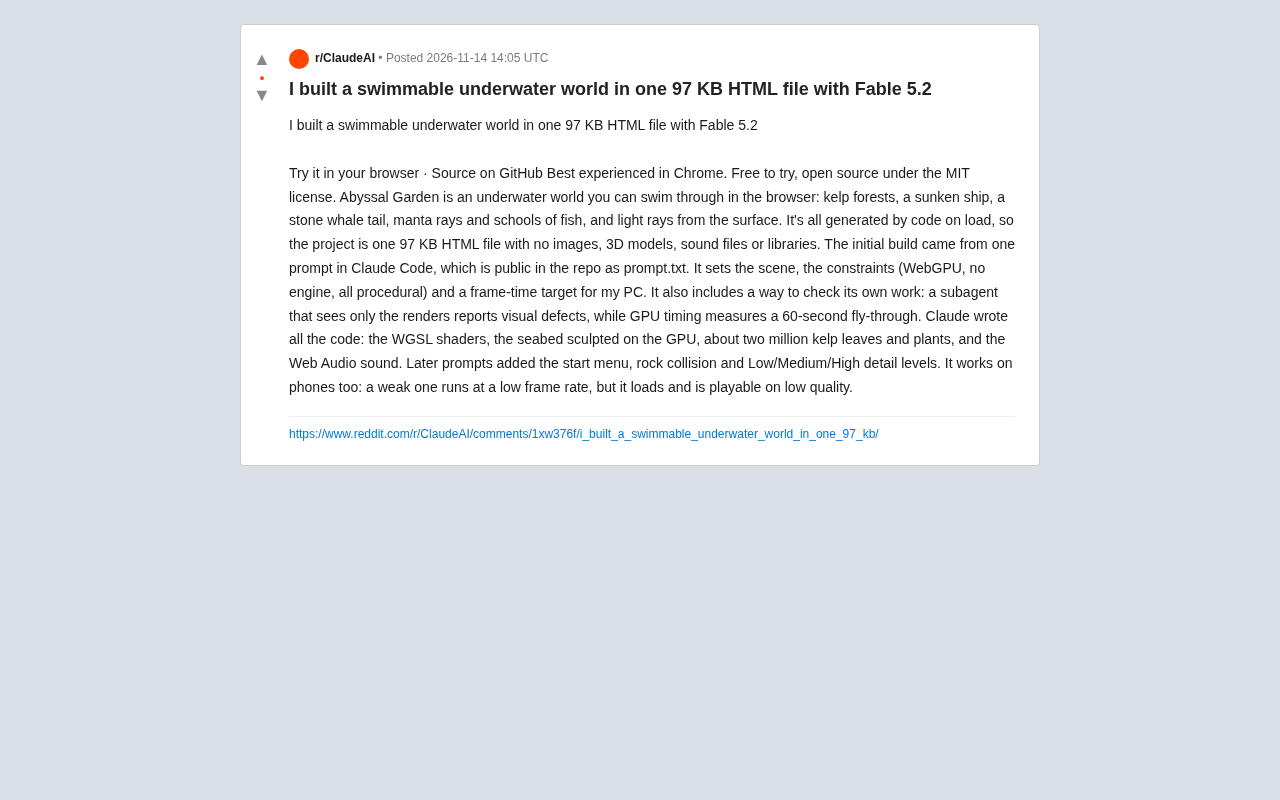
97KB Single-File HTML Underwater World: A WebGPU Experiment in AI Programming
A developer used a single prompt in Claude Code to generate a 97 KB single-file HTML underwater world, fully procedurally generated with WebGPU—kelp forests, a shipwreck, and fish, no images or model libraries, MIT-licensed, playable on mobile.
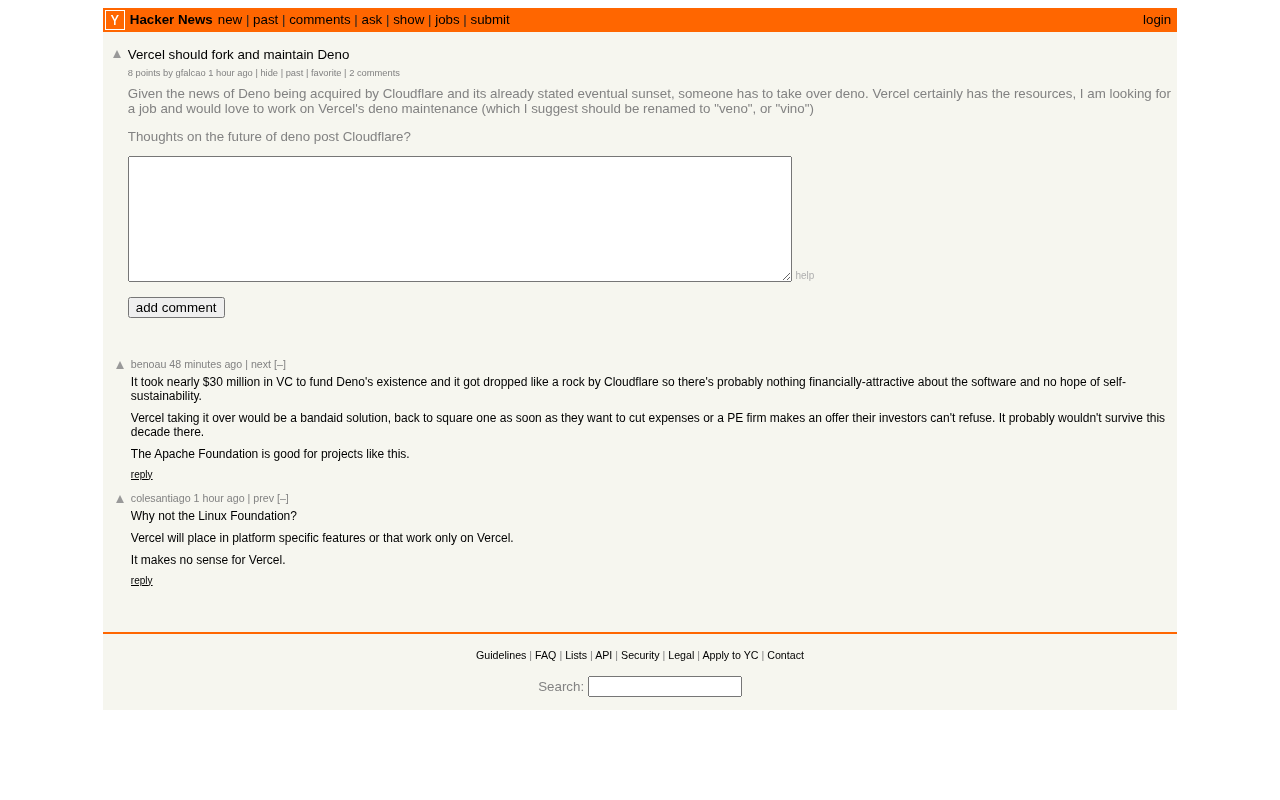
Should Vercel Fork and Maintain Deno? Developer Community Debates
Hacker News debates whether Vercel should fork and maintain Deno. This article analyzes the runtime ecosystem competition behind the claim, the commercialization dilemma of open-source projects, and the practical impact of forking on developers.
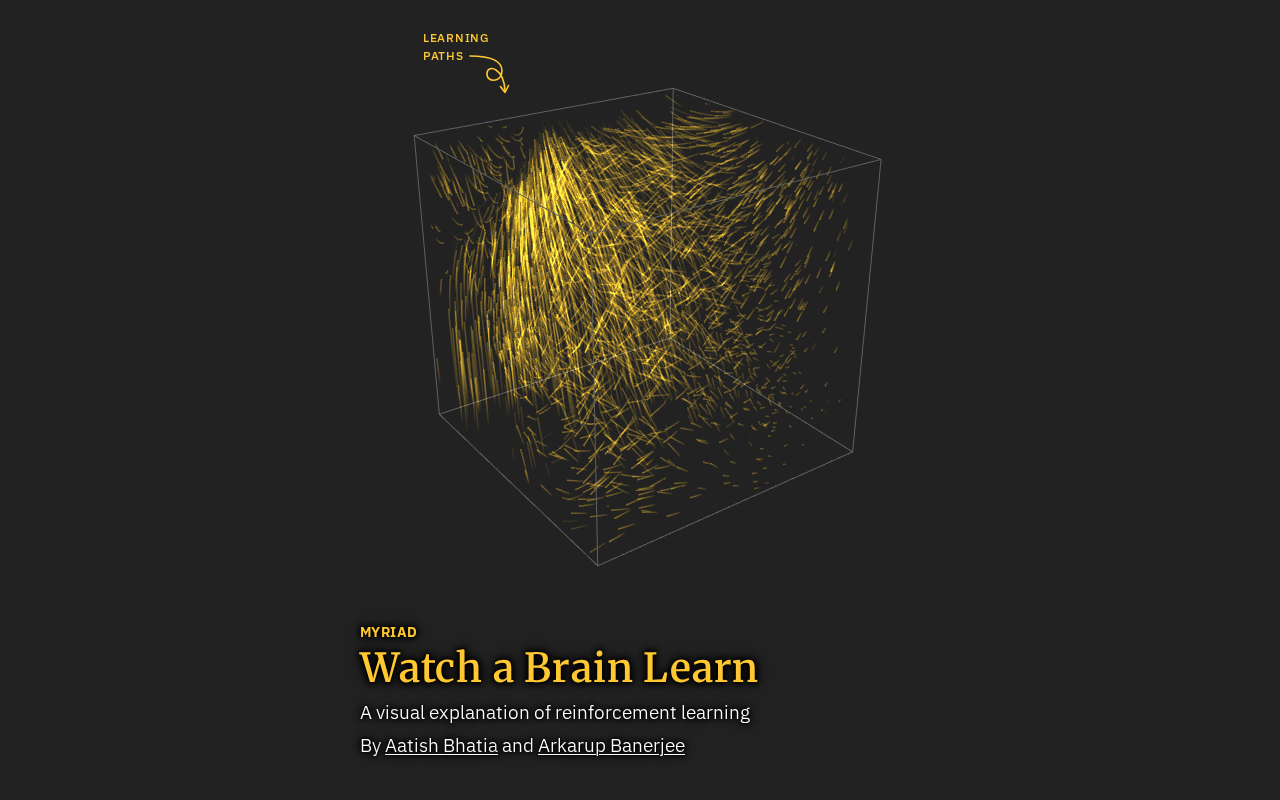
Visually Deconstructing Reinforcement Learning: An Intuitive Guide to Core Concepts
A visual guide to reinforcement learning's core concepts: the agent-environment loop, policies and value functions, and the exploration-exploitation trade-off. Ideal for beginners building intuition and lowering the barrier to RL.