Oura Acquires AI-Native Primary Care Company Counsel Health for $625M

Oura acquires AI primary care company Counsel Health for $625M, pivoting from hardware to health services.
Smart ring maker Oura announced it will acquire AI-native primary care startup Counsel Health for $625 million, just weeks after indefinitely postponing its IPO of up to $2.2 billion. The article argues both moves point to the same strategic direction: with the capital markets path blocked and hardware competition intensifying, Oura hopes to convert its advantage as an entry point for ring-collected health data into sustainable service revenue. Counsel Health's "AI-native" positioning means it organizes primary care around AI at the product architecture level, complementing hardware monitoring. The $625 million price shows Oura values the scarcity of AI healthcare service capabilities rather than short-term revenue. The real test lies in integrating data, compliance, and user experience.
Oura Acquires AI-Native Primary Care Company Counsel Health for $625M
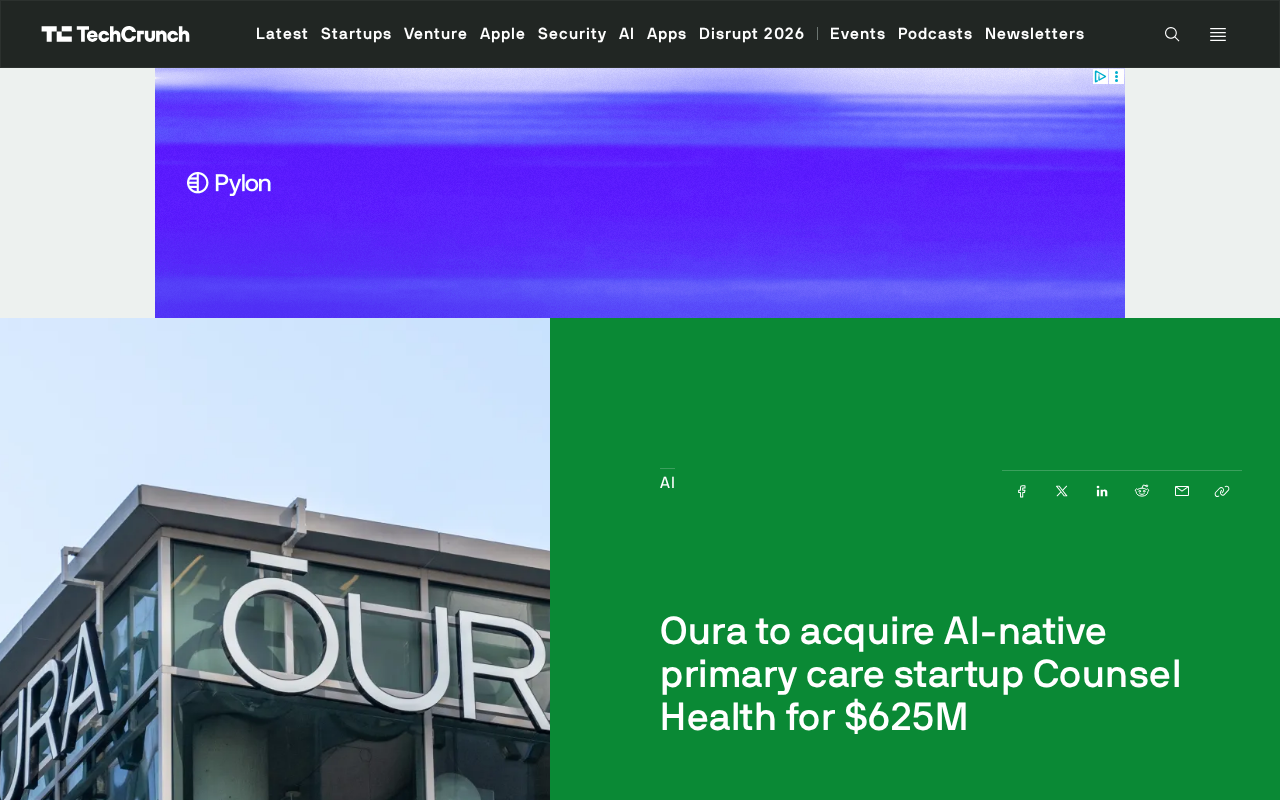
Smart ring maker Oura is extending from hardware into healthcare services. According to an RSS source, Oura will acquire AI-native primary care startup Counsel Health for $625 million. The deal comes shortly after Oura indefinitely postponed its IPO of up to $2.2 billion, citing "uncertainty in the IPO market" at the time.
Deal Background: A Strategic Pivot After the IPO Postponement
Only weeks separate Oura's IPO postponement from the announcement of this acquisition. On one side, the path to public capital markets is temporarily blocked; on the other, the company is swiftly moving to buy an AI healthcare company. Viewed together, both moves point in the same direction: Oura wants to find a self-sustaining growth curve beyond its IPO narrative.
Competition in the smart ring market is intensifying, and the ceiling of selling hardware alone is not hard to foresee. Bringing AI primary care services into the fold means Oura is trying to convert its advantage as an entry point for user health data into sustainable service revenue.
An IPO (initial public offering) is the path by which a company lists on a stock exchange by publicly issuing shares and raises capital from public markets. Postponing or withdrawing an IPO usually means a company cannot temporarily use public capital markets for valuation, pricing, and financing, and must rely on private financing, debt, or its own cash flow to sustain growth. For hardware companies, the IPO narrative often depends on a growth story of "user scale × hardware shipments"; once the listing window closes, pivoting to subscription or service-based revenue becomes an important alternative for proving sustainable growth to investors—this is also the key background for understanding Oura's acquisition motive.
Counsel Health's AI-Native Primary Care Positioning
Counsel Health's label is "AI-native primary care." The key word here is "native"—not a traditional clinic bolting on AI tools, but organizing primary care services around AI at the product architecture level.
Primary care is characterized by high frequency, fragmentation, and a focus on common illnesses and health management—exactly the scenarios AI can handle at scale. Oura's choice to place its bet at this link logically complements the physiological data continuously collected by its rings: hardware handles monitoring, services handle intervention.
"Primary care" refers to the first-contact and entry point of patient health management, typically covering common illness diagnosis and treatment, chronic disease follow-up, health screening, and referral coordination. It is characterized by high visit frequency, low per-visit complexity, and broad population coverage. Traditionally, this link relies heavily on general practitioner manpower, and scale is constrained by doctor supply. AI-native services attempt to automate core processes such as conversational consultation, triage, medication and follow-up recommendations, concentrating human effort on links requiring professional judgment, thereby gaining advantages in cost and accessibility. For wearable manufacturers, such services dovetail with the physiological data continuously collected by hardware, forming a closed loop of "monitoring—identification—intervention."
The Price Signal of $625 Million
$625 million is no small sum for a startup healthcare company. The price shows that what Oura values is not short-term revenue but the scarcity of Counsel Health's AI healthcare service capabilities.
Against the backdrop of a postponed IPO and an uncertain financing environment, Oura is still willing to pay a price of this magnitude, reflecting management's quite resolute judgment on the "hardware + AI healthcare services" combination.
Implications for the Smart Health Hardware Industry
Oura's move has reference value for other wearable manufacturers. When hardware features converge and data collection capability is no longer a differentiating moat, whoever can turn data into actual health services is more likely to build long-term user relationships.
After the acquisition closes, Oura's real test is integration: how to make an AI-native healthcare company and a hardware business connect smoothly across data, compliance, and user experience. The deal itself is only the beginning.
It should be noted that when health-related AI services are combined with consumer-grade hardware, the biggest real constraint comes from regulation and compliance. In the United States, patient-facing diagnostic and treatment recommendations may touch the FDA's regulatory boundary for software as a medical device (SaMD), and telemedicine involvement also requires compliance with state licensing and privacy regulations such as HIPAA governing the handling of health data; in Europe, GDPR and MDR must be considered. This means post-acquisition integration is not only about connecting products and data, but also about establishing responsibility allocation, clinical oversight mechanisms, and data governance systems—directly determining whether the service can scale.
One-line Summary
Oura acquires AI primary care company Counsel Health for $625M, pivoting from hardware to health services.
Paragraph Summary
Smart ring maker Oura announced it will acquire AI-native primary care startup Counsel Health for $625 million, just weeks after indefinitely postponing its IPO of up to $2.2 billion. The article argues that both moves point to the same strategic direction: with the capital markets path blocked and hardware competition intensifying, Oura hopes to convert its advantage as an entry point for ring-collected health data into sustainable service revenue. Counsel Health's "AI-native" positioning means it organizes primary care services around AI at the product architecture level, complementing hardware monitoring capabilities. The $625 million price shows Oura values the scarcity of AI healthcare service capabilities rather than short-term revenue. The real test after the acquisition lies in integrating data, compliance, and user experience.
Related articles

Why Rockets Don't Land Horizontally Like Airplanes: A Physics and Engineering Trade-off
Why don't rockets land horizontally like airplanes with wings? This article explains the engineering trade-offs behind Shuttle-style landings and Falcon 9 vertical landings from three angles: wing lift conditions, orbital velocity costs, and reusable booster structural reuse.

Can AI Governance Tools Block Agent and API Calls?
A Reddit developer questions whether AI governance tools only flag Agent calls rather than block them. We analyze the flagging vs. real-time blocking capability gap, vendor demo mismatches, and key questions to ask when buying.

Perplexity's New Default Setting: The Experience and the Logic Behind It
Exploring the significance and impact of Perplexity's default setting change, analyzing how defaults guide user experience and speculating on model, search scope, or answer style adjustments.