Oxagen: A Shared Context Control Plane for AI Coding Agents
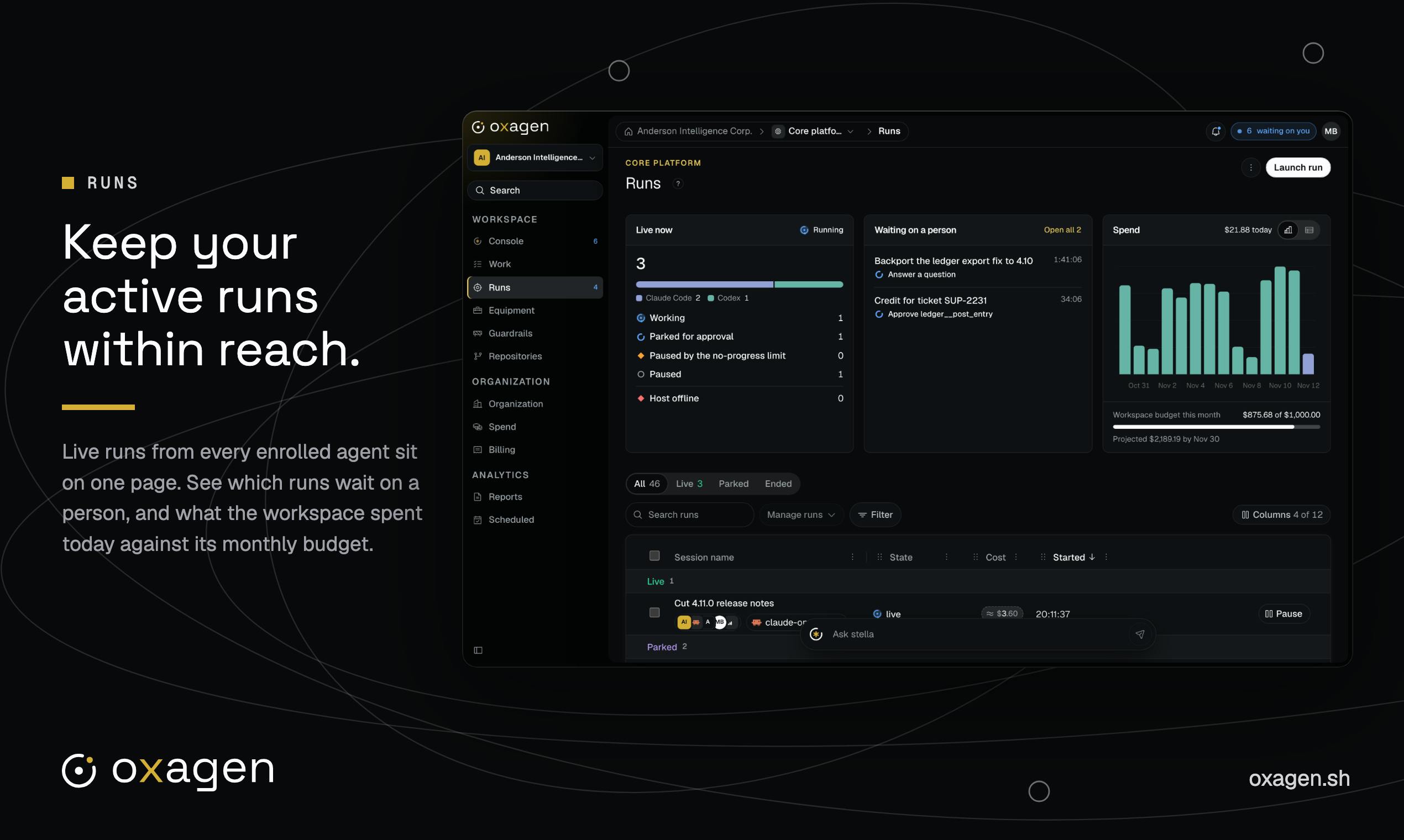
Oxagen positions itself as mission control, linking agent runs to people, code, costs, and outcomes for traceable governance.
Oxagen is an AI coding agent management tool for engineering teams launched on Product Hunt, positioned as "mission control." It binds every agent run to specific people, tasks, code changes, costs, and outcomes to form a complete chain of evidence, while also serving as a logging system, knowledge base, and policy enforcement point. It emphasizes shared, maintained context across team members and policy constraints on agent actions, aiming to make AI spend returns visible and tie costs to code changes.
As AI coding agents become a permanent fixture in the development workflow, the core tension teams face is no longer just model capability—it's lost context, fragmented instructions, and runaway costs. Oxagen, launched on Product Hunt, tries to answer this with a "mission control" positioning: linking every agent run to the people, work, code changes, costs, and outcomes behind it, so engineering teams can manage agents the way they manage infrastructure.
From single conversations to traceable run records
Oxagen's core design revolves around "records." It isn't content to be just a chat window—it binds every coding agent run to a specific person and task. Teams can therefore see why an agent was invoked, which code it changed, how much it cost, and what it ultimately produced. This traceability directly addresses a pain point when enterprises adopt AI coding tools: when agents touch production code, managers need a complete chain of evidence to judge whether the investment is worthwhile.
According to the Product Hunt page, teams use these records to "direct" agents, share validated instructions and tools, and enforce policies on the actions agents take through Oxagen. In other words, Oxagen simultaneously plays three roles: logging system, knowledge base, and policy enforcement point.
Coding Agent refers to an AI system that can autonomously read a codebase, plan modification steps, invoke tools (such as editors, terminals, and test frameworks), and actually write code. Typical examples include Cursor's Agent mode, Claude Code, and Devin. Unlike Copilot-style tools that only do completion, a single "run" of a coding agent may span multiple rounds of reasoning, multiple file reads and writes, and command executions, generating substantial context and side effects. This is precisely the technical premise behind Oxagen's emphasis on "traceability": a single conversational interaction is easy to review, but the decision chain, tool calls, and code changes involved in one agent run are distributed across multiple stages—without explicit recording, it's nearly impossible to reconstruct after the fact why an agent made a particular change. Understanding this is essential to understanding why "run records" can themselves become a product capability.
Shared context: closing the gaps in agent collaboration
The tagline "Mission control for agents to share + maintain context" captures the product's key differentiator. Most AI coding tools confine context to a single session or a single developer, whereas Oxagen emphasizes that context can be shared and maintained across team members. Validated prompts and tool configurations thus become team assets rather than tacit knowledge scattered across individual histories.
This direction has real significance for engineering organizations. When one engineer develops an efficient way to use agents, Oxagen makes that approach reusable; when an agent needs to carry information across tasks, shared context reduces the cost of repeated explanation. The product also offers policy enforcement capabilities that constrain the actions agents take, which gives it some appeal in compliance-sensitive development scenarios.
Context in the agent sense typically refers to all the information a model can see during a single task: system prompts, conversation history, retrieved code snippets, tool return results, and intermediate reasoning. Large models have a fixed context window, and once it's exceeded, pruning or summarization is required—causing early information to be lost. At the same time, most tools bind context to a single session or a single user account, with no way to pass it across people. Shared context addresses breaks at two levels: horizontally, team members cannot reuse each other's validated prompts and configurations; vertically, information across tasks and sessions needs to be re-injected. The common engineering approach is to externalize context into persistent, versionable storage (such as a shared memory store or project-level knowledge files), and Oxagen's positioning is close to this idea.
Return visibility on AI spend
Oxagen explicitly frames "seeing the real return on AI spend" as its value proposition. According to builder Mac Anderson, the team's goal is to give engineering teams quantifiable returns on AI investment while enabling excellent engineers to continue producing high-quality work in the agent era.
This goal targets a common friction point in current AI coding tool adoption: token consumption and subscription costs are growing, but output quality is hard to attribute. Tying costs to specific code changes and outcomes is a prerequisite for moving AI coding from "individual experimentation" to "team-level budget management." The product received 87 upvotes and ranked 20th on Product Hunt, categorized under SaaS, developer tools, and vibe coding—reflecting the community's early interest in agent governance tools.
Return visibility on AI spend involves the cost structure of AI coding tools: token-billed API calls, seat-based IDE plugin subscriptions, and the extra consumption from repeated agent reasoning—combined, these often grow faster than teams expect. The difficulty lies in attribution: a single monthly bill is hard to break down by specific task, specific engineer, or specific code change, making it impossible to tell which usage produced positive output. The industry typically uses metrics like "cost per merged PR" or "cost per thousand lines of effective changes" for coarse-grained attribution, but this requires linking call records with version control systems (such as Git commits and PRs). By binding costs to code changes and outcomes, Oxagen is essentially building this attribution chain—turning AI coding from an expense at the individual experience level into a measurable item that can be incorporated into team budgets and performance evaluation.
Opportunities and challenges for agent governance tools
Oxagen sits between AI coding assistants and engineering productivity platforms. Its opportunity lies in the fact that as agents take on more coding tasks, teams' demand for context management, instruction reuse, and policy control will continue to rise. The challenges are equally clear: such tools must be deeply embedded in existing development workflows to collect valuable run data without disrupting engineers' rhythm.
Based on publicly available information, Oxagen currently presents its product positioning rather than specific technical details; its actual integration capabilities, the range of supported agents, and the granularity of its policies remain to be verified. For engineering teams evaluating agent governance solutions, it offers a direction worth watching: treating agent context and costs as first-class citizens to be managed.
Agent Governance refers to organization-level controls that make AI agent behavior auditable and constrainable, typically including four types of mechanisms: permission and scope limits (which repositories and tools an agent can access), policy enforcement (blocking dangerous operations such as deleting files or pushing to the main branch), audit logs (recording every action in full), and cost quotas. This parallels traditional application security governance, but the subject shifts from "people" to "autonomous software entities"—the difficulty being that agent action sequences are highly dynamic and hard to enumerate in advance. Precisely for this reason, governance tools must be deeply embedded in the development workflow (IDE, code hosting, CI pipelines), intercepting and recording at the moment an action occurs rather than auditing after the fact. This explains why the capability ceiling of such products depends largely on integration breadth rather than on the design of the recording interface alone.
One-line Summary
Oxagen positions itself as mission control, linking agent runs to people, code, costs, and outcomes for traceable governance.
Paragraph Summary
Oxagen is an AI coding agent management tool for engineering teams launched on Product Hunt, positioned as "mission control." It goes beyond being a chat window by binding every agent run to specific people, tasks, code changes, costs, and output results to form a complete chain of evidence, while also serving as a logging system, knowledge base, and policy enforcement point. The product emphasizes that context can be shared and maintained across team members, turning validated prompts and tool configurations into team assets rather than individual tacit knowledge, and offers policy enforcement to govern agent actions. Its value proposition is to give teams visibility into the real return on AI spend and tie costs to code changes, moving AI coding from individual experimentation toward team-level budget management. The product received 87 upvotes and ranked 20th on Product Hunt.
Related articles

DeepSeek Harness Plugin "Footprints": Turn Your Photo Album into a 3D Earth
DeepSeek Harness plugin "Footprints" projects album photos onto a 3D Earth by GPS location, auto-generates travel storylines, and supports natural language photo search, "that day in years past," and landmark recognition, with a local read-only index for privacy.

Quiver Launcher + Game List: One-Stop Management for PC Ported Games
Learn how the open-source Quiver launcher (localized) and game project list work together: the list discovers PC port and recompilation projects, while the launcher handles installation, version updates, and tag management, with full workflow and manual import options.

Lost DSH Crash Logs? This Open-Source Black Box Makes Every Crash Traceable
DSH WARN logs flash by and vanish on restart? The open-source DSH Runtime Lock black box writes WARN/ERROR to local JSONL in real time, auto-rotates to keep four segments, zero dependencies, no network requests, one-command setup.