PARGAR: How Graph Attention Neural Receivers Solve the Sparse Pilot Problem

PARGAR models the OFDM resource grid as a graph, using pilot-anchor links and graph attention to improve detection under sparse pilots.
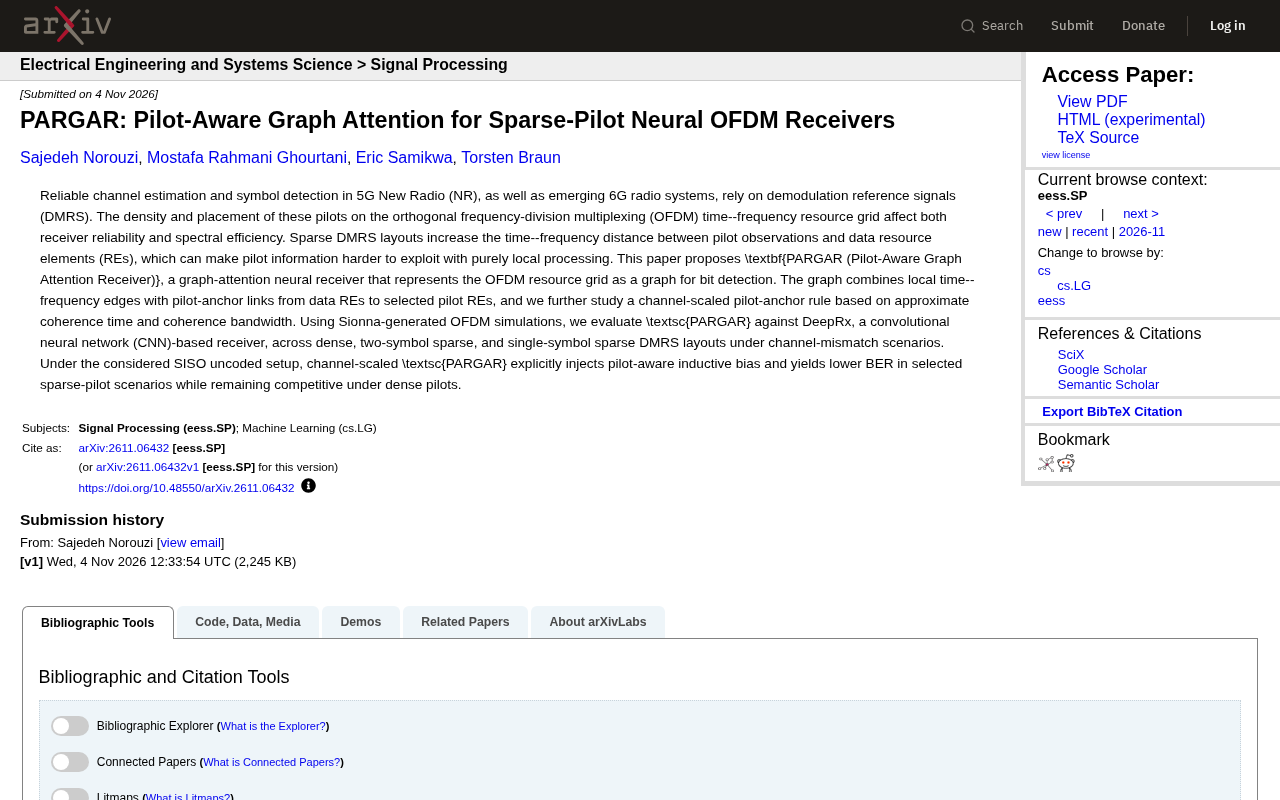
PARGAR (Pilot-Aware Graph Attention Receiver) addresses the difficulty CNN-based neural receivers face in exploiting distant pilot information under sparse pilots due to local receptive fields. It represents the OFDM time-frequency resource grid as a graph: nodes are resource elements, and edges include local time-frequency edges and "pilot-anchor links" connecting data REs directly to selected pilot REs. The paper proposes a channel-scaled anchor rule based on approximate coherence time and coherence bandwidth, using channel coherence to determine links and injecting pilot awareness as an inductive bias into the network structure. In Sionna simulations, PARGAR with this rule achieves lower BER than the CNN-based DeepRx in some sparse DMRS scenarios while remaining competitive under dense pilots. The conclusions are limited to the SISO uncoded setting, the advantage is selective, and MIMO, coding, and computational complexity remain to be validated.
In 5G NR and 6G-oriented wireless systems, demodulation reference signals (DMRS) are the cornerstone of channel estimation and symbol detection. The denser the pilots are placed on the OFDM time-frequency resource grid, the easier it is for the receiver to perform channel estimation, but the lower the spectral efficiency; the sparser they are, the higher the efficiency, but the time-frequency distance between pilots and data resource elements (REs) grows, making it increasingly difficult for traditional receivers that rely on local processing to fully "use" the pilot information. A recent paper's PARGAR (Pilot-Aware Graph Attention Receiver) is aimed squarely at this contradiction: it models the OFDM resource grid as a graph and uses graph attention mechanisms for bit detection.
The Pain Point of Sparse Pilots: Local Processing "Can't See" Distant Pilots
There is a natural tension among pilot density, reception reliability, and spectral efficiency. Dense DMRS layouts are receiver-friendly but incur high reference signal overhead; sparse layouts (e.g., single-symbol or dual-symbol DMRS) can significantly reduce overhead, but they increase the time-frequency distance from each data RE to the nearest pilot.
The problem is that convolutional neural network (CNN)-based neural receivers (such as DeepRx) essentially rely on local receptive fields. When pilots are sparse, information from distant pilots needs to propagate through multiple convolutional layers to reach data positions, and the information is diluted during propagation, making it difficult for the receiver to fully exploit these priors. This is precisely the core observation of the paper: there is a structural mismatch between purely local processing and sparse pilots.
PARGAR's Core Idea: Turn the Resource Grid into a Graph and Add "Anchors" to Pilots
PARGAR's approach represents the OFDM time-frequency resource grid as a graph, where nodes correspond to resource elements and edges fall into two categories: one is conventional local time-frequency edges connecting adjacent REs; the other is "pilot-anchor links," which connect data REs directly to selected pilot REs. In this way, even if pilots are physically far away, data nodes can directly "see" the pilots through an explicit edge.
On this basis, the paper further investigates a channel-scaled pilot-anchor rule based on approximate coherence time and coherence bandwidth. Simply put, it uses the channel's coherence properties to decide which pilots should establish anchor links with which data REs—coherence time and coherence bandwidth characterize the channel's "correlation range" in time and frequency, and only links established within this range make the pilot information more reference-worthy.
The essence of this design is to inject a "pilot-aware" inductive bias into the network: rather than expecting the network to slowly learn where pilots are and how to use them from data, it directly encodes the positional relationships of pilots into the graph structure.
Comparison with DeepRx: BER Advantage in Sparse Scenarios
The paper evaluates using OFDM simulations generated by Sionna, comparing against the CNN-based DeepRx receiver, covering three DMRS layouts—dense, dual-symbol sparse, and single-symbol sparse—and also examines channel-mismatch scenarios.
In the SISO uncoded setting, PARGAR with the channel-scaled rule achieves lower bit error rate (BER) in some sparse pilot scenarios while remaining competitive under dense pilots. What is noteworthy about this result is that it does not win through a larger model or more data, but by explicitly expressing pilot priors through the graph structure. In other words, when pilots are so sparse that local convolution "can't reach," the long-range connections provided by graph attention precisely fill this gap.
It should be viewed objectively that the paper's conclusions are limited to the SISO uncoded scenario, and the advantage in sparse scenarios is "selective"—not all sparse configurations are consistently superior. This suggests that PARGAR's value is more reflected under specific pilot layouts and channel conditions, rather than fully replacing CNN receivers.
Sionna Simulation Platform
Sionna is an open-source GPU-accelerated link-level simulation library introduced by NVIDIA, based on TensorFlow, supporting rapid simulation of 5G NR and 6G candidate physical-layer links, including OFDM waveform generation, channel models (such as TDL/CDL), DMRS pattern configuration, and neural receiver training. It provides a differentiable end-to-end link, facilitating training of receivers as neural networks. The paper uses Sionna to generate OFDM simulation data, ensuring standardization and reproducibility of channel and signal models.
DeepRx Receiver
DeepRx is a CNN-based neural receiver proposed by Nokia Bell Labs that maps the received resource grid (including DMRS) directly to log-likelihood ratios (LLRs) of coded bits and is trained end-to-end. It relies on convolutional layers to extract features within local time-frequency neighborhoods and performs excellently under dense pilots, but under sparse pilots it is difficult to fully utilize distant pilot information due to limited receptive fields—this is precisely the starting point for PARGAR's comparison.
Implications for Neural Receiver Design
PARGAR's significance goes beyond a single receiver model. It raises a more general question: should the structural design of neural receivers align with the physical layout of reference signals? The locality assumption of CNNs naturally matches dense pilots, but a mismatch emerges under sparse pilots. The graph structure provides a flexible carrier that takes "which information should be directly connected" out of the learning process and turns it into explicit structural design.
From an engineering perspective, the channel-scaled anchor rule also implies that the graph structure itself can adapt to channel conditions, offering an idea for future 6G systems to configure pilot density on demand while maintaining reception reliability. Of course, there is still a gap from simulation to practical deployment: computational complexity, graph construction overhead, and performance in MIMO and coded scenarios are all questions that need to be answered subsequently.
The evidence currently presented in the paper is concentrated at the SISO uncoded simulation level, representing results at the method-validation stage. For researchers and engineers focused on AI-native air interfaces and neural receivers, it offers a structural idea worth tracking: rather than letting the network learn where pilots are, it is better to draw pilot relationships directly into the graph.
Background Supplement
DMRS and OFDM Resource Grid
DMRS (demodulation reference signal) is a pilot signal used in 5G NR for demodulation of the physical downlink shared channel (PDSCH) and physical uplink shared channel (PUSCH). The receiver uses it to estimate the channel frequency response and then performs coherent detection of data symbols. The OFDM resource grid is a two-dimensional time-frequency plane: the horizontal axis is OFDM symbols (time), the vertical axis is subcarriers (frequency), and each intersection is a resource element (RE). DMRS is mapped to some REs according to a specific pattern (such as single-symbol or dual-symbol), while the remaining REs carry data. Pilot density refers to the proportion of DMRS REs in the grid; the higher the density, the more accurate the channel estimation, but the fewer data REs, and the lower the spectral efficiency.
CNN Receptive Field and Locality
Each neuron in a convolutional neural network (CNN) responds only to a local neighborhood of the input, and the size of that neighborhood is called the receptive field. In neural receivers, the CNN takes local time-frequency blocks of the resource grid as input and gradually expands the receptive field through multiple convolutional layers. However, receptive field expansion is indirect and limited: when pilots are sparse, information from distant pilots must propagate through multiple layers to affect detection of data REs, and the signal is diluted by nonlinear transformations during propagation. This is what the paper refers to as the "structural mismatch between local processing and sparse pilots."
Graph Attention Mechanism (GAT)
The Graph Attention Network (GAT) introduces the attention mechanism into graph neural networks: each node aggregates features of neighboring nodes through attention weights, which are dynamically computed from feature similarity between node pairs. Unlike graph convolution with fixed weights, GAT can adaptively decide which neighbor information is more important. PARGAR treats each RE as a graph node, with node features including the received signal, pilot position indicators, etc.; local time-frequency edges and pilot-anchor links jointly define the adjacency relationships, and graph attention layers aggregate information accordingly and output bit likelihood ratios for detection.
Coherence Time and Coherence Bandwidth
Coherence time refers to the time span over which the channel impulse response remains approximately invariant in the time domain, approximately ( T_c \approx 1/f_d ) (( f_d ) is the maximum Doppler shift); coherence bandwidth refers to the bandwidth over which the channel frequency response remains strongly correlated in the frequency domain, approximately ( B_c \approx 1/\tau_{max} ) (( \tau_{max} ) is the maximum delay spread). Together they characterize the channel's "correlation region" on the time-frequency plane. The channel-scaled pilot-anchor rule leverages this physical quantity: it establishes anchor links from data REs to pilot REs within the range delineated by coherence time and coherence bandwidth, ensuring that the connected pilots have channel reference value for the current data position and avoiding connecting distant pilots whose channels are uncorrelated.
One-line Summary
PARGAR models the OFDM resource grid as a graph and uses pilot-anchor links and graph attention to improve detection performance under sparse pilots.
Paragraph Summary
PARGAR (Pilot-Aware Graph Attention Receiver) addresses the problem that CNN-based neural receivers under sparse pilots struggle to utilize distant pilot information due to local receptive fields. It represents the OFDM time-frequency resource grid as a graph: nodes are resource elements, and edges include local time-frequency edges and "pilot-anchor links" that connect data REs directly to selected pilot REs. The paper proposes a channel-scaled anchor rule based on approximate coherence time and coherence bandwidth, using channel coherence properties to determine the linking scheme and injecting pilot awareness as an inductive bias into the network structure. In Sionna simulations, PARGAR with this rule achieves lower BER than the CNN-based DeepRx in some sparse DMRS scenarios while remaining competitive under dense pilots. The conclusions are limited to the SISO uncoded setting, the advantage is selective, and MIMO, coding, and computational complexity remain to be validated.
Related articles

A $100 New York Dinner Party? The Creative No-Utensils Challenge Menu
Food creator Zainab hosts a $100 no-utensils dinner party for five in NYC, designing a desi menu around keema with dal, paneer peppers, cucumber salad, and ice cream sandwiches—showing budget menu design thinking.

A Five-Year Quest: Deconstructing the Persimmon Cake Recipe
NYT food columnist Eric Kim shares a five-year persimmon-cardamom cake recipe, covering Fuyu persimmon selection, whipped cream folding, butter browning, and baking tips, with full details and failure attribution.

Naming the World's Most Famous Sourdough: Hunter Schafer and Michelle Yeoh's Fermentation Experiment
Starting from Hunter Schafer and Michelle Yeoh's sourdough conversation, this article explores the anthropomorphic tradition in fermentation culture, the technical logic of starters as living systems, and the emotional needs behind the home baking trend.